


Lee Yuan-tseh (李遠哲), Taiwan's representative at the APEC leaders' summit, promised Friday that Taiwan, as a newly industrialized economy, will share its experiences with other economies and offer the least developed countries assistance in industrializing.
During the speech entitled "Challenges for Developing Countries," the Nobel laureate for chemistry said at a CEO meeting that formed part of the APEC meetings, that developing countries must place absolute emphasis on science and education.
"Without engaging in scientific research and technological development, it will be difficult for developing countries to share the benefits of scientific work accomplished by developed countries," he said.
"In the era of the knowledge-based economy, we have to educate our young people to help them build up their capacity to learn and cultivate their curiosity in the pursuit of new knowledge," he said.
The head of the Academic Sinica is in Los Cabos, Mexico to attend the APEC summit on behalf of President Chen Shui-bian (陳水扁).
Friday's address marked the first time ever that a Taiwan envoy has been invited to deliver a keynote speech at any APEC leaders' summit.
Lee was initially supposed to give a speech on the future of energy, but the topic was altered two days ago because the organizers thought it would be more appropriate for Taiwan's representative to talk about the challenges facing developing countries in the light of Taiwan's rapid economic progress in recent years.
Lee said that the world was in many ways "overdeveloped," especially in terms of the consumption of national resources and damage done to the environment. Developing countries should avoid becoming "overdeveloped."
"If developing countries are able to find a new and sustainable way to develop, harmonize the relationship between humankind and nature and reverse the trend of overconsumption, they will lead the world towards sustainable development," he said.
Lee highlighted the significance of closing the gap between the wealthy and the poor in order to make a safer world. The world could not be a safe place if a large portion of humankind still suffered from poverty, disease, illiteracy and unemployment, he said
The scholar also reminded business leaders that challenges for developing countries are closely related to energy and the environment.
"Unless we learn to work together as a family, beyond national boundaries, to respect our culture, political and religious differences, to share scientific knowledge among ourselves, and to use our technological progress for the advancement for our common interests, these challenges are unlikely to be met with success," he said.
Besides giving the speech, Lee conducted bilateral talks with Singapore's Minister for Trade and Industry George Yeo, and Papua New Guinea (PNG) Prime Minister Michael Somare, during which the topics of anti-terrorism, trade exchanges and cross-strait issues were touched upon.
Sharing Yeo's views that the fight against terror is an urgent task, Lee considered poverty to be the root of the problem, which should be dealt with through education and understanding cultural differences.
The Singaporean minister welcomed the government's "Go South" policy, in which the DPP encouraged Taiwan's businessmen to invest in Southeast Asian nations in a bid to counter Taiwanese businessmen's "China fever."
During the meeting with Somare, the minister seized the chance to express his thanks for Taiwan's technological assistance and financial aid to his country.
Besides seeking to attract Taiwanese tourists and immigrants, the minister also said he hoped that Taiwan can help PNG to elevate its medical standards and make more investments in the agriculture, forestry, fishing and mining sectors.
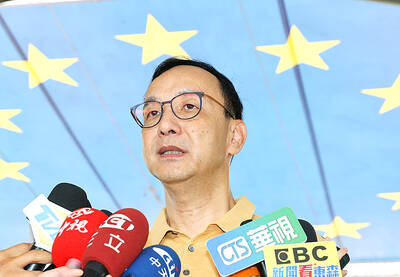
GOOD DIPLOMACY: The KMT has maintained close contact with representative offices in Taiwan and had extended an invitation to Russia as well, the KMT said The Chinese Nationalist Party (KMT) would “appropriately handle” the fallout from an invitation it had extended to Russia’s representative to Taipei to attend its international banquet last month, KMT Chairman Eric Chu (朱立倫) said yesterday. US and EU representatives in Taiwan boycotted the event, and only later agreed to attend after the KMT rescinded its invitation to the Russian representative. The KMT has maintained long-term close contact with all representative offices and embassies in Taiwan, and had extended the invitation as a practice of good diplomacy, Chu said. “Some EU countries have expressed their opinions of Russia, and the KMT respects that,” he
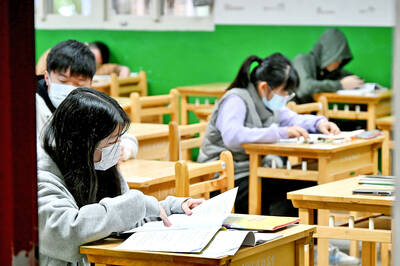
CHANGES: After-school tutoring periods, extracurricular activities during vacations or after-school study periods must not be used to teach new material, the ministry said The Ministry of Education yesterday announced new rules that would ban giving tests to most elementary and junior-high school students during morning study and afternoon rest periods. The amendments to regulations governing public education at elementary schools and junior high schools are to be implemented on Aug. 1. The revised rules stipulate that schools are forbidden to use after-school tutoring periods, extracurricular activities during summer or winter vacation or after-school study periods to teach new course material. In addition, schools would be prohibited from giving tests or exams to students in grades one to eight during morning study and afternoon break periods, the
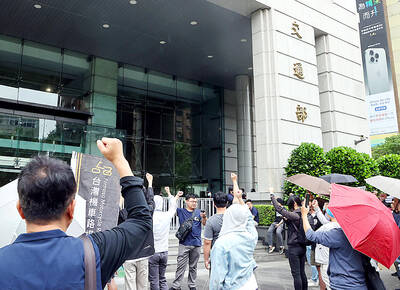
Advocates of the rights of motorcycle and scooter riders yesterday protested in front of the Ministry of Transportation and Communications in Taipei, making three demands. They were joined by 30 passenger vehicles, which surrounded the ministry to make three demands related to traffic regulations — that motorcycles and scooters above 250cc be allowed on highways, that all motorcycles and scooters be allowed on inside lanes, and that driver and rider training programs be reformed. The ministry said that it has no plans to allow motorcycles on national highways for the time being, and said that motorcycles would be allowed on the inner
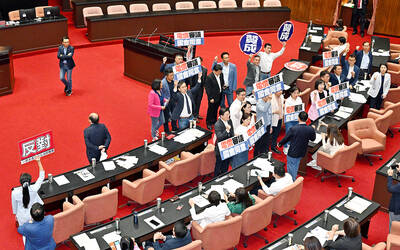
AMENDMENT: Contact with certain individuals in China, Hong Kong and Macau must be reported, and failure to comply could result in a prison sentence, the proposal stated The Chinese Nationalist Party (KMT) and the Taiwan People’s Party (TPP) yesterday voted against a proposed bill by Democratic Progressive Party (DPP) lawmakers that would require elected officials to seek approval before visiting China. DPP Legislator Puma Shen’s (沈伯洋) proposed amendments to the Act Governing Relations Between the People of the Taiwan Area and the Mainland Area (臺灣地區與大陸地區人民關係條例), stipulate that contact with certain individuals in China, Hong Kong and Macau should be reported, while failure to comply would be punishable by prison sentences of up to three years, alongside a fine of NT$10 million (US$309,041). Fifty-six voted with the TPP in opposition


 RSS
RSS