


Jiang Zemin (江澤民) has not yet met George W. Bush, but in their single telephone conversation last month, Jiang now says, "from his voice I could feel that he was a president I could do business with."
Jiang, who is the president, Communist Party secretary-general and military chairman of China, was optimistic about the future of Chinese-American relations this week in a rare interview at the leadership's seaside retreat, 270km east of Beijing.
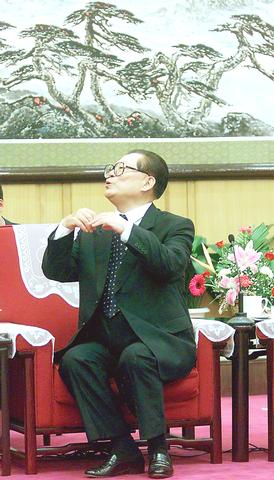
PHOTO: NY TIMES
"Both sides share a positive desire for a good relationship," he said, dismissing as routine background noise the voices in the Bush administration calling for mobilizing against a "China threat."
"We should try our best to find the common ground between us," he said, almost rising from his chair as he spoke.
Jiang met Wednesday with the publisher of The New York Times, Arthur Sulzberger Jr, senior editors, a columnist and China-based correspondents of the newspaper for an interview that was initially suggested by Chinese diplomats. Jiang's chief goal appeared to be to emphasize China's desire for smoother relations as the new American presidency takes shape and as China looks toward playing host to the Summer Olympics in Beijing in 2008 and braces for major transitions in political leadership and the economy.
The 85-minute interview took place in a formal meeting hall lined with red armchairs in a large gardened compound for senior leaders in this fading resort town. Jiang, 75, appeared cheerful and confident as he defended China's domestic and foreign policies, sometimes waving his arms and citing proverbs.
While his message was one of friendship, he gave no ground on areas of difference with the US, including Taiwan, Tibet and human rights. He suggested that foreigners did not understand China's goals and why it must adapt Communist rule to a changing society rather than scrap it altogether, as many in the West might prefer.
"I lived for three-fourths of the last century," he said when asked about the prospect of a major political loosening, "and I can tell you with certainty: Should China apply the parliamentary democracy of the Western world, the only result will be that 1.2 billion Chinese people will not have enough food to eat. The result will be great chaos, and should that happen, it will not be conducive to world peace and stability."
Bursting into English, he added, "And so I tell you very friendly and frankly, this is my opinion."
The well-guarded compound where the meeting took place is sprinkled with large two-story, pale-yellow manors. Every summer since the 1950s, leaders from Mao Zedong (毛澤東) onward have gathered in Beidaihe with other party mandarins to hash out major issues, and to swim in the Bohai Sea.
"People think we are here for a vacation," Jiang said. "But actually it's impossible to take a break, even for a single day.
"But there is one thing that I have to do every day," he added proudly, alluding to a habit he shares with predecessors like Mao and Deng Xiaoping (
The topics and schedules at Beidaihe are secret, but this year a major subject is said to be the coming changes in party leadership. Over the next two years, a large share of the central committee as well as Jiang and the other top two leaders, Prime Minister Zhu Rongji (
Jiang is expected to give up the post of party secretary-general next year, while his term as president runs out the following year. Asked whether he might consider retaining an official title after that -- some supporters have floated the idea of his keeping the military chairmanship or another high post -- Jiang did not respond, and his ambitions and the realistic possibilities are largely unknown.
Jiang said he felt confident that the next generation of party leaders would continue his general approach: opening the economy more widely to global competition and investment, as China is doing with its entry to the WTO, but preserving the monopoly of the Communist Party to protect national unity.
Just this week, a book of Jiang's speeches was published with great fanfare. In it, he calls for the party to embrace the new "advanced productive forces" in society like entrepreneurs and the technological elite. While he has been criticized for abandoning socialism and destroying a workers' party, he said his ideas were faithful to "the fundamental tenets of Marxism, applied to the real conditions in China."
Questioned about democracy and human rights, Jiang insisted that China was developing its own model and extolled the country's village-level elections, mistakenly asserting at two points that direct elections are also held for the much more senior and powerful county-level officials.
But he said it is unrealistic to think of direct elections for provincial or national leaders, in part because 100 million of the country's 1.26 billion people are illiterate.
Jiang, in a written answer, defended the crackdown on the Falun Gong spiritual movement, asserting that the group had "done great harm to people's physical and mental health" and that no government could sit idly in the face of such an "out-and-out cult."
He also wrote that the recent arrests and trials of several of Chinese-born scholars, some of them naturalized Americans or permanent residents of the US, were justified because they were "members of Taiwanese spy organizations," something the scholars have vehemently denied.
Though he acknowledged social strains as failing state industries lay off workers, he was upbeat about the long-term outlook, saying he had told "certain backward industries" seeking protection that "you have to be brave enough to swim in the sea -- you have to swim upstream!"
While China will seize the fantastic information potential of the Internet, Jiang said, he justified the country's efforts to control or block some content, including online versions of some foreign media, again citing what he says are China's unique problems of social stability.
On Tibet, one of China's most vexatious international issues, he said his government has had continuing, indirect communications with the exiled Dalai Lama. But he said that the Tibetan leader had never fully accepted China's conditions that Tibet is an inalienable part of China and that the People's Republic is the sovereign government.
Though he repeated China's longstanding goal of peaceful unification with Taiwan, he also made it clear that Taiwan's formal status as part of China would never be up for negotiation. If the US presses ahead with more sales of advanced weapons to Taiwan, then "I can only say that it would be very dangerous," he warned. He added that China would never renounce the use of force in the event that Taiwan moved toward independence.
He also warned that if a proposed American missile defense was perceived as negating China's small force of nuclear missiles, then "we would keep an appropriate number of forces to meet our defense needs," but he declined to be more specific.
Still, Jiang professed to be unworried by what some describe as a hawkish and anti-China climate in Washington. "At any time, there are all kinds of people with different opinions," he said, and he quoted a Song Dynasty poem: "People part and meet, they have sorrow and joy, just like the moon that wanes and waxes."
Jiang described a long and friendly acquaintance with the first president Bush and his wife, Barbara. He expressed his hope that the new president's visit to China in October would advance friendly ties, and said, "For two such big countries, it would be strange if they had no disagreements at all."

NO HUMAN ERROR: After the incident, the Coast Guard Administration said it would obtain uncrewed aerial vehicles and vessels to boost its detection capacity Authorities would improve border control to prevent unlawful entry into Taiwan’s waters and safeguard national security, the Mainland Affairs Council (MAC) said yesterday after a Chinese man reached the nation’s coast on an inflatable boat, saying he “defected to freedom.” The man was found on a rubber boat when he was about to set foot on Taiwan at the estuary of Houkeng River (後坑溪) near Taiping Borough (太平) in New Taipei City’s Linkou District (林口), authorities said. The Coast Guard Administration’s (CGA) northern branch said it received a report at 6:30am yesterday morning from the New Taipei City Fire Department about a

IN BEIJING’S FAVOR: A China Coast Guard spokesperson said that the Chinese maritime police would continue to carry out law enforcement activities in waters it claims The Philippines withdrew its coast guard vessel from a South China Sea shoal that has recently been at the center of tensions with Beijing. BRP Teresa Magbanua “was compelled to return to port” from Sabina Shoal (Xianbin Shoal, 仙濱暗沙) due to bad weather, depleted supplies and the need to evacuate personnel requiring medical care, the Philippine Coast Guard (PCG) spokesman Jay Tarriela said yesterday in a post on X. The Philippine vessel “will be in tiptop shape to resume her mission” after it has been resupplied and repaired, Philippine Executive Secretary Lucas Bersamin, who heads the nation’s maritime council, said

REGIONAL STABILITY: Taipei thanked the Biden administration for authorizing its 16th sale of military goods and services to uphold Taiwan’s defense and safety The US Department of State has approved the sale of US$228 million of military goods and services to Taiwan, the US Department of Defense said on Monday. The state department “made a determination approving a possible Foreign Military Sale” to the Taipei Economic and Cultural Representative Office in the US for “return, repair and reshipment of spare parts and related equipment,” the defense department’s Defense Security Cooperation Agency said in a news release. Taiwan had requested the purchase of items and services which include the “return, repair and reshipment of classified and unclassified spare parts for aircraft and related equipment; US Government

More than 500 people on Saturday marched in New York in support of Taiwan’s entry to the UN, significantly more people than previous years. The march, coinciding with the ongoing 79th session of the UN General Assembly, comes close on the heels of growing international discourse regarding the meaning of UN Resolution 2758. Resolution 2758, adopted by the UN General Assembly in 1971, recognizes the People’s Republic of China (PRC) as the “only lawful representative of China.” It resulted in the Republic of China (ROC) losing its seat at the UN to the PRC. Taiwan has since been excluded from


 RSS
RSS