


The government announced yesterday that it would ban controversial Japanese cartoonist Yoshinori Kobayashi from visiting Taiwan on March 8, saying he was a threat to public safety.
Responding to the ban, Kobayashi said in Tokyo yesterday that the reason why he wrote the comic was that he thought Taiwan was a democratic country, but yesterday said, "This ban reveals that Taiwan is not a democratic country and has no freedom of speech."
Critics immediately condemned the decision to stop Kobayashi from coming to Taiwan, saying the contents of Kobayashi's comic book On Taiwan (台灣論) belonged in the realm of free speech and should not be cited as a reason for the government to ban his visit.
"This decision will backfire heavily against the government and cause it to be strongly attacked, because his work is controversial. The government should not interfere," Chin Heng-wei (
Huang Fu-san (黃富三), a history professor at National Taiwan University, said the move was a step too far and could damage Taiwan's image as a democracy.
"He is only a cartoonist. Because of this small book, the government has decided to ban him from visiting. I think some might therefore equate Taiwan with a communist country where free speech is banned," Huang said.
Even officials admitted they were puzzled by the decision. "This is really odd. He is only a cartoonist, not a terrorist," a source at the Taipei Economic and Cultural Representative Office in Japan said.
After attending a committee meeting to review the case, Chien Tai-lang (
"The opinions and viewpoints depicted in the comic book On Taiwan by Yoshinori Kobayashi have triggered strong criticism in Taiwan. It has damaged our country's image, damaged our national dignity, affected what the international community thinks of us and endangered our national interests," Chien said.
Chien said the decision was made in accordance with Item 13, Article 17 of the Immigration Law, which states that foreigners might be banned from entering Taiwan if they "are believed to endanger national interests, public security, public order, or the good name of the State."
Cancellation of the ban, Chien added, would be contingent upon Kobayashi's "response" to the decision.
Ten out of the committee's 11 members attended the discussion, including officials from the interior ministry, the Ministry of Foreign Affair's bureau of consular affairs, the Ministry of Justice, the national security bureau and four people from outside the government, sources said.
Officials remained tight-lipped about the four non-officials, saying the nature of the meeting was confidential.
Lin Wen-chin (林文欽), president of the Avant Garde Publishing Company which released the Chinese-language edition of the comic book, said, "It's ridiculous for our government to make such a decision. It's a pity that the government has succumbed to pressure imposed by a minority of lawmakers and pro-China politicians."
Historian Huang Fu-san said the government's move was meant for domestic consumption, a response to demands made by pro-pro-China politicians from the opposition parties.
The book, 40,000 copies of which had been sold in Taiwan as of yesterday, has rekindled debate about Japanese colonialism in Taiwan, which was under Japanese rule from 1895 to 1945.
Huang predicted that yesterday's decision would trigger protests from pro-independence politicians as "most of the book depicted Taiwan's spirit as a sovereign and autonomous country."

A signaling system malfunction disrupted high-speed rail (HSR) services beginning at 8am today, with trains temporarily reduced to three northbound and three southbound trains per hour as authorities conduct inspections. The malfunction occurred on a section of track in Miaoli County during pre-operation checks early this morning, forcing northbound and southbound trains to use a single track, the HSR operator said. The regular schedule has been replaced with three hourly trains offering only nonreserved seating in each direction, stopping at every station, it said, adding that business class cars would still have reserved seating. Departures from terminal stations are scheduled at the top

DRONE CENTRAL: Taiwan aims to become Asia’s democratic hub for drones, with most exports focused on high-quality military-grade models, an official said Taiwan’s drone industry is expected to expand significantly by 2030, producing 100,000 units per month and exporting half of them, the Ministry of Economic Affairs said yesterday. Current drone production capacity is about 15,000 units per month, but the industry can quickly scale up as demand increases, Industrial Development Administration Director-General Chiou Chyou-huey (邱求慧) told a news conference in Taipei. Taiwan’s drone output grew 2.5-fold last year to NT$12.9 billion (US$408.3 million) under a government program to develop the uncrewed vehicle sector, he said. The Executive Yuan in October last year approved plans to invest NT$44.2 billion into domestic production of uncrewed aerial

VERBOSE VESSELS: A CGA cutter and a China Coast Guard exchanged verbal barbs for more than a day in Taiwanese-controlled waters before the Chinese vessel left The Taiwanese and Chinese coast guards had a standoff near the strategically located Pratas Islands (Dongsha Islands, 東沙群島) in the north of the South China Sea, the Coast Guard Administration (CGA) said yesterday. The two sides engaged in intense radio exchanges over sovereignty claims during the 33-hour standoff. China Coast Guard vessel 3501 eventually left the restricted waters, 26.6 nautical miles (49.2km) west of the Pratas Islands, at 5pm yesterday, the CGA said. Lying approximately between southern Taiwan and Hong Kong, the Taiwan-controlled Pratas are seen by some security experts as vulnerable to Chinese attack due to their distance — more than
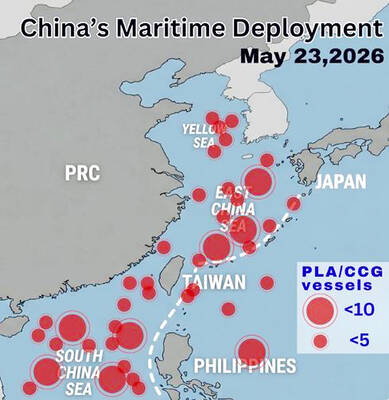
WARNING: China should stop engaging in actions that undermine regional peace and stability, as it would only build resentment among people across the Strait, the CGA said China has deployed more than 100 navy, coast guard and other vessels in waters from the Yellow Sea to the South China Sea and the western Pacific since US President Donald Trump and Chinese President Xi Jinping (習近平) met in Beijing, National Security Council Secretary-General Joseph Wu (吳釗燮) said yesterday. “In this part of the world, #China is the one & only PROBLEM wrecking the #StatusQuo & threatening regional peace & stability,” Wu wrote on X. In a separate post, he said Beijing was coercing Taiwan’s maritime domain, calling it illegal and provocative, after the Coast Guard Administration (CGA) expelled a


 RSS
RSS