


Freshly opened just two weeks ago, this new kid on the block has already generated significant buzz for delicious pizzas in a chic-casual setting. On the day of my visit, the speakers were piping out American country tunes by way of a Japanese radio station — an eclectic combination, offering a clue to this pizzeria’s aspiration toward Asian-mediated Americana.
Pizza Has a Face’s 12-inch thin-crust pies may be more New York than Naples, but the menu is nonetheless organized around the tricolor Italian flag.
Red-faced pizzas have a tomato base and include the classic marinara (NT$200) and margherita, known here as the Brooklyn (NT$280). The punchy tomato sauce stands up well to assertive toppings, such as the Django’s (NT$450) fennel sausage, pickled jalapeno peppers and rosemary. The combination is spicy, funky and almost reminiscent of a Thai curry.
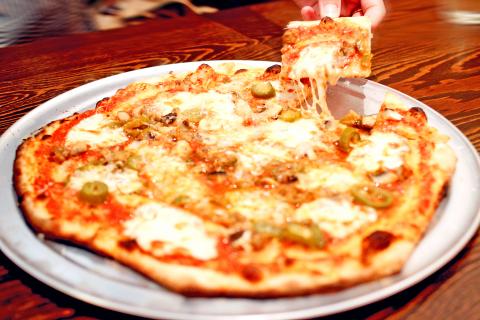
Photo: Davina Tham, Taipei Times
White-faced pizzas eschew the tomato for mozzarella and the occasional provolone, resulting in combinations such as the Triceratops (NT$480) with Brussels sprouts, mushroom and salami; and the Breakfast Club (NT$360) with egg and bacon.
Green-faced pizzas are slathered with a garlicky and herby pesto, which does a better job of complementing delicately flavored topppings like the squid and shrimp on the Moby Dick (NT$480).
Among the green pizzas is one of the most well-balanced and satisfying vegetarian versions I’ve had — the Black Friar (NT$420), topped with creamy mozzarella, sweet caramelized onion, zucchini and dabs of fresh ricotta, all punctuated with bursts of tart grilled grapes.
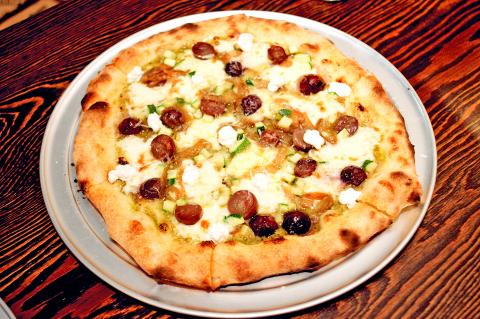
Photo: Davina Tham, Taipei Times
These pies are cooked in an electric pizza oven. Puritans may insist that any pizzeria worth its salt uses a wood-fired one, but I’m open to possibilities as long as the crust turns out charred and blistered, as it does here. Points are also given for the amount of thought given to the interaction of dough, toppings and cut of the pizza.
It’s difficult to overstate the importance of dough texture to a pizza. Here there are distinct differences depending on the toppings. Drier toppings go on a thicker dough that has a familiar raised edge. But saucier and heavier toppings are contrasted with a crust that’s flat all through to the edges, with more crunch than chew.
That also means things can get a little soggy in the middle. A connoisseur could write a thesis about the ideal angle of droop at the tip of a New York-style pizza, but here the restaurant simply acknowledges that heavily-loaded pizzas like the Django are better sliced into squares than triangles, and eaten with knives and forks.
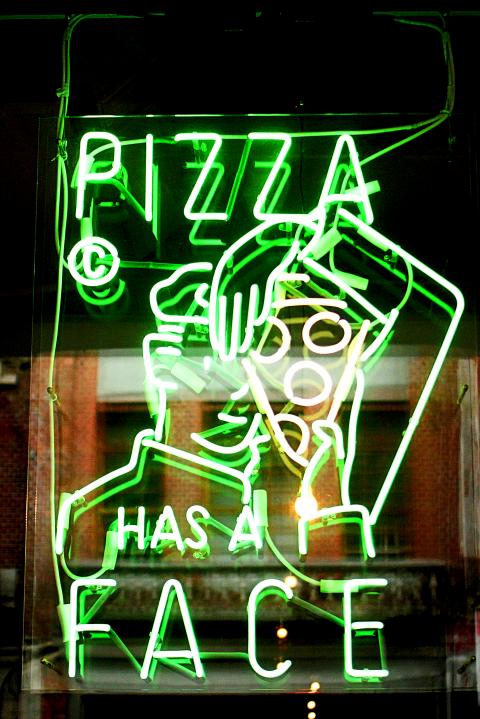
Photo: Davina Tham, Taipei Times
Parmesan potato wedges (NT$150) are the only sides on offer — a signal to concentrate on the pizzas — and for diners on-the-go or petite eaters, the marinara and margherita are also available by the slice (NT$150).
A selection of beers is dominated by the homegrown Alechemist label, giving diners a chance to try unusually flavored brews such as the Tana Jade (NT$220) with prickly ash; Valencia Ale (NT$220) with local Valencia oranges and coriander seed; and a pineapple India pale ale (NT$220).
There’s a strong sense of aesthetics and branding, evident from an eye-catching neon sign facing the road to the logo T-shirts worn by the all-millennial service staff, which diners can buy for a cool NT$650.
Photo: Davina Tham, Taipei Times
Good food — the reason for a restaurant’s existence — can often get lost amid the bells and whistles. I’m happy to report that in this case, pizza doesn’t just have a face, it also has the culinary chops to match.

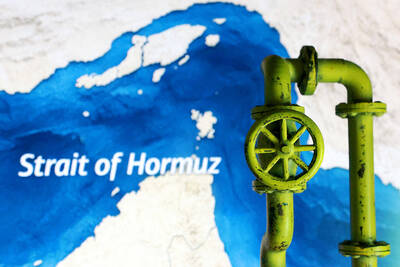
The US war on Iran has illuminated the deep interdependence of Asia on flows of oil and related items as raw materials that become the basis of modern human civilization. Australians and New Zealanders had a wake up call. The crisis also emphasizes how the Philippines is a swatch of islands linked by jet fuel. These revelations have deep implications for an invasion of Taiwan. Much of the commentary on the Taiwan scenario has looked at the disruptions to world trade, which will be in the trillions. However, the Iran war offers additional specific lessons for a Taiwan scenario. An insightful
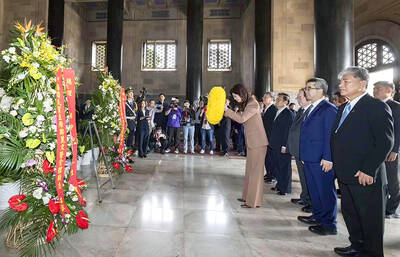
The problem with Marx’s famous remark that history repeats itself, first as tragedy, the second time as farce, is that the first time is usually farce as well. This week Chinese Nationalist Party (KMT) Chair Cheng Li-wun (鄭麗文) made a pilgrimage to the People’s Republic of China (PRC) “to confer, converse and otherwise hob-nob” with Chinese Communist Party (CCP) officials. The visit was an instant international media hit, with major media reporting almost entirely shorn of context. “Taiwan’s main opposition leader landed in China Tuesday for a rare visit aimed at cross-strait ‘peace’”, crowed Agence-France Presse (AFP) from Shanghai. Rare!
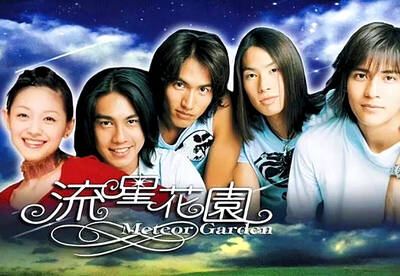
April 6 to April 13 Few expected a Japanese manga adaptation featuring four tall, long-haired heartthrobs and a plucky heroine to transform Taiwan’s television industry. But Meteor Garden (流星花園) took the nation by storm after premiering on April 12, 2001, single-handedly creating the “idol drama” (偶像劇) craze that captivated young viewers across Asia. The show was so successful that Japan produced its own remake in 2005, followed by South Korea, China and Thailand. Other channels quickly followed suit, with more than 50 such shows appearing over the following two years. Departing from the melodramatic

Sunflower movement superstar Lin Fei-fan (林飛帆) once quipped that the Democratic Progressive Party (DPP) could nominate a watermelon to run for Tainan mayor and win. Conversely, the DPP could run a living saint for mayor in Taipei and still lose. In 2022, the DPP ran with the closest thing to a living saint they could find: former Minister of Health and Welfare Chen Shih-chung (陳時中). During the pandemic, his polling was astronomically high, with the approval of his performance reaching as high as 91 percent in one TVBS poll. He was such a phenomenon that people printed out pop-up cartoon


 RSS
RSS