


World renowned primatologist and conservationist Jane Goodall, a proponent of curbing the human population explosion, says Taiwan’s low birth rate is a good thing, stressing that we need to find a way to maintain economic growth with a smaller population.
“The idea of having unlimited economic development on a planet with finite natural resources and growing population is bound to fail,” she tells the Taipei Times.
Goodall was recently in Taipei where she experienced a series of firsts: speaking at a temple, sharing the stage with a president and taking a selfie — with president Tsai Ing-wen (蔡英文). Goodall also snapped a selfie with the crowd that had gathered to listen to her speak at National Taiwan University of Science and Technology (台灣科技大學) Tuesday evening.
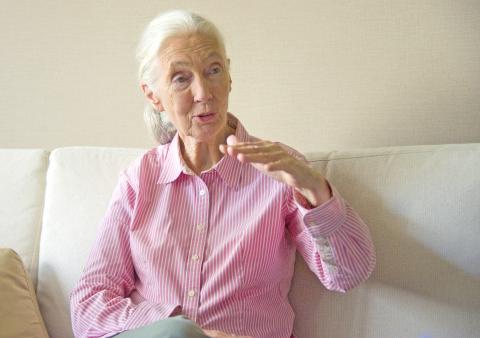
Photo: Han Cheung, Taipei Times
During the forum, Goodall asked Tsai her opinion on balancing the environment and economic interests. Tsai agrees that the age of unbridled consumerism is over, but there still needs to be economic activity to maintain a country. She says one solution is a “circular economy,” which stresses eco-friendly production and disposal as well as reuse of materials.
Tsai says it begins with the individual deciding to make a change in lifestyle — for example, paying more for a product that doesn’t harm the environment. Then, production methods and government policies will also change.
CONVERSATION
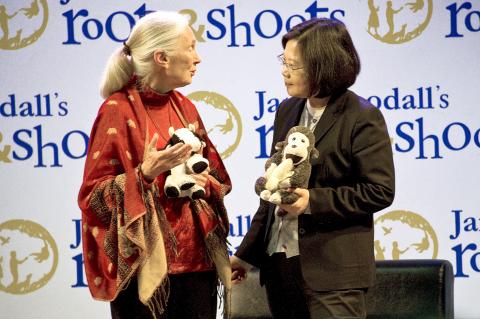
Photo: Han Cheung, Taipei Times
Goodall first visited Taiwan 20 years ago, when she conducted a late-night undercover investigation at Snake Alley, in Taipei’s Wanhua Districts (萬華), to check if the government had, as it had promised, rid the street of all the tortured snakes, turtles and chimpanzees.
“I thought maybe they [cleaned it up] just for my visit,” she says, as she had initially refused to come because of the infamous street. “And it really was okay.”
The 82-year-old Goodall arrived in Taiwan for the 16th time on Friday. In addition to her forum with Tsai, she presided over two parades, observed and listened to the results of various conservation projects and was also named honorary director of Chang Jung Christian University’s International Program for Sustainable Development.
Goodall says that one of her most memorable experiences was in 1997, when then-president Lee Teng-hui (李登輝) promised to take her to to Kenting National Park to observe the Sika deer reintroduction project.
“He forgot, and I had a meeting with him and reminded him,” she says. “He canceled all his engagements the next day and took me in his plane. There was a motorcade and all these police stopping traffic for miles. He kept his promise.”
After Sunday’s parade in Tainan, Goodall gave a talk in front of Chaohuang Temple (朝皇宮), where local students shared with her their progress of cleaning up an old canal in the Taijiang District (台江) and greening its surroundings. She says the experience was similar to the talks she’s given in other religious spaces.
“All of these places have very strong spiritual connections,” she says. “I think it’s very special to give a lecture in places which have given so many people hope, strength and courage.”
Goodall also visited Chang Jung University, which houses the International Jane Goodall’s Roots and Shoots Eco-Center and has put in much work into cleaning up Erjen River (二仁溪), once one of Taiwan’s most polluted. She says she is excited about the university and her foundation’s new endeavor where they will provide 30 scholarships per year to students from poor countries to come to Taiwan for a four-year, hands-on program on sustainable development.
POWER OF YOUTH
Since stepping into the Tanzanian jungle for the first time in 1960, Goodall’s mission has gone much beyond chimpanzee research. Today, she is concerned with conservation and mobilizing young people around the world to take action through her Roots and Shoots program, which she started in 1991 and now has more than 800 student clubs in Taiwan.
“You have this holistic vision,” she says. “You can’t save chimps without saving the forest, and you can’t save the forest without working with the people, and you can’t work with people without raising money, and on and on and on,” she says.
During the forum, club presidents of several university Roots and Shoots programs spoke about their endeavors, such as collecting waste oil to make soap and providing reusable food containers for students to use when they order take out.
Roots and Shoots focuses on young people because Goodall believes that they are the key to saving the environment. They are also the ones who will inherit this “mess we’ve made.”
“Many groups are fighting to save the animals and environment, but it’s clearly not much use if young people don’t grow up to be better stewards than we’ve been,” she tells the students at the forum. “We have not borrowed from our children. We’ve stolen. We’re still stealing your future. If anyone of you feel we have compromised our future, you are absolutely right.”


The US war on Iran has illuminated the deep interdependence of Asia on flows of oil and related items as raw materials that become the basis of modern human civilization. Australians and New Zealanders had a wake up call. The crisis also emphasizes how the Philippines is a swatch of islands linked by jet fuel. These revelations have deep implications for an invasion of Taiwan. Much of the commentary on the Taiwan scenario has looked at the disruptions to world trade, which will be in the trillions. However, the Iran war offers additional specific lessons for a Taiwan scenario. An insightful
The problem with Marx’s famous remark that history repeats itself, first as tragedy, the second time as farce, is that the first time is usually farce as well. This week Chinese Nationalist Party (KMT) Chair Cheng Li-wun (鄭麗文) made a pilgrimage to the People’s Republic of China (PRC) “to confer, converse and otherwise hob-nob” with Chinese Communist Party (CCP) officials. The visit was an instant international media hit, with major media reporting almost entirely shorn of context. “Taiwan’s main opposition leader landed in China Tuesday for a rare visit aimed at cross-strait ‘peace’”, crowed Agence-France Presse (AFP) from Shanghai. Rare!

April 6 to April 13 Few expected a Japanese manga adaptation featuring four tall, long-haired heartthrobs and a plucky heroine to transform Taiwan’s television industry. But Meteor Garden (流星花園) took the nation by storm after premiering on April 12, 2001, single-handedly creating the “idol drama” (偶像劇) craze that captivated young viewers across Asia. The show was so successful that Japan produced its own remake in 2005, followed by South Korea, China and Thailand. Other channels quickly followed suit, with more than 50 such shows appearing over the following two years. Departing from the melodramatic

Sunflower movement superstar Lin Fei-fan (林飛帆) once quipped that the Democratic Progressive Party (DPP) could nominate a watermelon to run for Tainan mayor and win. Conversely, the DPP could run a living saint for mayor in Taipei and still lose. In 2022, the DPP ran with the closest thing to a living saint they could find: former Minister of Health and Welfare Chen Shih-chung (陳時中). During the pandemic, his polling was astronomically high, with the approval of his performance reaching as high as 91 percent in one TVBS poll. He was such a phenomenon that people printed out pop-up cartoon


 RSS
RSS