


Although it’s still a bit too chilly for spring cleaning, for those of us who have too much junk lying around at home, Sunday will be a good opportunity to offload — while meeting new people and sampling some delicious home-cooked food in the process.
When Ellery Hamann hosted his first Really Really Free Market (RRFM) shortly after arriving in Taiwan in the summer of 2012, only about 15 people attended. Since then, the monthly event has grown tremendously, with hundreds of people expected to show up at Sunday’s gathering at the 228 Peace Memorial Park.
The RRFM movement, which first started in the US in 2003 to protest the country’s capitalist economy, eventually evolved into casual weekend get-togethers in cities around the world where people simply bring second hand goods to exchange with other items they want. For the Taipei gatherings, attendees are also encouraged to bring food to share, as well as to hold workshops such as drawing, sewing or guitar lessons. In other words, it’s as much an exchange of knowledge, talents and ideas as it is material objects.

Photo courtesy of Really Really Free Market
“I do not stress the anti-capitalism tenet at all, really,” Hamann tells the Taipei Times.
He adds that while that attracts some people to the event, the rest don’t think too much about it and come to have a good time instead.
“Most people come to make friends, find something interesting, get rid of old stuff they don’t need and have interesting conversations.”
But what happens if someone brings an item that’s highly valuable and another person brings something cheap?
Hamann says he gets asked that question a lot. While he admits that valuable items are picked up pretty quickly, no one would know who brought it since all the items are laid out on mats. In his experience, the market has tended to draw out the good in people rather than the bad, and that most people come with good intentions.
“It’s interesting because it’s almost like an experiment in human nature,” Hamann says.
He adds that it’s not so much an exchange, but more of a free economy that’s based on generosity and good will.
Hamann jokes that another reason to attend is that there’s usually some really bizarre items up for grabs.
“The weirdest thing I can think of may not be appropriate to mention in a news article,” Hamann says.
It was a mug with a breast on one side and the nipple was where you drank from. Someone took a fancy to it and brought it home.
That being said, there’s not always something for everyone. In the past, Hamann and his team have tried donating the leftover items from the market to various charities only to discover that they don’t always want the items they have. Because of this, participants are now asked to bring unclaimed items except for clothes back home with them — leftover clothes will be dropped in donation bins throughout the city.
The event has also spread to other cities in Taiwan including Taichung and Hsinchu. Hamann thinks it’s because the concept behind it is simple and alluring.
“The free market really is based on the idea that people are basically good and want good for themselves and others.”

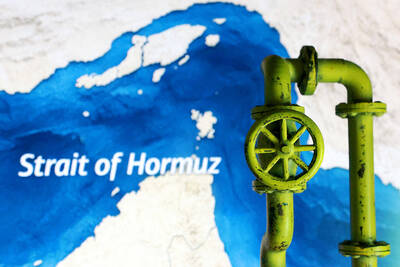
The US war on Iran has illuminated the deep interdependence of Asia on flows of oil and related items as raw materials that become the basis of modern human civilization. Australians and New Zealanders had a wake up call. The crisis also emphasizes how the Philippines is a swatch of islands linked by jet fuel. These revelations have deep implications for an invasion of Taiwan. Much of the commentary on the Taiwan scenario has looked at the disruptions to world trade, which will be in the trillions. However, the Iran war offers additional specific lessons for a Taiwan scenario. An insightful
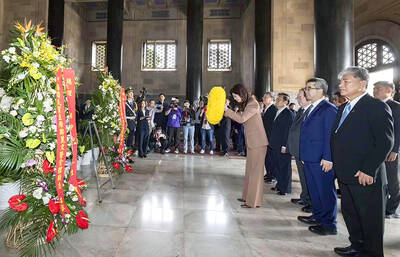
The problem with Marx’s famous remark that history repeats itself, first as tragedy, the second time as farce, is that the first time is usually farce as well. This week Chinese Nationalist Party (KMT) Chair Cheng Li-wun (鄭麗文) made a pilgrimage to the People’s Republic of China (PRC) “to confer, converse and otherwise hob-nob” with Chinese Communist Party (CCP) officials. The visit was an instant international media hit, with major media reporting almost entirely shorn of context. “Taiwan’s main opposition leader landed in China Tuesday for a rare visit aimed at cross-strait ‘peace’”, crowed Agence-France Presse (AFP) from Shanghai. Rare!
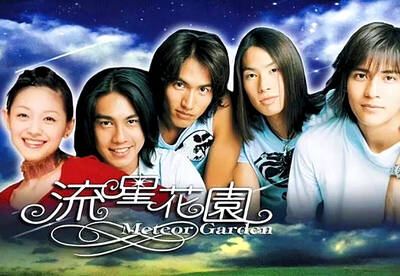
April 6 to April 13 Few expected a Japanese manga adaptation featuring four tall, long-haired heartthrobs and a plucky heroine to transform Taiwan’s television industry. But Meteor Garden (流星花園) took the nation by storm after premiering on April 12, 2001, single-handedly creating the “idol drama” (偶像劇) craze that captivated young viewers across Asia. The show was so successful that Japan produced its own remake in 2005, followed by South Korea, China and Thailand. Other channels quickly followed suit, with more than 50 such shows appearing over the following two years. Departing from the melodramatic
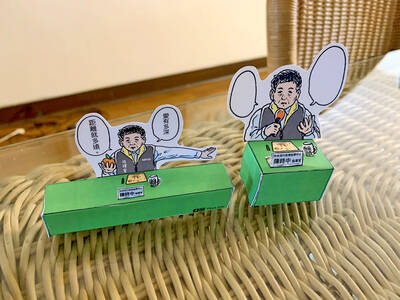
Sunflower movement superstar Lin Fei-fan (林飛帆) once quipped that the Democratic Progressive Party (DPP) could nominate a watermelon to run for Tainan mayor and win. Conversely, the DPP could run a living saint for mayor in Taipei and still lose. In 2022, the DPP ran with the closest thing to a living saint they could find: former Minister of Health and Welfare Chen Shih-chung (陳時中). During the pandemic, his polling was astronomically high, with the approval of his performance reaching as high as 91 percent in one TVBS poll. He was such a phenomenon that people printed out pop-up cartoon


 RSS
RSS