


Wilson Wang's (王煒勛) life could be taken from a Graham Greene novel. After working as an interpreter for the US Navy during the Vietnam War, the Vietnamese national and refugee drifted across Southeast Asia looking for a home. Twenty years ago he landed on these shores where he eventually became a salesman selling yachts to clients in Europe and North America.
Wang seems like he's had as many jobs and speaks as many languages - some fluently, others just a few sentences - as there are dishes on his restaurant's menu. Wang says before opening the restaurant six years ago, he went to Vietnam in search of the best recipes, which he brought back to Taiwan. And though they won't win any prizes for culinary expertise, the chow passes muster.
The restaurant's interior is non-descript - it's more a mom-and-pop style eatery than its upscale neighbors. The servers at most of these swankier joints just go through the motions that they are trained to do when attending to patrons. Wang, on the other hand, welcomes every customer with a warm greeting and, if you are willing to listen, tales from his colorful life.
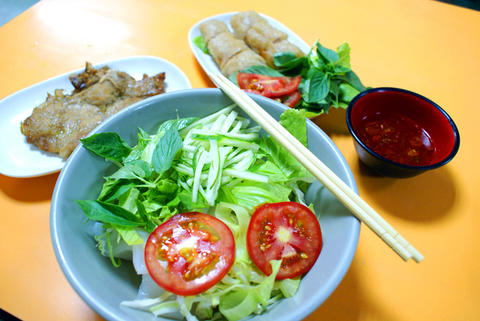
PHOTO: NOAH BUCHAN, TAIPEI TIMES
As I sit down, Wang serves black jelly, a cold beverage made from green beans that is consumed in the summer months to keep the body cool. In addition to the Vietnamese items the menu serves up standard fare from Thailand and Singapore.
The food, as one might expect, is not the stuff of upscale restaurants. However, the ingredients are fresh, the soups and fried rice are not oily and there is a vegetarian menu.
Served with fresh basil, lettuce and mild dipping sauce the spring rolls (NT$60) are as good a place as any to start a meal. The Tom Yum seafood noodle soup (NT$100) was a hit with this reviewer: Generous portions of seafood and fresh vegetables were brought to the table in a soup that made the taste buds quiver. The pork and noodles in fish sauce (NT$100) is also tasty, served with a sauce made of lemon, vinegar, garlic and chili.
Wang recommends the Vietnamese curry and seafood noodle soup (NT$100) and spicy curry fried noodles - choice of beef or pork - (NT$100).
If you were on an intimate night out, it would probably be a good idea to give Indo-China a miss. But if you are looking for a little raw culture with your meal, Wang's recipes and stories of a mysterious life will keep you enthralled.

I was 18 and a naive US Air Force airman when I first set foot on Taiwan in 1968. I left as a more mature, somewhat wiser 23-year-old. Despite transitioning to an adult in those important, formative years, I didn’t think much about coming back. Until recently. Last month, I returned to Taiwan for the first time in 53 years. It was not even remotely like the country I left in 1973. When I departed, Taiwan was a slow-moving, impoverished developing nation under martial law. Outside of the cities, people in conical bamboo hats hand-tilled expansive rice fields that dominated the countryside.

“You have several different internship experiences across different industries,” the interviewer told Hazel Lin (林敏淳). “But they are still internships, not jobs. Why should we hire you? What are you actually capable of?” It was a blunt question. It is also the question increasingly faced by many young Taiwanese workers trying to enter the AI economy, which is a key factor in transforming Taiwan into an indispensable global “AI island.” Lin studied international business, worked in marketing, supply-chain coordination and sustainability events, received a Master’s degree in customer relationship management in Germany and was completing an applied AI training program in Taiwan.
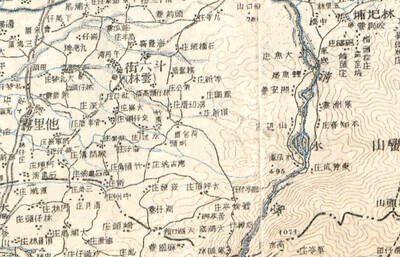
June 22 to June 28 “There are no good civilians within Yunlin’s jurisdiction,” declared Yunlin subprefecture head Yunoshin Matsumura before launching a bloody suppression campaign. Between June 19 and June 22, 1896, thousands of unarmed villagers were killed. Official reports recorded 4,947 houses burnt down in 55 settlements spanning today’s Douliu (斗六), Dounan (斗南), Gukeng (古坑), Tapi (大埤), Cihtong (莿桐), Linnei (林內) townships, as well as Jhushan (竹山) in Nantou County. Angukeng Village (庵古坑), located near the resistance’s mountain headquarters, suffered the heaviest destruction, with 505 households affected. Even Japanese accounts noted the
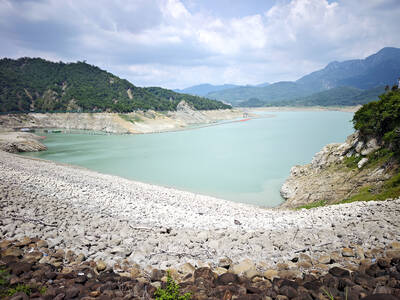
The rarest media reports involve things that work. It is not news that the traffic lights function normally or medicines are dispensed routinely from hospital pharmacies. Trains come and go on time with nary a peep from the media. Only when systems fail do reporters rush to the scene. The first half of the year saw the worst drought in 75 years in Taiwan. The Water Resources Agency (WRA) said that reservoirs south of the Hsinchu-Yilan line this winter received between 7 and 37 percent of the rainfall they received during the same period last year. Rainfall at reservoirs in Hsinchu


 RSS
RSS