


There are few areas of science more fiercely contested than the issue of what makes us who we are. Are we products of our environments or the embodiment of our genes? Is nature the governing force behind our behavior, or is it nurture? While almost everyone agrees that it is a mixture of both, there has been no end of disagreement about which is the dominant influence.
It is a disagreement that has been made yet more fraught by the political concerns that often underlie it. Traditionally, those on the left have tended to see the environment as the critical factor, because it ties in with notions of egalitarianism. Thus inequalities, viewed from this perspective, are not explained by inherent differences, but by social conditions.
Similarly, those on the right have leaned toward a more Darwinian conception, in which different social outcomes are accounted for by differences of suitability to the environment. In turn, such an understanding has in the past led to the promotion of eugenics (both on the left and right) — through selective breeding, sterilization and, in the case of the Nazis, wholesale murder.
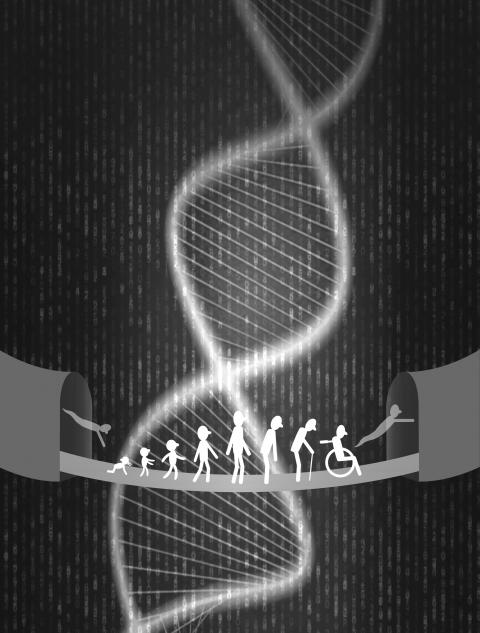
Illustration: Yusha
As a result, a shadow was cast across genetic research into human behavior, particularly of the kind that centers on differences between population groups. Charles Murray and Richard Herrnstein’s The Bell Curve, published in 1994, did just that, drawing controversial conclusions about the differing average IQ results of black and white residents in the US.
Someone who defended the data in that book, but who took exception to its conclusions, is the US psychologist and geneticist Robert Plomin, a pioneer of what is sometimes called “hereditarian” science.
In his new book, Blueprint: How DNA Makes Us Who We Are, Plomin takes genetic research and draws some provocative conclusions, but they are about individuals rather than groups.
In common with many other scientists, Plomin believes that Freud sent society looking in the wrong place for answers to the question of what makes us as we are. The key to personality traits does not lie in how you were treated by your parents, but rather in what you inherited biologically from them: namely, the genes in your DNA.
He finds that genetic heritability accounts for 50 percent of the psychological differences between us, from personality to mental abilities, but that leaves 50 percent that should be accounted for by the environment.
DNA DATA
However, Plomin has said that, according to research, most of that 50 percent is not attributable to the type of environmental influences that can be planned for or readily affected — that is, it is made up of unpredictable events — and that of the environmental influences that can be moderated, much of it is really an expression of genetics.
“We now know that DNA differences are the major systematic source of psychological differences between us,” Plomin wrote. “Environmental effects are important, but what we have learned in recent years is that they are mostly random — unsystematic and unstable — which means that we cannot do much about them.”
Plomin has been waiting 30 years to write Blueprint. It has taken him that long to conduct the research — much of it based on long-term twin studies — necessary to prove his case.
However, there was another reason for the delay, he said: “cowardice.”
For a long time, it was “dangerous” to study “the genetic origins of differences in people’s behavior and to write about it in scientific journals,” he added.
I asked him what he meant by this when I met him at his office at the Social, Genetic and Developmental Psychiatry Centre, which is located at the Institute of Psychiatry, Psychology and Neuroscience at King’s College London in south London.
Plomin is a towering figure — taller than 193cm — with a broad frame and a meaty handshake, but his limpid blue eyes and softly spoken voice give him the appearance of a gentle giant.
Originally from the US, where he worked at the Institute for Behavioral Genetics at the University of Colorado, he said that psychology has changed a great deal over the past 30 years.
“Genetics articles — I mean it was verboten, really, in the 1970s. Everything was environmental. Even schizophrenia was thought to be due to what your mother did in the first few years of life. It seems ridiculous now, but that was the orthodoxy back then — and to mention genetics was just beyond the pale,” Plomin said.
Within the world of science and psychology, there is no longer any problem, he said, but added that if you move out into other disciplines — he cited education as an example — “genetics is still the devil.”
That said, it has been decades since he has been called a Nazi, he said, brightening.
Ever since the development of genetics 150 years ago, the discovery of DNA’s double-helix structure 65 years ago and the mapping of the human genome 15 years ago, there has been an awareness that science was delving into secrets of Promethean flammability. While there has always been widespread acceptance that genes determine our physiology for good and bad, much greater controversy has surrounded the subject of our psychology — our behavior and personality traits.
It is one thing to state that genes largely determine how fast we run, how high we jump and how vulnerable we are to, for example, myopia, but it is another to argue that genes also largely determine how intelligent, empathetic or antisocial we are. We prefer to think of such traits as social constructions, brought about by the familial and social environments into which we happened to have been born.
After all, if one child is subject to parental love and attention in comfortable, secure surroundings with plenty of intellectual stimulation, while another grows up in conditions of neglect and social deprivation, we expect the former to perform better at school and in life in general. By and large, they do, although Plomin believes that it has less to do with social factors than with biological ones.
Once again, it is genetic inheritance, not conditions of upbringing, that makes the most difference, he said.
This is a difficult concept to absorb for several reasons. The first is that we can all come up with examples in which environment would have a profound effect on outcome. For example, if you locked a child in a room and never taught that child to read, then that child, when released at age 13, would display distinct learning difficulties.
Plomin’s argument is that, in a society with universal education, the greatest part of the variation in learning abilities is accounted for by genetics, not home environment or quality of school — these factors do have an effect, but it is much smaller than is popularly believed, he said.
PUBLIC CONFUSION
Another problem that Plomin encounters when explaining his findings is that people often confuse group and individual differences — or, to put it another way, the distinction between means and variances.
The average height of northern European males has increased by more than 15cm over the past 200 years. That is obviously due to changes in environment, but the variation in height between northern European males is due to genetics. The same applies to psychological traits.
“The causes of average differences aren’t necessarily related to causes of individual differences,” he said. “So that’s why you can say heritability can be very high for a trait, but the average differences between groups — ethnic groups, gender — could be entirely environmental, as a result of, for example, discrimination. The confusion between means and variances is a fundamental misunderstanding.”
For much of the relatively brief history of genetic science, there has been an even greater misunderstanding — the notion that the presence or absence of single genes is the determining factor that accounts for such things as illnesses, abnormalities and dysfunctions.
Hence, some environmentalists have demanded to be shown the gene for various complaints and, when it is not produced, declare that there is no genetic explanation, but single-gene conditions are rare and, as far as anyone knows, nonexistent in psychology.
The big breakthrough in the past few years is polygenic testing, which is able to correlate multiple genes — often thousands — with behavior differences.
No one yet understands the complex relationships between different genes, but this is not necessary for predictive purposes, Plomin said.
Polygenic testing comes up with heritability estimates that correspond to a whole range of physical and psychological traits, he said, adding that the larger the study group, the more accurate the predictions — and as an increasing number of people have their genome mapped, the study groups are growing all the time.
“We’re explaining more variance in GCSE [General Certificate of Secondary Education] scores than you can predict with anything else, including parents’ educational level and socioeconomic status,” Plomin said.
One voluble critic of Plomin’s work has been psychologist Oliver James, who believes that “sticking with the genetic story holds out no hope.”
Instead, James prefers to stick with the environmental story, which is a far richer narrative, full of parental missteps, social maltreatment and educational neglect.
I asked James what question he would put to Plomin. He wanted to know what it would take for Plomin to accept that “genetic variants play little or no part in explaining transmission of human psychological traits from parent to child?”
When I told Plomin that I had consulted James for his opinion, he rolled his eyes.
Plomin said that James simply does not understand, or follow the developments that have taken place over the past few years in genetics.
“Show me a study that doesn’t find genetic influence. You can’t just say: ‘Oh, parents resemble children and I think it is environmental.’ With DNA now, you have to take this polygenic score that’s been shown in 20 studies to predict educational attainment, and show me that it doesn’t. Oliver’s coming from straight Freudian psychoanalytical stuff, where that whole edifice was built up on no data.”
A further argument made in Blueprint is that even those effects that are environmental might also be genetically influenced, what Plomin calls the “nature of nurture.”
If we look at the correlation between parental socioeconomic status and their children’s educational and occupational outcomes, the tendency is to see it as environmental — better-educated parents pass on privilege, thus limiting social mobility.
However, genetics “turns the interpretation of this correlation upside down,” Plomin wrote.
Instead, the socioeconomic status of parents might be viewed as a measure of their educational outcomes, which are heritable, so children benefit from their parents’ genes more than from their socioeconomic privilege.
ARGUMENT AGAINST
James believes that if, as a society, we accept the heritability argument, then it will lead to blaming the poor for their own plight and privileging the rich for their good fortune.
He is not alone.
The Guardian ran an editorial earlier this year in response to a paper that Plomin (and others) published in which they stated that “differences in exam performance between pupils attending selective and non-selective schools mirror the genetic differences between them.”
The editorial described Plomin’s ideas as “pernicious and incendiary.”
Eric Turkheimer, head of the Genetics and Human Agency Project at the University of Virginia, wrote a critique of the paper in which he said the authors had described genetic effects that could just as well have been environmental.
“There is nothing in the paper to push one’s thinking in either a genetic or environmental direction,” he said.
Plomin said his research is robust and it points in a genetic direction.
The Guardian’s own conclusion amounted to a warning sign being placed on Plomin’s work: “In understanding cognitive ability, we must not elevate discrimination to a science: allowing people to climb the ladder of life only as far as their cells might suggest.”
Asked if his findings support a right-wing, neo-Darwinian vision of society, Plomin said: “There are no necessary policy implications of finding that genetics is the major systematic force making us who we are. Right-wing values might lead someone to say that we should educate the best and forget the rest, but my view is that the intellectual capital of a society depends on the many not just the few. Left-wing values might lead someone to say that we should put whatever resources are needed to bring children who didn’t draw good genetic cards at conception up to minimal levels of literacy and numeracy needed to participate in our increasingly technological world.”
If we do manage to iron out environmental differences, we then have to accept the genetic differences that remain, Plomin said.
The more we reduce environmental differences, the more we highlight genetic differences — in other words, if we want equality of opportunity, then the price is that we much acknowledge a genetically loaded inequality of outcome.
Plomin believes that we should go with the science, not settle on a story that suits our political sympathies.
“It is better to be right than wrong,” he said.
Perhaps the most radical aspect of Plomin’s findings has little to do with the issue of equality, but instead seeks to rethink our treatment of mental health. At the moment, mental health follows the classical medical model by diagnosing a disorder and then seeking to deal with its cause, but genetic research suggests that there are no clear lines in mental disorders, but rather a spectrum on which we are all genetically placed.
The example that Plomin gives is depression. If there were, for example, 1,000 DNA differences found between two control groups of depressed and non-depressed people, it might be that in the general population the average person would have 500 of these depression-causing differences.
BIG CONCLUSION
Many people would have far fewer. Those with the fewest would be at least risk of becoming depressed and those with the most, at the greatest risk.
It is a question of probability, not certainty — an underlying predisposition that might be triggered by unpredictable events.
“This genetic research leads to a momentous conclusion,” Plomin wrote. “There are no qualitative disorders, only quantitative dimensions.”
“That means you can’t cure a disorder, because there is no disorder,” he said. “It is all quantitative. You can ameliorate the symptoms, which is what they do now with schizophrenia. They don’t try and cure the underlying problem. They just say: ‘There are some behaviors, and CBT [cognitive behavioral therapy] can help people change their behaviors so that they rub along better in life.’”
Such thinking will no doubt be anathema to the very large and growing psychotherapeutic community, but for anyone who is baffled by the seemingly arbitrary diagnoses that have long been a characteristic of mental health, it makes a certain sense.
Plomin believes that psychiatry is already adjusting to the findings by reclassifying some disorders as spectra, such as schizophrenia spectrum disorder and autistic spectrum disorder.
“Spectra is another word for dimensions,” he said.
All of which means that the distinction between “normal” and “abnormal” becomes not just more blurred, but artificial.
“They are merely the quantitative extremes of continuous traits,” Plomin said.
As we came to the end of a long and thought-provoking discussion, I asked him how he thought his book would be received.
“I’m holding my breath,” he said, smiling. “I know it has changed psychology, and it is going to change clinical psychology. It is changing all the life sciences, and eventually society will come along. But I think we’re at a tipping point, and what I’m holding my breath about is which way it is going to tip.”
Geneticists can make their cases on the strength of Plomin’s claims.
For the rest of us, the temptation to jump to hasty conclusions might well prove too great. The social stakes, after all, are high.
The possibilities for exploitation and abuse of genetic information are ones that have long been rehearsed in science fiction, and remain all too easy to imagine, but there is no progressive course of action that does not address the scientific facts. For better or worse, ignorance is not an option.

Weeks into the craze, nobody quite knows what to make of the OpenClaw mania sweeping China, marked by viral photos of retirees lining up for installation events and users gathering in red claw hats. The queues and cosplay inspired by the “raising a lobster” trend make for irresistible China clickbait. However, the West is fixating on the least important part of the story. As a consumer craze, OpenClaw — the AI agent designed to do tasks on a user’s behalf — would likely burn out. Without some developer background, it is too glitchy and technically awkward for true mainstream adoption,
On Monday, the day before Chinese Nationalist Party (KMT) Chairwoman Cheng Li-wun (鄭麗文) departed on her visit to China, the party released a promotional video titled “Only with peace can we ‘lie flat’” to highlight its desire to have peace across the Taiwan Strait. However, its use of the expression “lie flat” (tang ping, 躺平) drew sarcastic comments, with critics saying it sounded as if the party was “bowing down” to the Chinese Communist Party (CCP). Amid the controversy over the opposition parties blocking proposed defense budgets, Cheng departed for China after receiving an invitation from the CCP, with a meeting with
Chinese Nationalist Party (KMT) Chairwoman Cheng Li-wun (鄭麗文) is leading a delegation to China through Sunday. She is expected to meet with Chinese President Xi Jinping (習近平) in Beijing tomorrow. That date coincides with the anniversary of the signing of the Taiwan Relations Act (TRA), which marked a cornerstone of Taiwan-US relations. Staging their meeting on this date makes it clear that the Chinese Communist Party (CCP) intends to challenge the US and demonstrate its “authority” over Taiwan. Since the US severed official diplomatic relations with Taiwan in 1979, it has relied on the TRA as a legal basis for all
A delegation of Chinese Nationalist Party (KMT) officials led by Chairwoman Cheng Li-wun (鄭麗文) is to travel to China tomorrow for a six-day visit to Jiangsu, Shanghai and Beijing, which might end with a meeting between Cheng and Chinese President Xi Jinping (習近平). The trip was announced by Xinhua news agency on Monday last week, which cited China’s Taiwan Affairs Office (TAO) Director Song Tao (宋濤) as saying that Cheng has repeatedly expressed willingness to visit China, and that the Chinese Communist Party (CCP) Central Committee and Xi have extended an invitation. Although some people have been speculating about a potential Xi-Cheng


 RSS
RSS