


Who gains from a trade war with China?
At the APEC summit in Peru over the weekend, one of the biggest questions was whether US president-elect Donald Trump would stick to his threat to erect steep trade barriers against Beijing, dragging the US into a tit-for-tat confrontation with the world’s second-largest economy.
No such war has begun, yet it seems clear that the US has already lost. China has been steadily gaining in the global economic system.
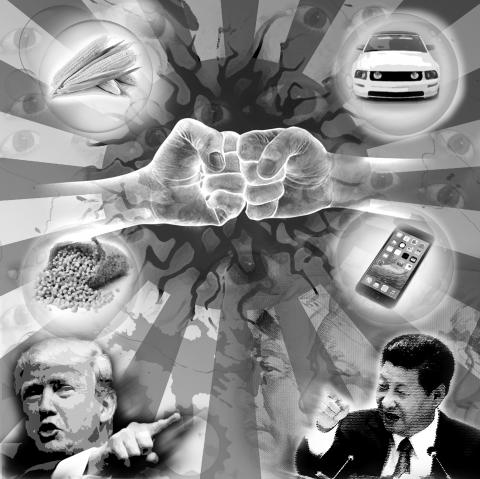
Illustration: Kevin Sheu
Waging war against globalization, the US is making China’s case. Eswar Prasad, a former head of the Chinese division at the IMF, argues that “over the long term China comes out a winner no matter what.”
China’s economy would surely suffer if the US were to impose a 45 percent tariff on nearly US$500 billion worth of Chinese imports. The US absorbs only 16 percent of Chinese exports, but it is China’s healthiest export market. Fears of US protectionism are already stoking capital flight from China.
However, China might be better placed than the US to take the blow. And it would certainly counterpunch. An editorial in the Global Times, a Chinese Communist Party mouthpiece, is probably not far-off in its warning that US action would mean: “A batch of Boeing orders will be replaced by Airbus. US auto and iPhone sales in China will suffer a setback, and US soybean and maize imports will be halted.”
China has several ways to retaliate. It could bar state-owned companies from doing business with US businesses. It could limit access to essential commodities, as it did in response to a fishing dispute with Japan by stopping exports of so-called rare earth minerals essential to the electronics industry. It could soft-pedal efforts to combat the piracy of US patents and copyrights.
ROUGH RIDE
Some of the US’ most successful companies would be in for a rough ride. The vast majority of Apple’s iPhones, for example, are assembled in China. The assembly costs, though, account for less than 4 percent of the value added of the device. That means China could force a halt in iPhone production at little cost to itself, while Apple would face a deeply disruptive, expensive effort to shift production elsewhere. Building it from scratch in the US is nearly impossible.
How long could the US resolve hold? An analysis by the pro-trade Peterson Institute for International Economics concluded that a full-blown trade war with China and Mexico would push unemployment in the US to nearly 9 percent in 2020, from 4.9 percent today. That would not improve the economic outlook for millions of working-class Americans in whose name Trump proposed this fight.
And that might not even be the worst part. Circling the wagons around the US border plays directly into China’s hands in other ways.
Washington would be cast as the villain in the fight. No matter how many tricks the Chinese government might deploy against US interests, it would remain the victim in the eyes of many nations, a champion for the cause of open rules-based trade.
Even if Trump is just bluffing, as many of his allies say, to gain leverage in some future negotiation, much of the damage has been done. His bluster has changed the perception of the role the US would play in the world.
Amid a turn toward populist nationalism in other rich countries — like Britain and France — China has emerged in the unlikely role of defender of globalized capitalism.
INTEGRATION
“China is the one major power still talking about increased integration,” said Nicholas Lardy, a China specialist at the Peterson Institute. “China is the only major country in the world projecting the idea that globalization brings benefits.” And that is the US’ loss.
A great many countries in the developing world still believe prosperity depends on their successful integration into the supply chains that traverse the global economy. By turning inward — a move already reinforced by the rejection of the Trans-Pacific Partnership — the US appears to have little to offer.
Australian Minister for Trade Steven Ciobo conveyed that point only a few days after the US election by saying that his nation would work to conclude the Regional Comprehensive Economic Partnership — a Chinese initiative among 16 Asian and Pacific countries that excludes the US — and would support Beijing’s proposed Free Trade Area of the Asia Pacific. Ditto for Peru and Chile, which, according to a senior Chinese official in Lima, are also now seeking to join the Chinese trade initiative.
“Almost certainly every economy in the Asian region sees its future lying more closely linked with China,” Prasad said. “With Trump talking about withdrawing from trade deals and making allies pay for protection, it will be tough for Asian countries to resist China’s embrace.”
And if Washington’s actions against China start to disrupt Asia’s supply chains, the US could quickly become the region’s economic pariah.
WHY?
The question is, to what purpose? It can not simply be about stopping currency manipulation. That is an outdated fear. Instead of working to lower the value of its currency to improve its exports, China has spent about US$1 trillion lately to prop up the value of the renminbi in the face of capital flight. If it stopped, the currency would drop like a stone, enhancing China’s trade competitiveness.
Moreover, slapping trade barriers against China would do little to narrow the US trade deficit. US companies building things in China would not bring much manufacturing home; in most cases they would go to some other country with cheap labor. And to the extent they did “reshore” production, most of it would be highly automated, employing few additional Americans.
“It does not make economic sense for Trump to want to balance trade with China,” said Derek Scissors, a China specialist at the conservative American Enterprise Institute. “Balanced trade doesn’t bring back jobs.”
Initially, Trump might look like a winner, resolute in his defense of the working class, but any increase in popularity would be unlikely to last as the consequences started to become apparent.
Washington has already been playing a relatively weak hand trying to contain China’s influence. China has skillfully deployed investments to win over countries from Africa to Latin America, broadening its network of influence. Its proposed Asian infrastructure bank proceeded, despite opposition from the US President Barack Obama’s administration, after Britain and other US allies jumped on board.
“China is becoming a leading member of the international community,” Prasad wrote in his new book Gaining Currency, but not, “as the West prefers, by being co-opted into existing institutions under the current rules of the game.” Instead, China is “co-opting other countries into the system of rules it wants to dictate.”
Trump just gave China’s alternative system of rules a big push forward.

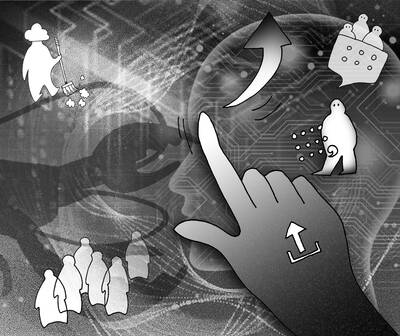
Weeks into the craze, nobody quite knows what to make of the OpenClaw mania sweeping China, marked by viral photos of retirees lining up for installation events and users gathering in red claw hats. The queues and cosplay inspired by the “raising a lobster” trend make for irresistible China clickbait. However, the West is fixating on the least important part of the story. As a consumer craze, OpenClaw — the AI agent designed to do tasks on a user’s behalf — would likely burn out. Without some developer background, it is too glitchy and technically awkward for true mainstream adoption,
On Monday, the day before Chinese Nationalist Party (KMT) Chairwoman Cheng Li-wun (鄭麗文) departed on her visit to China, the party released a promotional video titled “Only with peace can we ‘lie flat’” to highlight its desire to have peace across the Taiwan Strait. However, its use of the expression “lie flat” (tang ping, 躺平) drew sarcastic comments, with critics saying it sounded as if the party was “bowing down” to the Chinese Communist Party (CCP). Amid the controversy over the opposition parties blocking proposed defense budgets, Cheng departed for China after receiving an invitation from the CCP, with a meeting with
Chinese Nationalist Party (KMT) Chairwoman Cheng Li-wun (鄭麗文) is leading a delegation to China through Sunday. She is expected to meet with Chinese President Xi Jinping (習近平) in Beijing tomorrow. That date coincides with the anniversary of the signing of the Taiwan Relations Act (TRA), which marked a cornerstone of Taiwan-US relations. Staging their meeting on this date makes it clear that the Chinese Communist Party (CCP) intends to challenge the US and demonstrate its “authority” over Taiwan. Since the US severed official diplomatic relations with Taiwan in 1979, it has relied on the TRA as a legal basis for all
A delegation of Chinese Nationalist Party (KMT) officials led by Chairwoman Cheng Li-wun (鄭麗文) is to travel to China tomorrow for a six-day visit to Jiangsu, Shanghai and Beijing, which might end with a meeting between Cheng and Chinese President Xi Jinping (習近平). The trip was announced by Xinhua news agency on Monday last week, which cited China’s Taiwan Affairs Office (TAO) Director Song Tao (宋濤) as saying that Cheng has repeatedly expressed willingness to visit China, and that the Chinese Communist Party (CCP) Central Committee and Xi have extended an invitation. Although some people have been speculating about a potential Xi-Cheng


 RSS
RSS