


US tycoon Donald Trump has been elected to be the next US president. Huge construction projects are likely to become a policy focus, the most controversial of which is the construction of a wall along the border separating the US from Mexico.
According to an estimate by the Massachusetts Institute of Technology, a 15m-high wall stretching 1,600km would cost up to US$40 billion, which, converted to New Taiwan dollars, would cost about NT$750 million (US$23.43 million) per kilometer.
Trump has also said that he wants to rebuild US infrastructure, as he feels that its airports, railway system, road network and subway systems are vastly inferior to those in Asian nations. He is planning to invest US$1 trillion in transportation infrastructure over the next 10 years.
Traffic culture and aesthetics is another important issue. A look at cities like Boston, New York, Philadelphia and Washington shows that the quality of railways, subway networks, stations and highways is deteriorating. Security at many train and subway stations is becoming a problem, there is no high-speed rail, subway networks are dirty and worn down and very few people drive luxury car brands.
However, there is definitely an advanced awareness of traffic culture and aesthetics.
In the Pennsylvania community where I live, there are no traffic lights at road intersections, and a stop sign is all there is to maintain orderly traffic. Drivers are certain to stop at the signs and make sure that there are no pedestrians before they drive on. Pedestrians always have the right of way as they cross the road. In short, traffic is orderly.
Americans also pay a great deal of attention to traffic aesthetics, and the buildings at important transportation hubs such as train stations, airports and other stations are certain to become local landmarks.
Different states put a great deal of effort into their car license plates to ensure that they represent the state color, symbol and slogan.
Taiwan has good transportation networks, but it lacks a developed traffic culture and aesthetic. Drivers stop and go as they try to anticipate which way pedestrians will move, creating a lot of fear among pedestrians. Large vehicles do not give right of way to smaller vehicles, scooters or bicycles, and there is a never-ending supply of impatient drivers. Traffic culture is at a very low level.
When it comes to traffic aesthetics, it is very difficult to detect more developed aesthetics around main traffic stations in the greater Taipei area, and the white car plates with their black numbers and letters lack any kind of aesthetic value. Putting those plates on a luxury car will make it look plain to the point that it almost loses the right to be called a luxury car.
Taiwan’s transportation infrastructure has developed rapidly over the past two decades, and it is now more developed than many other developed nations’. Still, when it comes to traffic culture and aesthetics, Taiwan remains a developing nation.
All Taiwanese, as well as the nation’s traffic authorities, must make a joint effort to raise the level of traffic culture and aesthetics in Taiwan.
Su Yu-shou holds a doctorate in city and regional planning from the University of Pennsylvania.
Translated by Perry Svensson

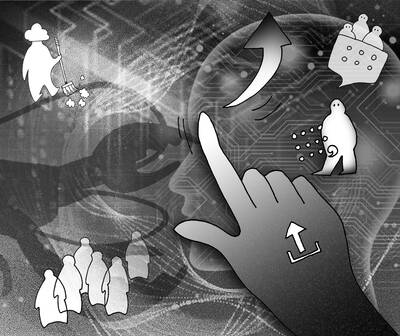
Weeks into the craze, nobody quite knows what to make of the OpenClaw mania sweeping China, marked by viral photos of retirees lining up for installation events and users gathering in red claw hats. The queues and cosplay inspired by the “raising a lobster” trend make for irresistible China clickbait. However, the West is fixating on the least important part of the story. As a consumer craze, OpenClaw — the AI agent designed to do tasks on a user’s behalf — would likely burn out. Without some developer background, it is too glitchy and technically awkward for true mainstream adoption,
On Monday, the day before Chinese Nationalist Party (KMT) Chairwoman Cheng Li-wun (鄭麗文) departed on her visit to China, the party released a promotional video titled “Only with peace can we ‘lie flat’” to highlight its desire to have peace across the Taiwan Strait. However, its use of the expression “lie flat” (tang ping, 躺平) drew sarcastic comments, with critics saying it sounded as if the party was “bowing down” to the Chinese Communist Party (CCP). Amid the controversy over the opposition parties blocking proposed defense budgets, Cheng departed for China after receiving an invitation from the CCP, with a meeting with
Chinese Nationalist Party (KMT) Chairwoman Cheng Li-wun (鄭麗文) is leading a delegation to China through Sunday. She is expected to meet with Chinese President Xi Jinping (習近平) in Beijing tomorrow. That date coincides with the anniversary of the signing of the Taiwan Relations Act (TRA), which marked a cornerstone of Taiwan-US relations. Staging their meeting on this date makes it clear that the Chinese Communist Party (CCP) intends to challenge the US and demonstrate its “authority” over Taiwan. Since the US severed official diplomatic relations with Taiwan in 1979, it has relied on the TRA as a legal basis for all
A delegation of Chinese Nationalist Party (KMT) officials led by Chairwoman Cheng Li-wun (鄭麗文) is to travel to China tomorrow for a six-day visit to Jiangsu, Shanghai and Beijing, which might end with a meeting between Cheng and Chinese President Xi Jinping (習近平). The trip was announced by Xinhua news agency on Monday last week, which cited China’s Taiwan Affairs Office (TAO) Director Song Tao (宋濤) as saying that Cheng has repeatedly expressed willingness to visit China, and that the Chinese Communist Party (CCP) Central Committee and Xi have extended an invitation. Although some people have been speculating about a potential Xi-Cheng


 RSS
RSS