


A search through the Awakening Foundation’s database on the women’s movement in Taiwan shows that the foundation has long advocated that women must enter politics — in the widest sense of the word — and strive for equality if they want to change the logic and environment of the political scene.
During former vice president Annette Lu’s (呂秀蓮) terms in office, an elementary-school girl wrote in an essay on the topic “My Dream” that she wanted to be vice president when she grew up. Gender equality educators used this as an example to ask why girls should not dare to dream about becoming president, vice president or anything else they want to be.
With the presidential election only weeks away, Taiwan might be close to the historical moment when a woman becomes head of state. What does this indicate, and what does it mean to this new democracy?
None of the presidential candidates have proposed any women’s or gender policies, including Democratic Progressive Party (DPP) presidential candidate Tsai Ing-wen (蔡英文), who heads the opinion polls and is the only female candidate.
Some say she should be a president for the whole public, not just women, but there is no clear division between men and women: women’s political, economic, social and cultural disadvantages inevitably affect their family members, who rely on women most.
Take the case of Radio Corp of America, a now-defunct electronics company involved in a water pollution scandal in Taiwan. Those who suffered most in the nation’s gendered society were the female workers who were working while taking care of their families.
When air is unhealthy to breathe, many laborers still need to work outdoors, pick up and drop off family members or look after those who are ill.
In Taiwan’s first democratic election in 1989, the Awakening Foundation and other women’s groups proposed 10 major policies. During every election since, they have proposed such policies and demanded that candidates respond to them.
Looking at past government transitions, all presidents failed to implement women’s policies, even the basic pledge that one-fourth of their Cabinet members would be female. Former president Chen Shui-bian (陳水扁) and President Ma Ying-jeou (馬英九) only achieved this during the first year of their presidencies, and the proportion dropped after Cabinet reshuffles.
Social conditions have deteriorated during the Chinese Nationalist Party’s (KMT) eight-year rule from 2008 and trouble is everywhere. The capacity of public services like childcare and long-term care has deteriorated, prices have risen and quality is uneven.
Discrimination against pregnant women and sexual harassment in the workplace are rampant. Women’s careers are interrupted by marriage and pregnancy, and they lack economic security in their later years.
Food safety problems and environmental pollution scandals are frequent, and due to the commercialization of higher education, university tuition has been rising and students have problems finding jobs after graduating and must accept low salaries while they are burdened by student loans.
The killing of women is commonly seen, including crimes of passion, violence in connection to breakups, domestic violence and child abuse. Despite all this, budgets and personnel for government agencies have been reduced, rather than increased.
Moreover, lesbian, gay, bisexual and transgender people are discriminated against at schools and in the workplace. For same-sex couples who want to have their relationship recognized by the government regarding property inheritance and legal representation, legal amendments addressing marriage equality and partnership rights have been delayed in the legislature. The government says that it is necessary to reach a “social consensus.”
Single-parent, migrant worker and Aboriginal families have fewer rights and welfare resources, while the government argues that its tax revenue is insufficient, although it repeatedly cuts taxes for the rich in complete disregard of social distributive justice.
During televised presidential debates to take place tomorrow and on Saturday next week, Tsai will hopefully give clear and definite answers as to whether she will be able to implement a variety of women’s and gender policies that the KMT has failed to implement over the past eight years.
Hopefully, KMT presidential candidate Eric Chu (朱立倫) and People First Party presidential candidate James Soong (宋楚瑜) will give some positive surprises — what remedies do they have for the Ma administration’s poor performance?
If a woman is elected president, hopefully the male-dominated political logic and environment will change and more women will enter the political landscape.
On the other hand, female politicians might quickly adopt the traditional male-dominated politics and stand with the interests of capitalism and the patriarchal logic of big business.
Hopefully, the three presidential candidates will propose women’s and gender policies and focus the debate on concrete policies to benefit the public and social development.
Tseng Chao-yuan is a senior researcher at the Awakening Foundation. Chen Yi-chien is chairwoman of the Awakening Foundation and an associate professor at the Graduate Institute for Gender Studies at Shih Hsin University.
Translated by Eddy Chang

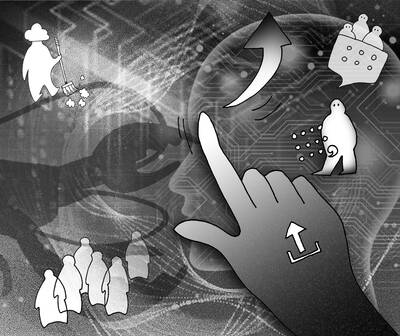
Weeks into the craze, nobody quite knows what to make of the OpenClaw mania sweeping China, marked by viral photos of retirees lining up for installation events and users gathering in red claw hats. The queues and cosplay inspired by the “raising a lobster” trend make for irresistible China clickbait. However, the West is fixating on the least important part of the story. As a consumer craze, OpenClaw — the AI agent designed to do tasks on a user’s behalf — would likely burn out. Without some developer background, it is too glitchy and technically awkward for true mainstream adoption,
On Monday, the day before Chinese Nationalist Party (KMT) Chairwoman Cheng Li-wun (鄭麗文) departed on her visit to China, the party released a promotional video titled “Only with peace can we ‘lie flat’” to highlight its desire to have peace across the Taiwan Strait. However, its use of the expression “lie flat” (tang ping, 躺平) drew sarcastic comments, with critics saying it sounded as if the party was “bowing down” to the Chinese Communist Party (CCP). Amid the controversy over the opposition parties blocking proposed defense budgets, Cheng departed for China after receiving an invitation from the CCP, with a meeting with
Chinese Nationalist Party (KMT) Chairwoman Cheng Li-wun (鄭麗文) is leading a delegation to China through Sunday. She is expected to meet with Chinese President Xi Jinping (習近平) in Beijing tomorrow. That date coincides with the anniversary of the signing of the Taiwan Relations Act (TRA), which marked a cornerstone of Taiwan-US relations. Staging their meeting on this date makes it clear that the Chinese Communist Party (CCP) intends to challenge the US and demonstrate its “authority” over Taiwan. Since the US severed official diplomatic relations with Taiwan in 1979, it has relied on the TRA as a legal basis for all
A delegation of Chinese Nationalist Party (KMT) officials led by Chairwoman Cheng Li-wun (鄭麗文) is to travel to China tomorrow for a six-day visit to Jiangsu, Shanghai and Beijing, which might end with a meeting between Cheng and Chinese President Xi Jinping (習近平). The trip was announced by Xinhua news agency on Monday last week, which cited China’s Taiwan Affairs Office (TAO) Director Song Tao (宋濤) as saying that Cheng has repeatedly expressed willingness to visit China, and that the Chinese Communist Party (CCP) Central Committee and Xi have extended an invitation. Although some people have been speculating about a potential Xi-Cheng


 RSS
RSS