

During World War II, scientists from the Center for Radiological Research in Manhattan toiled on the Manhattan Project, working feverishly to develop an atomic bomb before Nazi Germany.
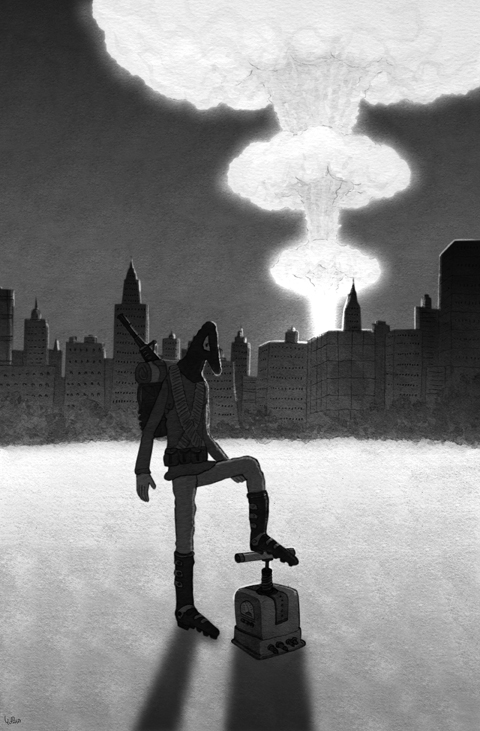
Some 70 years later, physicists from the center, now part of Columbia University Medical Center, are once again racing against time, but their work today centers on containing the damage from a much smaller and less sophisticated weapon: the dirty bomb, a crude explosive rigged to spray radioactive material.
In a cramped room off Broadway on West 120th Street, in Columbia’s mechanical engineering department, sits the prototype of a large robotic apparatus that could, after a dirty bomb detonated, test tens of thousands of New Yorkers a day for radiation exposure using a simple finger prick. Currently, such tests must be done manually, with blood removed from the arm and the sample shipped to a laboratory.
“In the best of circumstances, you could do only a few hundred people a day, even with many labs involved,” said David Brenner, the center’s director and a professor of radiation biophysics, who has been collaborating on the project with mechanical engineers and biologists from Columbia.
A dirty bomb attack has never occurred, but there have been scares. In 1998 authorities in Chechnya defused a container filled with radioactive materials attached to an explosive. The work at Columbia has taken on new urgency after a car bomb was left on a bustling street in Times Square in May but failed to detonate.
“The concern is that it’s not that hard to manufacture a dirty bomb,” Brenner said. “Basically you just need to get some radioactive materials.”
The development of a fully automated testing system, with the potential to process up to 30,000 blood samples in a single day, is important because the type of treatment for radiation sickness depends on the dose received.
Another reason government officials and scientists are pushing to bring the device to market is allaying fears after a bombing.
“The last thing you want is somebody like me going on TV and saying, ‘Don’t panic,’ because everyone will panic,” Brenner said. “The idea is to have some physical test that you can give individuals whereby you can demonstrate what their radiation exposure really is. Most people will get almost no dose.”
“The bad guys want to create disruption and panic. If you can fight that by reassuring people, then you have defeated the goals of the terrorists,” he said.
The New York Police Department has long been on alert for a radiological attack, particularly since the Sept. 11 attacks, the department’s chief spokesman Paul Browne said.
“Our focus in counterterrorism is on intelligence-gathering that would learn of any plot before a device could be deployed,” Browne said. “But we do have some robust detection programs up and running now.”
Nearly 2,000 police officers carry devices the size of a BlackBerry that clip to their belts and detect the gamma radiation that a dirty bomb would emit. More advanced searches are done by officers wearing special backpacks with equipment that can also register the neutron radiation that a fission or fusion bomb would unleash. Even larger pieces of detection equipment are deployed in police trucks and helicopters to pick up “any radiological signature” emanating from other vehicles, Browne said.
Still, those efforts are meant to find a bomb before it explodes. The task of measuring the harm afterward would fall to city health officials, who say they are tracking the progress of Brenner’s team.
“The development of a validated system to rapidly and accurately assess public radiation exposure is important,” the health department said in a statement, adding that the city would “weigh in on public applications” when the system was ready.
One company, Northrop Grumman, plans to manufacture a compact version of the machine. But the US Food and Drug Administration must approve the device first, a process that could take three years or more.
Brenner said a medium-size dirty bomb might result in significant doses of radiation “only within only a few hundred yards of an actual event, and possibly less.”
A large bomb, however, could affect people miles away, depending on the winds.
While some people may envision widespread illness from a dirty bomb, Brenner said the reality would probably be quite different.
In 1987 in Goiania, a city of 1.3 million people in Brazil, thieves stole and broke open sources of radioactive cesium from an abandoned medical center. The dispersal of radiation was equivalent to what scientists would classify as a medium-size dirty bomb.
About 130,000 people overwhelmed hospital emergency rooms. Of those, 250 people, some with radioactive residue still on their skin, were found to be contaminated through the use of Geiger counters. (The counters can detect radioactive material, but if the material is no longer present, they cannot necessarily tell whether an individual was exposed.)
Eventually, only 20 people showed signs of radiation sickness and required treatment.
“So the lesson from that is you need triage,” Brenner said. “You need to be able to figure out who actually needs treatment, and those are the sort of numbers from a dirty bomb that you might expect — one in 10,000 might need treatment.”
While people with lower doses would not need immediate care, he added, they could be at risk for cancer later in life.
The Columbia center is one of several institutions that have won grants and contracts since Sept. 11 to develop products and therapies for use in a radiological attack. Brenner and the scientists have received US$25 million since 2005 from the National Institute of Allergy and Infectious Diseases to develop new, faster ways to measure radiation exposure. Additional financing has come from the Biomedical Advanced Research and Development Authority, part of the US Department of Health and Human Services.
“Some of our scenarios are based on tens of thousand of people being exposed,” said Gary Disbrow, deputy director of the authority’s Division of Chemical, Biological, Radiological and Nuclear Countermeasures. “But in addition to that, we expect 10 times that number of ‘worried well,’ and they will want access to those countermeasures.”
The most troubling message coming out of Washington for Taipei is not any single statement but the cumulative effect of a series of signals suggesting that US President Donald Trump is rethinking Taiwan’s strategic value while viewing the US-China relationship through the lens of a transactional great-power bargain. The danger behind Trump’s new softness toward Beijing is a potential US-China bargain that undermines Taiwan’s core interests. During Chinese President Xi Jinping’s (習近平) recent state visit to Washington, Trump and Xi appeared to rewrite the history of World War II. In a Sept. 25 fact sheet on Xi’s visit, the White House said,
Southeast Asian food delivery platform Grab Holdings Ltd in March applied to acquire Delivery Hero SE’s Foodpanda operations in Taiwan, with the Fair Trade Commission (FTC) scheduled to announce its decision on Oct. 27. On the surface, the deal is a business merger — but in substance, it involves personal data, national geospatial information and digital sovereignty. It cannot be assessed solely in terms of market share and price competition. Grab has extensive and long-standing connections to Chinese capital. In 2015, Chinese ride-hailing firm Didi Chuxing and China Investment Corp, a sovereign wealth fund, invested in Grab. Grab invested in Chinese autonomous-driving
The official English name for Democratic Progressive Party (DPP) Legislator and Taipei mayoral candidate Puma Shen’s (沈伯洋) campaign is “the Taipei Current.” It comes from the Chinese term yangliu (洋流), a direct translation of which would be “ocean current,” using the last character of Shen’s name, yang (洋, “ocean”). The Chinese term is a reference to the 2018 campaign for Kaohsiung mayor that swept a hitherto marginal player within the Chinese Nationalist Party (KMT), Han Kuo-yu (韓國瑜), who is now legislative speaker, whose successful campaign then was termed the “Han Wave” (韓流). Shen’s usage of the Chinese term is intentional.
Early this month, the Chinese Nationalist Party (KMT) held two large election campaign rallies in Taichung and New Taipei City on the same day. However, KMT Chairwoman Cheng Li-wun (鄭麗文) was marginalized at the rallies. Cheng shouted herself hoarse campaigning onstage for the mayoral candidates, but neither candidate was onstage at the time. In the morning of that day, the KMT’s Taichung mayoral candidate, Deputy Legislative Speaker Johnny Chiang (江啟臣), entered the venue accompanied by Legislative Speaker Han Kuo-yu (韓國瑜), Taichung Mayor Lu Shiow-yen (盧秀燕) and New Taipei City Mayor Hou You-yi (侯友宜). That afternoon, the party’s New Taipei City


 RSS