


Worried about melamine contamination and dissatisfied with the Department of Health, a group of social activist bloggers calling themselves “Happy Mobs” are pushing for more corporate and government transparency.
“It’s been weeks since the melamine scare first broke and the government has changed the tolerable limit for melamine quite a few times. But they never explained to us why the changes were made, why we decided to follow the EU standard or the Hong Kong standards and how everything was decided,” Cheng Kuo-wei (鄭國威), initiator of the campaign, told the Taipei Times in a telephone interview.
“We want safe food and we want to know how the government makes decisions,” he said.
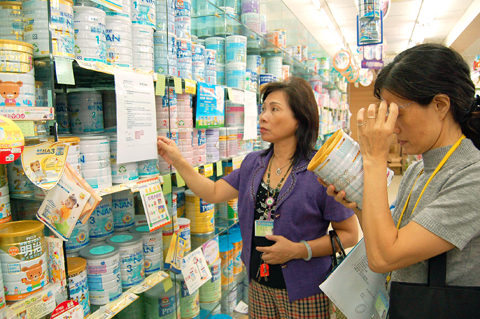
PHOTO: WU HSING-HUA, TAIPEI TIMES
“Although there’s a Government Information Disclosure Act [政府資訊公開法], it’s poorly executed,” he said. “I think the melamine scare is a good opportunity to push for more transparency.”
In a statement released by Happy Mobs, it asked the government to release “complete and clear records of all expert meetings — where the numbers came from and why some numbers were chosen but not others.”
“We would like to urge the government to come up with a set of standard food testing procedures, not an ambiguous ‘non-detectable’ standard,” it said. “We would also like to ask the government to allow concerned civic groups to participate in meetings and the policy-making process.”
Meanwhile, Tseng Chao-ming (曾昭明), founder of Corporate Social Responsibility Taiwan, called on food companies to fulfill their responsibilities by making public detailed information about their products, including where all the raw materials come from.
However, unlike more conventional civic groups, members of Happy Mobs do not meet face-to-face to discuss issues — many of them do not even know who their peers are.
Instead, they use a forum-like online platform to plan actions or compose common statements.
Each member posts the statements on their own blogs or forwards them to friends via e-mail.
So far, 657 blogs are participating in the campaign against melamine, which is just the latest issue Happy Mobs has taken on.
“We are a group of bloggers who are concerned about public issues. We’ve actually initiated other campaigns for the preservation of Losheng Sanatorium and environmental issues, and advocated support for the Green Party Taiwan [in the legislative elections],” said Daphne Hu (胡慕情), one of the bloggers.
“The advantage of an online campaign is that it is not limited by place or time and is a good way for those who may not have other channels to express their thoughts,” Hu said.
“I don’t expect the government to respond to us right now, but we want to accumulate enough sway to show the government what the public is thinking,” she said. “And if the government doesn’t want to listen to us, we may just have to solve that with a change of government.”
Happy Mobs discussions are open to the public and accessible by joining groups.google.com.tw/group/happymobs.

NATIONAL SECURITY: Authorities are working to confirm the identities of the military personnel involved and investigating possible illegal conduct and regulatory violations Authorities are probing possible national security implications after Kinmen police and immigration officers on Sunday found a Chinese woman allegedly posing as a tourist while engaging in prostitution involving more than 10 military personnel. The woman, surnamed Chen (陳), has since been deported, authorities said, adding that investigators are still working to confirm the identities of those implicated, as the records only listed code names and aliases. The case stemmed from a report received by the Kinmen District Prosecutors’ Office on Friday last week from the Jinhu Precinct of the Kinmen County Police Bureau. On Sunday, police, along with the National Immigration

GLOBALGIVING: ‘ Caving to external pressure is not acceptable for an organization that has cultivated justice reform and human rights for 30 years,’ one NGO said A slew of non-government organizations (NGOs) have withdrawn from the GlobalGiving fundraising platform after it announced it would use “Chinese Taipei” instead of “Taiwan” from next month. The Taiwan Good Rice Association wrote on Facebook on Friday that it was informed on April 28 via a teleconference call of the change, which was made because the platform wanted to operate in China. Taiwan Good Rice is to terminate all cooperative relationships with GlobalGiving in response to the platform’s “unilateral and non-negotiable” decision to remove references to Taiwan, the NGO said. “Taiwan is in the official name of Taiwan Good Rice Association and the

HEAVY WEATHER: Typhoon Jangmi is due to crash straight into the Ryukyus as airlines look to shift flights to larger aircraft or cancel flights to Okinawa entirely Taiwan’s international air carriers announced flight adjustments over the weekend as Typhoon Jangmi is forecast to hit the Ryukyu Islands today and tomorrow. The Central Weather Administration (CWA) upgraded Jangmi from a tropical storm to a typhoon at 8am yesterday, with the eye located 580km south of Naha city. It was moving north at 19kph. Today, China Airlines’ CI-120, CI-121, CI-122 and CI-123 flights between Taoyuan and Naha, Okinawa, have been canceled as well as CI-132 and CI-133 between Kaohsiung and Naha. EVA Air’s BR-112, BR-113, BR-186 and BR-185 flights between Taoyuan and Naha are also canceled. Low-cost carrier Tigerair Taiwan canceled IT-230,

Chinese Nationalist Party (KMT) Chairwoman Cheng Li-wun (鄭麗文) yesterday briefed her party’s Central Standing Committee regarding her scheduled visit to the US between Monday next week and June 16, saying that her purpose would be to persuade the US that the Republic of China (ROC) Constitution was a “one China” constitution that would foster stable and peaceful cross-strait relations. The ROC Constitution is the most important defense for all Taiwanese citizens, as it upholds our democracy and has contributed to our robust economy, which aligns with international and US interests, she said. “We would not be troublemakers and drag the US under,”


 RSS
RSS