


China’s strong economy appeared to put the nation on the global high ground when the financial tsunami first struck last month, but as the storm continues to rage, that position is looking less sure.
After five years of annual double digit economic growth, and with more than US$1.9 trillion in foreign reserves as well as a closed financial system that protected it from toxic US assets, China seemed insulated from the crisis.
But with thousands of workers already being laid off as exports shrink, the property market slowing and the stock market low on confidence, the world’s fourth biggest economy is clearly starting to hurt amid the global downturn.
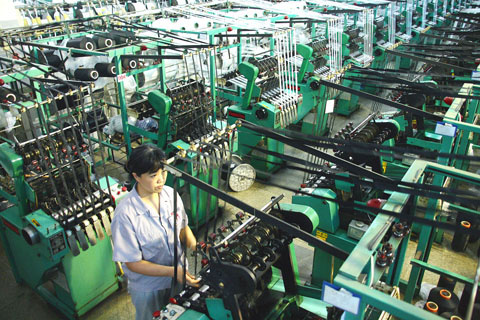
PHOTO: AFP
“People are starting to see the pain, that is in business and also in the labour market. It’s not as easy to get a job as it was a few months ago,” Beijing-based World Bank economist Louis Kuijs said.
“The bigger the economic crisis — the recession in the US and in Europe — the more it will be felt in China,” he said.
China’s leaders, for their part, have said the country’s best strategy is to keep the economy growing.
“If a large country of 1.3 billion people can keep up stable and relatively fast economic growth, that’s a big contribution to the world,” Chinese Premier Wen Jiabao (溫家寶) said.
China will release its third quarter GDP figure today.
China’s GDP growth is expected to shrink to 9.1 percent in the third quarter from 10.1 percent in the second, a forecast by Goldman Sachs said.
If accurate, it would mark the first time China’s quarterly GDP growth has fallen below 10 percent since the end of 2005.
But a fall in the third quarter figure would mostly reflect government policies to moderate growth, Goldman Sachs said, not the US crisis.
Morgan Stanley predicts full-year GDP growth will shrink to 9.8 percent and to 8.2 percent next year — still above Beijing’s official 8.0 percent target.
However, if property markets melt down across the country, the economy could see a hard landing with GDP growing less than 7 percent, Morgan Stanley said. Its economists estimate there is about a one in four chance of that.
Independent Shanghai-based economist Andy Xie (謝國忠) is more pessimistic, saying a property crash is imminent because prices are too high and developers have borrowed heavily and built too much.
He points to Guangdong Province where property prices have already crashed.
The booming city of Shenzhen has experienced one of the deepest corrections, with prices down 40 percent in August from a peak a year earlier.
“The economy is going to go through a rough patch. All these bubbly things are going to bounce back on people,” he said.
Officials said last week that industrial output growth in the Shanghai metropolitan area slowed to 6 percent on year in September, compared with an average of 11.5 percent on year growth for the first three quarters.
And exporters, who accounted for 40 percent of China’s GDP last year, are already being hit hard.
In one of the highest-profile examples, a toy maker that sold to US giants Mattel and Disney announced last week it had gone bust due to the global economic crisis, leaving up to 7,000 people jobless.
Exporters across a wide range of industries are increasingly voicing pessimism about their immediate futures.
Analysts widely expect China’s leaders will speed up infrastructure projects around the country to stimulate the economy in a downturn, as well as push ahead with their long-term plans to boost domestic consumption.
The Ministry of Finance has 2.7 trillion yuan (US$400 billion) deposited in the central bank to help fund a stimulus package, Standard Chartered economist Stephen Green wrote in a research note.
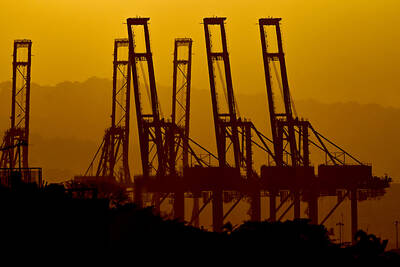
A subsidiary of a Hong Kong-based company that has lost control of two critical ports on the Panama Canal said it is seeking US$2 billion of compensation in damages from Panama over its “illegal” takeover of the ports. Panama Ports Co, a unit of Hong Kong’s CK Hutchison Holdings (長江和記實業), on Friday said in a statement that it is demanding the sum under international arbitration proceedings that it had already started. The Panamanian government last week seized control of the Balboa and Cristobal ports on each end of the Panama Canal, after the country’s Supreme Court declared earlier that a concession allowing
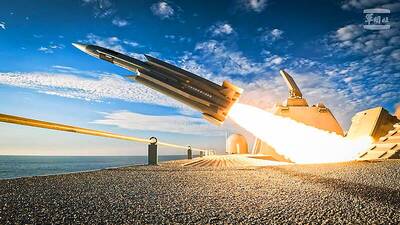
DETERRENCE: With 1,000 indigenous Hsiung Feng II and III missiles and 400 Harpoon missiles, the nation would boast the highest anti-ship missile density in the world With Taiwan wrapping up mass production of Hsiung Feng II and III missiles by December and an influx of Harpoon missiles from the US, Taiwan would have the highest density of anti-ship missiles in the world, a source said yesterday. Taiwan is to wrap up mass production of the indigenous anti-ship missiles by the end of year, as the Chungshan Institute of Science and Technology has been meeting production targets ahead of schedule, a defense official with knowledge of the matter said. Combined with the 400 Harpoon anti-ship missiles Taiwan expects to receive from the US by 2028, the nation would have

POSSIBILITIES EMERGE: With Taiwan’s victory and Japan’s narrow win over Australia, Taiwan now have a chance to advance if South Korea also beat the Aussies Taiwan has high hopes that the national baseball team would advance to the World Baseball Classic (WBC) quarter-finals after clinching a crucial 5-4 victory over South Korea in a nail-biting extra-inning game at the Tokyo Dome yesterday. Boosted by three home runs — two solo shots by Yu Chang (張育成) and Cheng Tsung-che (鄭宗哲) and a two-run homer by Stuart Fairchild — the triumph gave Taiwan a much-needed second victory in the five-team Pool C, where only the top two finishers would advance to the knockout stage in Miami, Florida. Entering extra innings with the game tied at four apiece, Taiwan scored
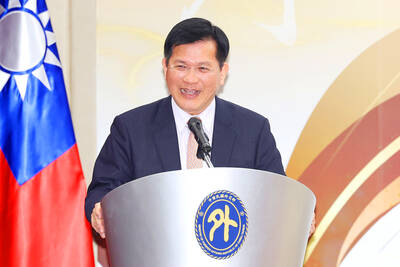
MISSION OF PEACE: The foreign minister urged Beijing to respect Taiwan’s existence as an independent nation, and work together to ensure peace and stability in the region Minister of Foreign Affairs Lin Chia-lung (林佳龍) yesterday rejected Chinese Minister of Foreign Affairs Wang Yi’s (王毅) comments about Taiwan, criticizing China as a “troublemaker” in the international community and a disruptor of cross-strait peace. Speaking at a news conference on the sidelines of the Chinese National People’s Congress, Wang said that Taiwan has always been a territory of China and that it would be impossible for it to become its own country. The “return” of Taiwan to China was the natural outcome of the Chinese people’s resistance against Japan in World War II, and that any pursuit of independence was “doomed


 RSS
RSS