


The accessory of choice in the New York fashion shows of last week was, apparently, a campaign badge for one political party; or the other one, depending on your point of view. One well-regarded stylist, Mary Alice Stephenson, had a Bush/Cheney pin on her list of What Not to Wear. But it's safe to say that, were the Bush twins to turn up to any shows with or without a dad pin, they wouldn't have been turned away.
Both US President George W. Bush and Senator John Kerry have made substantial use of their pretty offspring in the battle for the hearts and minds of voters who can't be bothered to read a manifesto -- the Kerry daughters feature in a shoot for this month's Vogue; the Bush twins have already been there and done that.
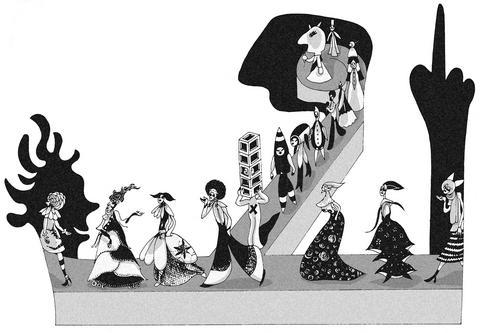
ILLUSTRATION MOUNTAIN PEOPLE
Politicians will line up behind anything that might give voters a warm, fuzzy feeling. They care not for the likely political leanings of their photo-companions -- they'll use babies, dogs, horticulture, fish-and-chip shops.
There's an interesting comparison to be drawn here with royals, who will mainly only use children for PR purposes if they're terminally ill, and save their big photo-opportunity smiles for posing behind a beer pump in a pub.
Anyway, suffice it to say that Bush and Kerry will be equally delighted by fashionista support, and, lagging 10 points behind, Kerry must be glad that his daughters got the modishly lanky genes, a nice contrast to the Bush family legacy of we-look-like-people-who-enjoy-a-drink-or-two.
But just for future fashion week/election crossovers, it might divert us to nail down which party is the most fashionable, to avoid those shaming accessory errors. Socially, Bush-era Republicanism is as unfashionable as it's possible for a political position to be. Interestingly, although fashion has a reputation as one of the flightiest and most changeable of cultural forms, it has actually stuck resolutely to a liberal social agenda.
Abstinence and celibacy cults have taken hold in much of American culture: pop stars preach virginity; the largely rightwing news media report on organizations like True Love Waits with admiration rather than bafflement. Yet the sexual politics of the fashion industry have remained basically unchanged since the 1960s.
Where primness pops up, it is ironic. The music and film industries tend to use nudity cynically and misogynistically. It will only be required of young women; they will then feel compelled to launch self-justifications, in the style of the evangelical Beyonce, who defended her skimpy outfits with the remark: "I honestly believe He [God] wants people to celebrate their bodies -- as long as you don't compromise your Christianity in the process."
Fashion has a much more bohemian attitude toward bare flesh, admiring it equally from men and women, never grubbying itself with a side-order of 1950s morality. Homophobia, likewise, is anathema to the industry.
People have detected a dodgy attitude toward women in the fact that models have to be so thin, but that's about no more than the line of the garment -- the men have to be thin as well.
All models have to look perfect for clothes. There's no malicious subtext.
The emphasis of couture is on iconoclasm and originality, which would also be at odds with any conservative agenda. And yet, at the same time, it can be read as the most capitalistic cultural form there is. Its sine qua non is that newness is valuable for no better reason than that it is new.
It relies on reckless consumption, since the very nature of the changing seasons is entirely unrelated to weather, addressing itself instead to the utterly strange idea of six-month-old items being passe, ergo worthless.
No other industry pursues acquisition so baldly as an end in itself, nor relies so totally on obsolescence as a given, regardless of whether the product in question is broken or has an egg stain on it.
Of all the strands of culture, fashion probably has the purest and least abashed relationship with capitalism. This is what makes it so irritating when it borrows the imagery and language of civil rights and/or leftist movements in its advertising; not the fact that clothes are trivial and rights aren't, rather the fact that it panders to our basest instincts, the rotten core of us that makes us want to spend a lot on some teal boots and too bad for the family that could live on that for a month.
In conclusion, then, a Bush badge is too conservative to be fashionable. A Ralph Nader badge is too hypocritical to be fashionable. Had Howard Dean won the democratic leadership, he'd be too left-wing. The triangulated, socially liberal but politically centrist views of Kerry -- and, should an election ever bisect London Fashion Week, British Prime Minister Tony Blair -- dovetail perfectly with what's in vogue. Just remember, no carbs at the after-show parties.
From the Iran war and nuclear weapons to tariffs and artificial intelligence, the agenda for this week’s Beijing summit between US President Donald Trump and Chinese President Xi Jinping (習近平) is packed. Xi would almost certainly bring up Taiwan, if only to demonstrate his inflexibility on the matter. However, no one needs to meet with Xi face-to-face to understand his stance. A visit to the National Museum of China in Beijing — in particular, the “Road to Rejuvenation” exhibition, which chronicles the rise and rule of the Chinese Communist Party — might be even more revealing. Xi took the members
The Chinese Nationalist Party (KMT) and the Taiwan People’s Party (TPP) on Friday used their legislative majority to push their version of a special defense budget bill to fund the purchase of US military equipment, with the combined spending capped at NT$780 billion (US$24.78 billion). The bill, which fell short of the Executive Yuan’s NT$1.25 trillion request, was passed by a 59-0 margin with 48 abstentions in the 113-seat legislature. KMT Chairwoman Cheng Li-wun (鄭麗文), who reportedly met with TPP Chairman Huang Kuo-chang (黃國昌) for a private meeting before holding a joint post-vote news conference, was said to have mobilized her
Before the Chinese Communist Party (CCP) and its People’s Liberation Army (PLA) can blockade, invade, and destroy the democracy on Taiwan, the CCP seeks to make the world an accomplice to Taiwan’s subjugation by harassing any government that confers any degree of marginal recognition, or defies the CCP’s “One China Principle” diktat that there is no free nation of Taiwan. For United States President Donald Trump’s upcoming May 14, 2026 visit to China, the CCP’s top wish has nothing to do with Trump’s ongoing dismantling of the CCP’s Axis of Evil. The CCP’s first demand is for Trump to cease US
As artificial intelligence (AI) becomes increasingly widespread in workplaces, some people stand to benefit from the technology while others face lower wages and fewer job opportunities. However, from a longer-term perspective, as AI is applied more extensively to business operations, the personnel issue is not just about changes in job opportunities, but also about a structural mismatch between skills and demand. This is precisely the most pressing issue in the current labor market. Tai Wei-chun (戴偉峻), director-general of the Institute of Artificial Intelligence Innovation at the Institute for Information Industry, said in a recent interview with the Chinese-language Liberty Times


 RSS
RSS