

The crisis of American power that has been building since the Twin Towers attacks is close to a point of no return. The bombs which brought havoc to Baghdad and Jerusalem last week and the likely collapse of the ceasefire in the Holy Land illustrate how unsteady the American hand is in the Middle East. Great enterprises demand great qualities. While the US has certainly not yet failed in Iraq, Afghanistan and the Holy Land, and has some achievements, ultimate success depends on it showing a new determination and clarity.
The Americans have been slow -- slow to act and slow witted; slow to discard the assumption that Iraq and Afghanistan could easily be restored to normality after their regimes were destroyed; slow to set aside ideological preconceptions; and slow to grasp, if they have grasped at all, the deviousness of their Israeli ally.
That slowness has allowed Islamic extremists to move into Iraq, in what force it is not yet known, but it would be prudent to assume it is substantial. That slowness has allowed Afghanistan to slip into a political limbo, half a real state and half a collection of dubious chieftaincies, in which, again, extremists can not only survive but pose a real threat to the country's future.
ILLUSTRATION: MOUNTAIN PEOPLE
That slowness has given the government of Prime Minister Ariel Sharon in Israel room to manipulate the "road map", a plan for peace which took an unconscionably long time to emerge. The fact that the bombs came on the same day, and shortly after serious Taliban attacks in Afghanistan, was fortuitous. But it is a reminder of how closely events in these three places are linked, much more closely than when the US used to make play with "arcs of crisis" running from the Horn of Africa to Pakistan.
This time the crisis is as American as it is regional. It would not have unfolded in this way had the US not intervened in Afghanistan and Iraq, and resumed its attempts to manage the conflict between Israelis and Palestinians, and if its interventions had not then faltered.
There is a natural tendency to assume that everything would be better if the US would give the UN, its allies and the international community generally more say in all three situations. Should not the Baghdad tragedy, especially, shock the US and the UN into a more equal partnership in Iraq? But America and the UN, as well as other actors like the EU, cannot shed their differences so easily. Already the interpretations of this week's attacks are showing a familiar divergence. For US President George W. Bush, the bombs show that allies who have so far been unwilling to offer much help must now stand up and be counted in a war against those who would destroy civilization.
For most leaders elsewhere in the world, the bombs demonstrate that America is in trouble, in part because of mistakes it insisted on making in spite of much advice, and that it is still not ready to change its attitude or policy. That does not mean that they think that America will not ultimately prevail. But their impulse may be, as nations, and insofar as they influence the UN, to limit their own exposure to the difficulties of Iraq.
The real danger is that such an impulse will be paralleled by a similar American readiness to contemplate retreat. Certainly the political pressures on the Bush administration are growing. That would be the worst of both worlds, an America striving to cut its losses by "internationalizing" and an international community unwilling to assume fully the burden.
Important as Iraq is, the most urgent aspect of this American crisis is in Israel and Palestine. Unless the US faces up to the fact that Sharon and Defense Minister Shaul Mofaz have been working to undermine the remarkable accord between Palestinian factions which has recently brought a period of relative peace to the Holy Land, a complete breakdown is entirely possible.
The Sharon government sees the road map as an instrument for the disarmament and political extinction of all radical groups and parties among the Palestinians. The peace process as it worked out on the Palestinian side instead brought a deal likely to preserve those groups on the basis that they suspended armed action. The Americans seemed to half recognize that, although no such deal had been envisaged by the road map, it was, in fact, a realistic basis on which to proceed.
The Israeli government, on the other hand, was enraged that its plan to bring about the political and military demise of the radicals was being derailed. It clearly determined to provoke Hamas and Islamic Jihad by assassinating their leaders, even though the two had called off their attacks. As surely as the suicide bomber himself, Sharon and Mofaz were responsible for the deaths and injuries in the Jerusalem bus attack this week, and now by their incursions and yet another assassination they may well have destroyed the Palestinian ceasefire.
Bush and US Secretary of State Colin Powell should act with speed and vigor. Deploring the loss of life, blaming both sides and endorsing the Israeli right to respond to attacks will not do. They need to pin the responsibility where it belongs, on the Sharon government, and prevent a new round of attacks. Unpalatable though such pressure on Israel may be to this administration, it is vital to exert it if America's larger purposes are to be served. Progress toward a settlement in the Holy Land is not a panacea which will end terrorism. But lack of progress, or, worse, the abandonment of the effort to achieve it, would undoubtedly feed the growth of terrorism, and that now includes a threat to America, and anybody associated with America, in Iraq. Even if those who bombed the UN were Saddamists rather than Islamists, the two may have a common cause. Sharon, in other words, endangers American troops and American purposes in the largest and boldest of its undertakings abroad.
Pity the poor Iraqis. They did not deserve to be delivered from former Iraqi president Saddam Hussein only to find themselves on the front line of a war between America and Arab extremists, especially the Islamist terrorists who were the one malign force from which seclusion under dictatorship had preserved them. One bomb does not yet indicate that fate, but the possibility undoubtedly looms.
The Americans now need Iraqi help as much as Iraqis ever needed American help, because the most effective policing has always been self policing. Indeed, the Americans need help from all quarters but, above all, they need to help themselves.
The Bush administration embarked on these interventions with the expectation that their own political interests, preferences and prejudices could be paramount in all the choices they would have to make. That is an illusion which they must shed, above all in dealing with the conflict in the Holy Land.
Taiwan’s democracy and high-tech economy play a crucial role in global affairs and are central to the world’s embrace of a raft of next-generation technologies, including AI. It is underpinned by a security relationship with the United States that’s existed in several iterations since 1949 and the Chinese Nationalist Party’s (KMT) retreat from China. A central pillar of that security relationship is the American willingness to sell arms to Taiwan. Indeed, since 1979 it has been embedded in US law, with the Taiwan Relations Act (TRA) charging the US with helping to improve the island’s ability to deter an attack from
Academia Historica director Chen Tsui-lien (陳翠蓮), speaking at the handover ceremony for her new role on Monday, said that when she accepted the position, she knew that her peaceful life as a history professor was a thing of the past, and that from now on she would have to “wear a helmet.” A specialist in Taiwan’s post-World War II history and the 228 Incident, she has been accused of being politically divisive. A phrase she used in her acceptance speech set headlines alight this week, putting her in the sights of editorials in blue-leaning media. She said opposition figures calling for
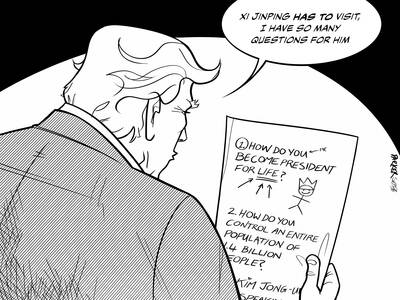
EDITORIAL CARTOON
Taiwanese-Americans, lawmakers and civic groups marched through Manhattan on Saturday last week in support of Taiwan’s participation in the UN. Marshall Islands Permanent Representative to the UN John Silk joined the demonstration, saying he hoped Taiwan would one day be able to participate in UN meetings as a member, and Democratic Progressive Party Legislator Wang Yi-chuan (王義川) took part while visiting New York City with a delegation. Taiwanese communities in Vancouver held a “UN for Taiwan” event. The campaign comes as the 81st UN General Assembly gets under way. In Taipei, President William Lai (賴清德) said China was deliberately misinterpreting UN


 RSS
RSS