


Some of the coffee world’s most discerning palettes came together in the heart of Brazil’s coffee belt on Friday to judge which brews in the world’s top grower are best for an expanding specialty market.
After hours of painstaking swilling, spitting and note making this week, judges at the Brazilian round of the international Cup of Excellence competition whittled the field down to 11 finalists from 56 entries.
The judges said the quality of Brazilian coffee had improved this year despite a wet harvest period that spoiled large quantities of produce in the world’s top grower.
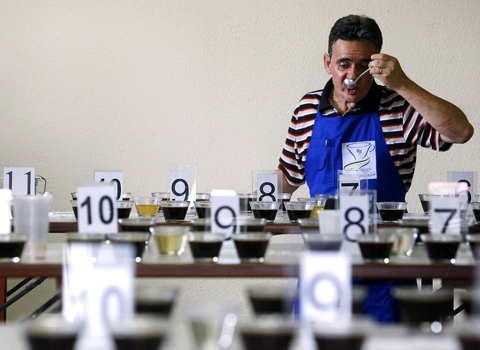
PHOTO: REUTERS
“I honestly think the quality is much better this year. A lot of people told me quality would be lower because of the rains, but the top-tier coffees are presenting much better characteristics than in other years,” chief judge Erwin Mierisch said.
Cup of Excellence, sponsored in Brazil by the export promotion agency APEX, holds annual competitions to seek South and Central America’s best produce. It aims to expand the market for high quality coffee to give growers the incentive to produce better beans.
Begun a decade ago to counter the perception that Brazil had little to offer beyond its large supply of bulk coffee, it has spread to other producers in the region. East African nation Rwanda now also takes part.
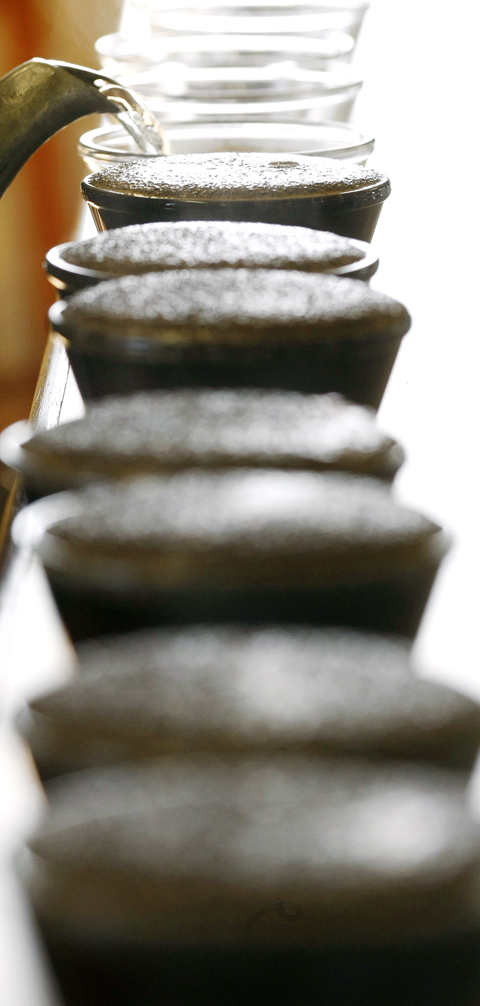
PHOTO: REUTERS
Judges paced up and down with silver spoons, sampling the line of coffees, each of which had been roasted for the same time and at the same temperature and ground in a machine cleaned repeatedly to avoid contamination. Their faces gave nothing away as they made notes in silence before moving on to the next sample.
“I immediately spotted one which was outstanding. I gave it a 97 score,” out of a possible 100, said Vytautas Kratulis, director of Sviezia Kava, a roaster in Lithuania after the cupping process ended.
He also preferred this year’s coffees over last year’s. Still, he said he expected quality coffee would be in shorter supply in his country this year and at higher costs. The global economic crisis has hit Baltic states particularly hard, making Lithuanian coffee drinkers reluctant to pay premium prices.
Judges drifted out of the sampling room, mouths tired after forcefully drawing coffees dozens of times from the spoon with loud rasps, and congregated to discuss the qualities of each entry.
Numbers eight and 11 emerged as two potential winners. Judges compared their flavors to fruits like pineapple or red berries, while others were more often likened to chocolate or savory flavors like butter.
Judges laughed as one peer described a coffee as having a “taco” taste and another’s acidity as “polite, not aggressive.”
Coffee number eight emerged a fraction of a point ahead of 11 at the award ceremony on Friday night. The grower, Candido Rosa, was from Bahia in the northeast, a hotter, drier state than where most of the moisture-loving trees grow in Brazil.
He was presented with a plaque made with coffee beans.
Japanese coffee roaster Yuko Itoi, who has traveled to other rounds of the contest in Nicaragua, Colombia, Bolivia and Guatemala as well as Brazil this year, said the Cup of Excellence label was increasingly recognized back at home.
“Little by little, we can now see Cup of Excellence coffee in famous department stores and coffee stores,” she said.
Japan is often one of the main buyers in the online auctioning of the winning and runner up coffees in the Brazilian round, which will take place on Jan. 19.
Itoi said Japanese consumers had a soft spot for Brazilian coffee, even though not an elite origin like Colombia or Guatemala, because their countrymen had helped make Brazil into the world’s biggest producer.
“For Japan, Brazil coffee has a very special position because we immigrated 100 years ago” to farm it in Brazil, she said.
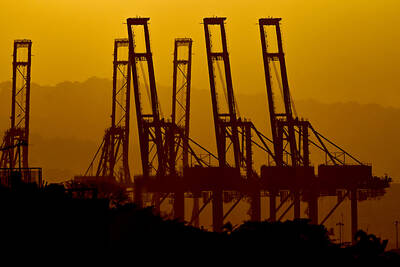
A subsidiary of a Hong Kong-based company that has lost control of two critical ports on the Panama Canal said it is seeking US$2 billion of compensation in damages from Panama over its “illegal” takeover of the ports. Panama Ports Co, a unit of Hong Kong’s CK Hutchison Holdings (長江和記實業), on Friday said in a statement that it is demanding the sum under international arbitration proceedings that it had already started. The Panamanian government last week seized control of the Balboa and Cristobal ports on each end of the Panama Canal, after the country’s Supreme Court declared earlier that a concession allowing
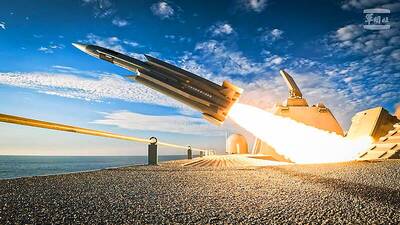
DETERRENCE: With 1,000 indigenous Hsiung Feng II and III missiles and 400 Harpoon missiles, the nation would boast the highest anti-ship missile density in the world With Taiwan wrapping up mass production of Hsiung Feng II and III missiles by December and an influx of Harpoon missiles from the US, Taiwan would have the highest density of anti-ship missiles in the world, a source said yesterday. Taiwan is to wrap up mass production of the indigenous anti-ship missiles by the end of year, as the Chungshan Institute of Science and Technology has been meeting production targets ahead of schedule, a defense official with knowledge of the matter said. Combined with the 400 Harpoon anti-ship missiles Taiwan expects to receive from the US by 2028, the nation would have

POSSIBILITIES EMERGE: With Taiwan’s victory and Japan’s narrow win over Australia, Taiwan now have a chance to advance if South Korea also beat the Aussies Taiwan has high hopes that the national baseball team would advance to the World Baseball Classic (WBC) quarter-finals after clinching a crucial 5-4 victory over South Korea in a nail-biting extra-inning game at the Tokyo Dome yesterday. Boosted by three home runs — two solo shots by Yu Chang (張育成) and Cheng Tsung-che (鄭宗哲) and a two-run homer by Stuart Fairchild — the triumph gave Taiwan a much-needed second victory in the five-team Pool C, where only the top two finishers would advance to the knockout stage in Miami, Florida. Entering extra innings with the game tied at four apiece, Taiwan scored
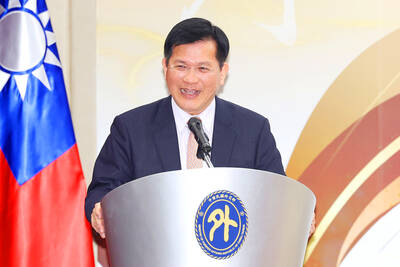
MISSION OF PEACE: The foreign minister urged Beijing to respect Taiwan’s existence as an independent nation, and work together to ensure peace and stability in the region Minister of Foreign Affairs Lin Chia-lung (林佳龍) yesterday rejected Chinese Minister of Foreign Affairs Wang Yi’s (王毅) comments about Taiwan, criticizing China as a “troublemaker” in the international community and a disruptor of cross-strait peace. Speaking at a news conference on the sidelines of the Chinese National People’s Congress, Wang said that Taiwan has always been a territory of China and that it would be impossible for it to become its own country. The “return” of Taiwan to China was the natural outcome of the Chinese people’s resistance against Japan in World War II, and that any pursuit of independence was “doomed


 RSS
RSS