


Though the US is still the world's leading oil consumer, its might in the global petroleum business is dwindling.
Developing countries are locking up a bigger share of the world's oil and gas resources to profit from high prices and fuel industrial growth. Some experts view the shift as an emerging threat to the US economy, while others see benefits for consumers, saying an expanding list of suppliers diminishes the impact of any single disruption.
Still others see the shift simply as a reflection of globalization, whereby emerging economies lean on rising financial strength and technological know-how to become tougher competitors.
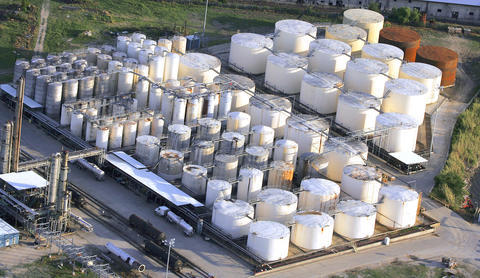
PHOTO: AP
New research by investment bank Goldman Sachs suggests four countries in particular -- Brazil, Russia, India and China, or the so-called BRIC countries -- are grabbing the most market share from US companies. The BRIC's share of the industry's market value has grown from virtually nothing 15 years ago to more than one third today, while US companies' stake has dwindled from more than half to less than a third.
The biggest factor, most analysts agree, is the growth of state-controlled national oil companies, including PetroChina Ltd, an arm of China National Petroleum Corp; Russia's OAO Gazprom, the world's biggest natural gas producer; and Brazil's Petroleo Brasileiro SA, or Petrobras. And the high price of oil -- crude futures finished Friday close to US$73 a barrel -- is playing a big role in their expansion plans.
China National Petroleum Corporation (CNPC, 中國石油天然氣) last week acquired rights to search for oil in Canada. India's state-owned oil company, Oil and Natural Gas Corp divulged plans last month to expand in Brazil. And in May the Venezuelan government took majority control of its last privately run oil projects, part of a resource nationalization strategy also being pursued by Russia.
trend
Whether this trend is bad for the US' long-term strategic interests is debated by analysts and executives.
Daniel Yergin, author of The Prize, the Pulitzer Prize-winning history of the oil industry, said it's time to acknowledge what's been evolving for years: US oil companies simply don't have the clout they did a decade or two ago, and it's not necessarily a bad thing.
"A lot of our energy debate harkens back to a world when we were much more self sufficient and doesn't take into account the reality of how integrated we are into a much larger and complex global marketplace," Yergin said.
Exxon Mobil Corp remains the world's largest publicly traded oil company, and its US$39.5 billion profit last year was a record for US companies. Yet the Irving, Texas-based company pumped just 3 percent of the world's oil last year. National oil companies, which control almost 90 percent of global oil reserves, produced the bulk of the world's supply.
ConocoPhillips chairman Jim Mulva said the global petroleum hunt has become very competitive due in part to the rising influence of the BRIC countries, though he stopped short of calling them dominant. After all, the US' daily oil consumption of about 21 million barrels dwarfs that of the BRIC countries, whose combined daily use last year was about 15 million barrels, according to the US Energy Department.
Still, Mulva credited China and India with creating energy policies focused on keeping their economies expanding -- something he believes the US sorely lacks.
"When energy prices increase, we tend to place blame and not address the real issue: that is, how are we going to develop a long-term energy plan that stresses conservation, additional resources, technology and diversification versus the unrealistic expectation of independence," said Mulva, whose company operates in more than 40 countries and posted a record annual profit of US$15.5 billion last year.
Jerry Taylor, an energy analyst at the Cato Institute, a free-market oriented think tank, said the trend documented in the Goldman Sachs report doesn't necessarily make the US more vulnerable. Governments have rarely used the so-called "oil weapon" by cutting off supplies to other markets, he said. If they did they'd risk hurting themselves, due to lost revenue, more than they'd hurt the US, he added.
reasons
Goldman Sachs cites several reasons for the US' declining role, such as the growth of production outside of North America and Europe and consolidation, including BP PLC's acquisitions of US companies Amoco and Arco.
At the end of the first Gulf War in 1991, slightly more than half of the 20 largest companies in the energy industry by market capitalization were US, while less than half were European, according to the Goldman Sachs' study. Now, BRIC countries and Europe account for more than two-thirds of the companies, while American countries make up less than a third.
Antoine Halff, head of energy research at Fimat USA LLC, said the shift, driven mainly by the energy needs of the BRIC countries themselves, has its benefits. As more countries boost their production of oil and gas, hurricanes, terror attacks, pipeline accidents and other disruptions have less impact on the worldwide supply chain -- and on prices for consumers.
But others see longer term risks to the US relying too much on energy resources other nations control.
"Energy is beginning to look like a political weapon, and countries that have access to resources are sitting very pretty," said Fadel Gheit, an analyst at Oppenheimer & Co.
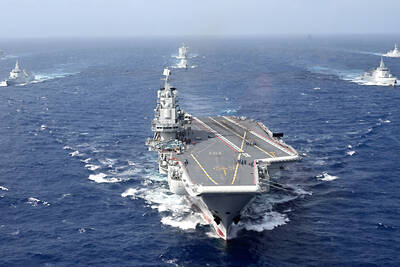
PROVOCATIVE: Chinese Deputy Ambassador to the UN Sun Lei accused Japan of sending military vessels to deliberately provoke tensions in the Taiwan Strait China denounced remarks by Japan and the EU about the South China Sea at a UN Security Council meeting on Monday, and accused Tokyo of provocative behavior in the Taiwan Strait and planning military expansion. Ayano Kunimitsu, a Japanese vice foreign minister, told the Council meeting on maritime security that Tokyo was seriously concerned about the situation in the East China and South China seas, and reiterated Japan’s opposition to any attempt to change the “status quo” by force, and obstruction of freedom of navigation and overflight. Stavros Lambrinidis, head of the EU delegation to the UN, also highlighted South China Sea

The final batch of 28 M1A2T Abrams tanks purchased from the US arrived at Taipei Port last night and were transported to the Armor Training Command in Hsinchu County’s Hukou Township (湖口), completing the military’s multi-year procurement of 108 of the tanks. Starting at 12:10am today, reporters observed more than a dozen civilian flatbed trailers departing from Taipei Port, each carrying an M1A2T tank covered with black waterproof tarps. Escorted by military vehicles, the convoy traveled via the West Coast Expressway to the Armor Training Command, with police implementing traffic control. The army operates about 1,000 tanks, including CM-11 Brave Tiger
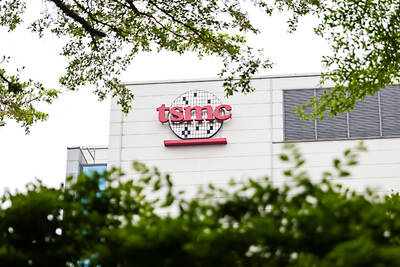
Taiwan Semiconductor Manufacturing Co (TSMC, 台積電), the world’s largest contract chipmaker, said it expects its 2-nanometer (2nm) chip capacity to grow at a compound annual rate of 70 percent from this year to 2028. The projection comes as five fabs begin volume production of 2-nanometer chips this year — two in Hsinchu and three in Kaohsiung — TSMC senior vice president and deputy cochief operating officer Cliff Hou (侯永清) said at the company’s annual technology symposium in Silicon Valley, California, last week. Output in the first year of 2-nanometer production, which began in the fourth quarter of last year, is expected to
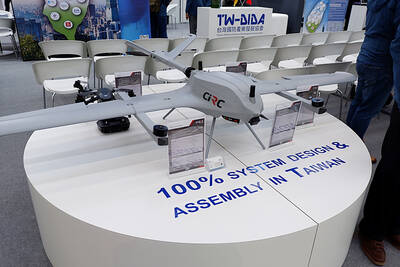
Taiwan’s drone exports surged past US$100 million in the first quarter, exceeding last year’s full-year total, with the Czech Republic emerging as the largest buyer, the Ministry of Economic Affairs said. Exports of complete drones reached US$115.85 million in the period, about 1.2 times the total recorded for all of last year, the ministry said in a report. Exports to the Czech Republic accounted for about US$100 million, far outpacing other markets. Poland, last year’s top destination, recorded about US$11.75 million in the first quarter. Taiwan’s drone exports have expanded rapidly in the past few years, with last year’s total


 RSS
RSS