


Bamboo is a versatile, ancient plant that shows up in creation myths as well as in pots on Manhattan terraces. It comes in clumping varieties that behave themselves and running "timber" types that spread by rhizomes -- great for a grove, but not so good when they are planted as a property screen that escapes into a neighbor's yard.
But it's that very vigor that has environmentalists hailing bamboo as the new "it" plant for saving the earth.
Bamboo is a workhorse at sequestering carbon dioxide and pumping out oxygen. It is a tough plant that manufactures its own antibacterial compounds and can thrive without pesticides. And its porous fibers make a cloth that breathes and is as soft as silk. In fact, there is such a stampede of fabric designers to China and Japan, where it is farmed and processed -- no such industry exists in the US -- that in its May issue, National Geographic predicted that "this upstart fabric may someday compete with King Cotton."
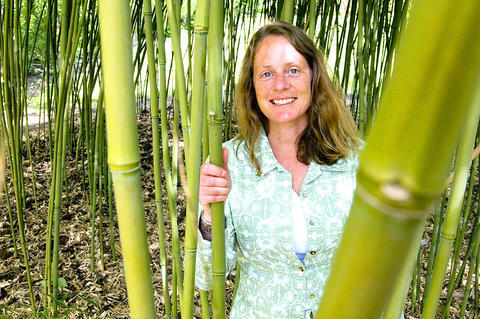
PHOTO: NY TIMES NEWS SERVICE
Yet as the world clamors for more, bamboo is in short supply. A plant that generally flowers only every 60 to 120 years and then dies is hard to propagate from seed. And growing it by dividing existing plants is notoriously difficult.
So when Jackie Heinricher and Randy Burr figured out how to make bamboo in test tubes -- selling their first 2,000 plants in 2004 to local garden centers in the Skagit Valley in Washington -- they made waves in the world of horticulture.
"It's funny, because bamboo has this reputation for taking over the universe, and yet it's the hardest plant to produce," Heinricher, a biologist, said one afternoon in early June at the production center for her company, Boo-Shoot Gardens, here in Mount Vernon, a town about two hours north of Seattle.
Heinricher, who grew up with bamboo -- her father tended golden bamboos all around their house in Olympia, Washington -- first tried to propagate the plant in the late 1990s in a little greenhouse at her home in nearby Anacortes, where she lives with her husband, Guy Thornburgh, a marine biologist, and where she founded Boo-Shoot Gardens in 1998.
"I got interested in noninvasive bamboos early on, knowing that they were very beautiful, but impossible to make," Heinricher said. She quickly realized just how impossible, as she tried to divide some of her own rare specimens and watched many die.
So she persuaded Burr, an owner of nearby B&B Laboratories, to help her. Burr and his company had been in business for almost 30 years, with a 1,300m2 tissue culture lab and 3,700m2 of greenhouses. B&B had pumped out plants as varied as rhododendrons and cauliflower, and had figured out how to tissue-culture the Boston fern in 1973, for a nursery in Oxnard, California, and thousands of other plants.
"But bamboo was the hardest," Burr said, looking back over eight years of trying seemingly endless combinations of variables to trigger bamboo to regenerate in a test tube.
When I asked what finally worked, Burr stared back deadpan and said: "We'd have to shoot you."
Bamboo fibers are a renewable resource for fabric, food and paper. And experimental plantings in Alabama financed by the Agriculture Department between 1933 and 1965 showed bamboo's promise for paper and other wood products -- bamboo produced 13 tonnes of wood an acre, as against seven for loblolly pine, a major source of timber in the US.
Planted in large groves, bamboo can store "four times the carbon dioxide of a stand of trees of similar size," Heinricher said, citing a study by Jules Janssen of the Technical University Eindhoven in the Netherlands, in 2000.
"And it releases 35 percent more oxygen," she said.
Many of these plants can now be produced on a vast scale, which is revolutionary for the garden industry. Countries like Belgium have explored the tissue-culturing of bamboo, but Boo-Shoots appears to be taking the lead.
In the old days, bamboo had to be divided and grown to marketable size in a cycle lasting three to five years. Now Monrovia and other growers can buy trays full of young plants from Boo-Shoots, which are potted up and sold as a finished product to other wholesalers and retail nurseries across the country.
Developing tissue culture is a time-consuming process, Burr explained, in which a tiny cutting is sterilized in bleach, then put into a soup, or agar, of inorganic salts, plant sugars, hormones, vitamins and "all the building-block components that encourage tissue to generate and shoot new growth." Getting that formula right can take years.
And the rooting stage is tricky, too. "We'd put out 10,000 plants and lose 10,000," Heinricher said.

NO HUMAN ERROR: After the incident, the Coast Guard Administration said it would obtain uncrewed aerial vehicles and vessels to boost its detection capacity Authorities would improve border control to prevent unlawful entry into Taiwan’s waters and safeguard national security, the Mainland Affairs Council (MAC) said yesterday after a Chinese man reached the nation’s coast on an inflatable boat, saying he “defected to freedom.” The man was found on a rubber boat when he was about to set foot on Taiwan at the estuary of Houkeng River (後坑溪) near Taiping Borough (太平) in New Taipei City’s Linkou District (林口), authorities said. The Coast Guard Administration’s (CGA) northern branch said it received a report at 6:30am yesterday morning from the New Taipei City Fire Department about a

IN BEIJING’S FAVOR: A China Coast Guard spokesperson said that the Chinese maritime police would continue to carry out law enforcement activities in waters it claims The Philippines withdrew its coast guard vessel from a South China Sea shoal that has recently been at the center of tensions with Beijing. BRP Teresa Magbanua “was compelled to return to port” from Sabina Shoal (Xianbin Shoal, 仙濱暗沙) due to bad weather, depleted supplies and the need to evacuate personnel requiring medical care, the Philippine Coast Guard (PCG) spokesman Jay Tarriela said yesterday in a post on X. The Philippine vessel “will be in tiptop shape to resume her mission” after it has been resupplied and repaired, Philippine Executive Secretary Lucas Bersamin, who heads the nation’s maritime council, said

REGIONAL STABILITY: Taipei thanked the Biden administration for authorizing its 16th sale of military goods and services to uphold Taiwan’s defense and safety The US Department of State has approved the sale of US$228 million of military goods and services to Taiwan, the US Department of Defense said on Monday. The state department “made a determination approving a possible Foreign Military Sale” to the Taipei Economic and Cultural Representative Office in the US for “return, repair and reshipment of spare parts and related equipment,” the defense department’s Defense Security Cooperation Agency said in a news release. Taiwan had requested the purchase of items and services which include the “return, repair and reshipment of classified and unclassified spare parts for aircraft and related equipment; US Government

More than 500 people on Saturday marched in New York in support of Taiwan’s entry to the UN, significantly more people than previous years. The march, coinciding with the ongoing 79th session of the UN General Assembly, comes close on the heels of growing international discourse regarding the meaning of UN Resolution 2758. Resolution 2758, adopted by the UN General Assembly in 1971, recognizes the People’s Republic of China (PRC) as the “only lawful representative of China.” It resulted in the Republic of China (ROC) losing its seat at the UN to the PRC. Taiwan has since been excluded from


 RSS
RSS