


A crew of former crab fishermen from Alaska has found a new livelihood in warmer and less dangerous waters off Hawaii, harvesting water from 915m below the surface to use in everything from beer to face creams.
The crew was hired by Deep Ocean Hawaii, a Honolulu-based company that is desalinating deep seawater aboard a vessel off Oahu and then marketing it as an ingredient free of impurities.
The company projects that it can become a US$50 million business in two years, eventually pumping 1.8 million liters of fresh deep seawater a day. It also hopes to develop its shipboard technology as an emergency source for drinking water.
In just a few years, deep seawater already has become Hawaii's biggest foreign export, with four other businesses shipping US$37 million worth of bottled seawater a year, mostly for sale in Japan for up to US$5 a bottle.
DOHawaii is the first company that will be exporting the Hawaii water in giant bladders for use in other products, rather than by the bottle.
"We're making ingredients, not the finished product," said Rudy Ahrens, chief executive of DSH International Inc, which operates as DOHawaii. "But this is going to add value to products all over the world."
The benefits and purity of any bottled water over treated tap water have been debated for years as the bottled water industry has expanded globally, but desalinated Hawaii deep seawater offers a special appeal.
It is touted by DOHawaii and other companies as a commodity that is thousands of years old, protected from modern impurities and pollution by a layer of the ocean which separates the warm surface water from colder water near the bottom.
Unlike water found above the thermocline layer, deep seawater does not contain hormones, pollution, pathogens or other compounds as the water has slowly migrated from the Arctic, said Hans Krock, professor emeritus in ocean engineering at the University of Hawaii and president of OCEES International Inc, a renewable energy consulting company.
"It's basically water that's been isolated from human influences," said Krock, who also advises and has a small ownership share in DOHawaii.
Independent research confirms that deep seawater is more pristine and isolated from chemicals and other human-caused impurities found near the surface of the ocean, said Daniel Repeta, a senior scientist with the Woods Hole Oceanographic Institution in Massachusetts.
But the water could still be affected by materials dropped into the ocean, said Repeta, who has independently studied the deep water off the Big Island.
DOHawaii's 44m Spirit of the North, anchored more than three 4.8km off the west coast of Oahu recently, started filling 19,685 liters bladders installed in 6.1m-cargo containers. Current production is at 302,825 liters of fresh water a day.
Much of the crew of the ship has spent the past 25 years in Alaska fishing for king crab, so development of the technology to harvest the water was a new challenge, said Ken Ostebo, president of DOHawaii's maritime operation.
"The idea of deep ocean water is simple, but being able to get it is the key," Ostebo said.
DOHawaii is entering a market developed by Koyo USA Corp and other companies based on the Big Island.
DOHawaii is cashing in on an unlimited resource and the reputation the islands have as an exotic, isolated spot surrounded by relatively clear and clean waters.
Ahrens said beer companies want to develop "Hawaiian deep-ocean brews" and health and beauty businesses are searching for purer water for cleansers, face creams and other products. Companies producing sauces and juices and those packaging products such as tuna have also shown interest and some local hotels plan to use the water in their spas, he said.
The company has inked contracts with a bottling company in Taiwan and with Deep Ocean Enterprise, which creates packaging for companies wanting to sell bottled water.
DOHawaii is also in talks with a major US beer company and another brewery in Japan, cosmetic companies on the mainland and in Europe, as well as hotels, said Ahrens, who has a background as a merchant banker.
After researching other methods for nearly four years, DOHawaii developed a new system which lowers a hose into the ocean and then pumps it onto a moored boat. The water is then desalinated through reverse osmosis, packaged in the cargo containers and lifted onto a barge, which travels back and forth to the shore.
On the Big Island, the state, as a commercial venture, pumps the water using a 915m pipeline and then transports it to the companies, which do the desalination, filtering, bottling and packaging.
Four companies already selling the water, and other enterprises are planning to enter the market, said Ron Baird, chief executive officer of the National Energy Laboratory of Hawaii Authority. A Maui company uses that water to make a vodka called Ocean.
Ahrens recruited retired veteran Air Force pilot Rich Treadway to serve as his chief operating officer after meeting him during a flight from Honolulu to Los Angeles. Treadway said he hopes to develop a market with the military, which spends millions of dollars to get water to troops in desert areas.
Ahrens said a future focus of the company will be on emergency relief, as water becomes scarce.
EUROPEAN TARGETS: The planned Munich center would support TSMC’s European customers to design high-performance, energy-efficient chips, an executive said Taiwan Semiconductor Manufacturing Co (TSMC, 台積電), the world’s largest contract chipmaker, yesterday said that it plans to launch a new research-and-development (R&D) center in Munich, Germany, next quarter to assist customers with chip design. TSMC Europe president Paul de Bot made the announcement during a technology symposium in Amsterdam on Tuesday, the chipmaker said. The new Munich center would be the firm’s first chip designing center in Europe, it said. The chipmaker has set up a major R&D center at its base of operations in Hsinchu and plans to create a new one in the US to provide services for major US customers,
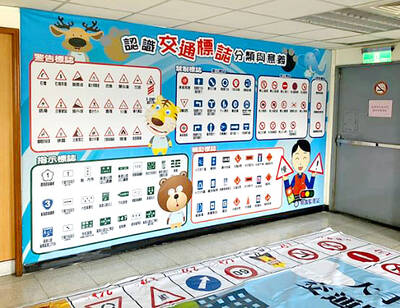
The Ministry of Transportation and Communications yesterday said that it would redesign the written portion of the driver’s license exam to make it more rigorous. “We hope that the exam can assess drivers’ understanding of traffic rules, particularly those who take the driver’s license test for the first time. In the past, drivers only needed to cram a book of test questions to pass the written exam,” Minister of Transportation and Communications Chen Shih-kai (陳世凱) told a news conference at the Taoyuan Motor Vehicle Office. “In the future, they would not be able to pass the test unless they study traffic regulations
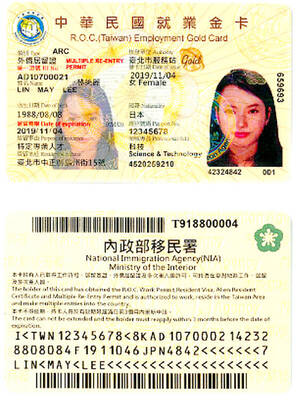
GAINING STEAM: The scheme initially failed to gather much attention, with only 188 cards issued in its first year, but gained popularity amid the COVID-19 pandemic Applications for the Employment Gold Card have increased in the past few years, with the card having been issued to a total of 13,191 people from 101 countries since its introduction in 2018, the National Development Council (NDC) said yesterday. Those who have received the card have included celebrities, such as former NBA star Dwight Howard and Australian-South Korean cheerleader Dahye Lee, the NDC said. The four-in-one Employment Gold Card combines a work permit, resident visa, Alien Resident Certificate (ARC) and re-entry permit. It was first introduced in February 2018 through the Act Governing Recruitment and Employment of Foreign Professionals (外國專業人才延攬及雇用法),

‘A SURVIVAL QUESTION’: US officials have been urging the opposition KMT and TPP not to block defense spending, especially the special defense budget, an official said The US plans to ramp up weapons sales to Taiwan to a level exceeding US President Donald Trump’s first term as part of an effort to deter China as it intensifies military pressure on the nation, two US officials said on condition of anonymity. If US arms sales do accelerate, it could ease worries about the extent of Trump’s commitment to Taiwan. It would also add new friction to the tense US-China relationship. The officials said they expect US approvals for weapons sales to Taiwan over the next four years to surpass those in Trump’s first term, with one of them saying


 RSS
RSS