


Barely coping with declining passenger numbers and high fuel costs, the nation's four airlines operating domestic routes have a still tougher challenge ahead when the Taiwan High Speed Rail Corp's (THSRC, 台灣高鐵) west coast service begins at the end of the year.
With cheaper seats, the bullet train is expected to snatch passengers away from the domestic airlines. According to a Civil Aeronautics Administration (CAA) evaluation, domestic air traffic in the western corridor will fall by two-thirds after the high-speed railway launches.
In preparation for the pending crisis, the four domestic airlines -- Mandarin Airlines (華信航空), Uni Airways Corp (立榮航空), TransAsia Airways (復興航空) and Far Eastern Air (遠東航空) -- will jointly operate the Taipei-Kaohsiung and Taipei-Tainan routes after gaining approval from the Fair Trade Commission for the combined strategy last month.
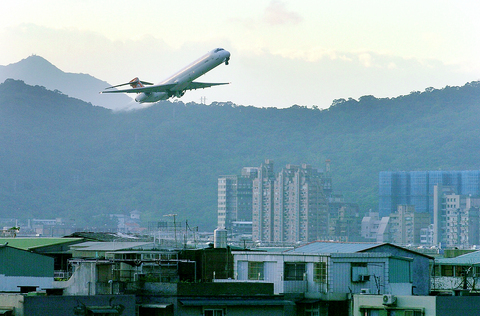
PHOTO: CHIEN JUNG-FONG, TAIPEI TIMES
Taipei-Kaohsiung flights account for 50 percent of all domestic air traffic, and business for this route is expected to be hit the hardest by the high-speed railway.
According to the deal, passengers on the two routes can board any flight that is available regardless of the airline that sells the tickets and without extra charge.
The four airlines have agreed on a way of splitting the bill that is incurred from switching flights, but they refuse to reveal the details.
Even so, the joint operation will not be enough to sustain the four airlines.
Domestic air traffic has been declining over the past 10 years. According to CAA statistics, a high of 37.4 million passengers traveled domestically by air in 1997. This figure slid to 19.29 million passengers last year.
And despite cutting the number of flights, the load factor -- the ratio of paid passenger seats to total seating capacity -- reached only 65.5 percent now, the statistics showed.
The nation's lackluster economy and industry migration, which has reduced vitality in business travel, have resulted in the downturn, said Janet So (湛華生), public relations manager at TransAsia Airways.
High oil prices further inflicted damage upon the four fragile airlines, So said.
Against this backdrop, Evergreen Group (
Uni Airways, for example, could be merged with EVA Airways, while Mandarin Airlines could be merged with parent company China Airlines (華航), the nation's largest carrier, Chang suggested.
To ease the impact brought by the bullet train, Chang called on the government to waive taxes for the four airlines for five years.
His remarks came after he took the high-speed train during a test ride. Praising it as smooth and safe, he said he believed that the high-speed railway would make a profit within six months of operation.
Chen Tien-shih (陳天識), director of the CAA's Air Transport Division, said the administration was drafting measures for the consolidation and would announce them soon.
While the airlines understand that consolidation is essential, they hesitate to do so because of future distribution of traffic rights, particularly in regard to China, Chen said.
According to aviation regulations, each airline operates a quota for certain regions, and mergers and acquisitions (M&As) would result in a reduction of the quota, he said.
China Airlines chairman Philip Wei (
Unlike M&As in the banking industry, in which parties only need to take assets and liabilities into account, airlines need to integrate fleets, which is a huge cost, Wei said. The cost includes parts purchasing, maintenance and staffing, and that is why most airlines try to streamline their fleets to save money, he said.
"The combined airlines may lose a big amount of money before the synergy is created," Wei said.
A five-year tax waiver would not help the airlines, either, he said, because "the airlines already don't need to pay tax when they're in the red."
Without rich parent firms like Mandarin Airlines and Uni Airways to compensate losses, Far Eastern Air saw a loss of NT$50 million (US$1.52 million) in the first three quarters of the year, Far Eastern manager Jason Chen (陳進勇) said.
Although TransAsia Airways earned NT$14 million in the January-September period, profits may be eroded by a slack fourth quarter, So said.
Acknowledging the difficulties with consolidation, Chen said that all four airlines were trying to boost revenues in international routes. Far Eastern Air currently operates flights from Taipei to Palau, Jeju and Angkor, and from Kaohsiung to Inchon, Laoag, Hanoi and Ho Chi Minh City, as well as a number of charter flights.
After a series of promotions, the carrier's international flights have contributed to half of its revenue, Chen said.
"We are not that pessimistic about the post-bullet train era," he said.
The key to long-term survival for the carriers is still liberalization of cross-strait transportation, Chen said.
With a sizeable number of Taiwanese businesspeople traveling frequently between Taiwan and China, the new market would be a shot in the arm for the four carriers, he said.

NO HUMAN ERROR: After the incident, the Coast Guard Administration said it would obtain uncrewed aerial vehicles and vessels to boost its detection capacity Authorities would improve border control to prevent unlawful entry into Taiwan’s waters and safeguard national security, the Mainland Affairs Council (MAC) said yesterday after a Chinese man reached the nation’s coast on an inflatable boat, saying he “defected to freedom.” The man was found on a rubber boat when he was about to set foot on Taiwan at the estuary of Houkeng River (後坑溪) near Taiping Borough (太平) in New Taipei City’s Linkou District (林口), authorities said. The Coast Guard Administration’s (CGA) northern branch said it received a report at 6:30am yesterday morning from the New Taipei City Fire Department about a

IN BEIJING’S FAVOR: A China Coast Guard spokesperson said that the Chinese maritime police would continue to carry out law enforcement activities in waters it claims The Philippines withdrew its coast guard vessel from a South China Sea shoal that has recently been at the center of tensions with Beijing. BRP Teresa Magbanua “was compelled to return to port” from Sabina Shoal (Xianbin Shoal, 仙濱暗沙) due to bad weather, depleted supplies and the need to evacuate personnel requiring medical care, the Philippine Coast Guard (PCG) spokesman Jay Tarriela said yesterday in a post on X. The Philippine vessel “will be in tiptop shape to resume her mission” after it has been resupplied and repaired, Philippine Executive Secretary Lucas Bersamin, who heads the nation’s maritime council, said

REGIONAL STABILITY: Taipei thanked the Biden administration for authorizing its 16th sale of military goods and services to uphold Taiwan’s defense and safety The US Department of State has approved the sale of US$228 million of military goods and services to Taiwan, the US Department of Defense said on Monday. The state department “made a determination approving a possible Foreign Military Sale” to the Taipei Economic and Cultural Representative Office in the US for “return, repair and reshipment of spare parts and related equipment,” the defense department’s Defense Security Cooperation Agency said in a news release. Taiwan had requested the purchase of items and services which include the “return, repair and reshipment of classified and unclassified spare parts for aircraft and related equipment; US Government

More than 500 people on Saturday marched in New York in support of Taiwan’s entry to the UN, significantly more people than previous years. The march, coinciding with the ongoing 79th session of the UN General Assembly, comes close on the heels of growing international discourse regarding the meaning of UN Resolution 2758. Resolution 2758, adopted by the UN General Assembly in 1971, recognizes the People’s Republic of China (PRC) as the “only lawful representative of China.” It resulted in the Republic of China (ROC) losing its seat at the UN to the PRC. Taiwan has since been excluded from


 RSS
RSS