


Swiss drugmaker Roche has found itself sitting on a gold mine with its Tamiflu antiviral drug in hot demand around the world because experts are pinning their hopes on it as the best defense against an influenza pandemic.
But the attention has put pressure on the company to step up production, cut prices and allow other companies to make copies of Tamiflu. Critics have questioned the company's intentions. Governments and individuals, fearing that the current bird flu virus could mutate into a strain that easily transmits among humans, have been snapping up supplies.
Roche, whose control of Tamiflu has been the subject of debate for weeks, opened its headquarters in Basel to reporters on Wednesday for a full-day tour and demonstration of the drug's manufacture -- which the company maintains is extremely complicated.
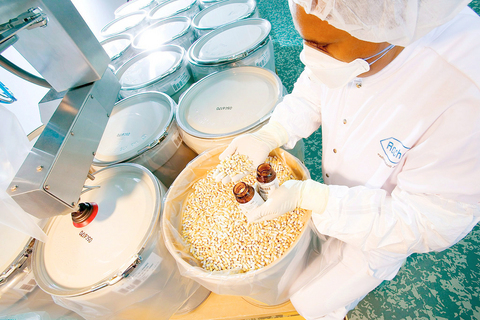
Top executives first briefed a packed amphitheater of reporters and then sent them on a three-hour tour of its plants, past swirling beakers, giant fermentation vats and filters.
The executives reiterated several times their philosophy that "the patient comes first" and sought to reassure governments concerned about bird flu, saying the company was producing enough of its antiviral drug Tamiflu to treat 55 million people this year.
David Reddy, the company's influenza pandemic task force leader, said production will be nearly tripled next year to 150 million treatments, and that in 2007, Roche will be in a position to make 300 million treatments.
In the same breath, executives played down the current threat of a pandemic and Tamiflu's role in the case it happened.
"At the moment it's an animal welfare and economic problem," said William Burns, chief executive of the pharmaceutical division, in an apparent reference of the slaughter of more than 150 million chickens and other poultry at farms primarily in Asia. "We need to keep a sense of balance and a sense of proportion."
"Pandemic preparedness is Tamiflu and more. The preparedness of society will need to be much greater. How are we going to keep the wheels of society turning? There won't be enough intensive care units or respiratory equipment," he said.
But John Oxford, a professor of virology at Queen Mary's University of London, who said he would receive a fee for speaking at the Roche briefing, insisted much of the burden rested with Tamiflu.
"We need plans and ammunition and Tamiflu is at least half of our ammunition," Oxford said, adding there was a clear relationship between the current H5N1 strain and the deadly Spanish flu virus of 1918-1919. "Without Tamiflu, we would be going into this naked."
He also warned that bird flu was "like the Scarlet Pimpernel: You never know where it's going to appear. And it's got a greater spectrum of variety than any other flu virus we've ever seen before."
Until last month, Roche had insisted it would not allow anyone else to make Tamiflu as sales of the once-obscure drug's sales have skyrocketed from US$76 million in 2001 to an expected US$1.1 billion to US$1.2 billion this year.
Consequently, Roche been accused of benefiting from a global health crisis, and has come under international pressure to ease its control on the manufacture of the drug.
The company was compared negatively to Bayer AG, the maker of anthrax treatment Cipro. In late 2001, as governments scrambled to stockpile Cipro in the face of US anthrax attacks, Bayer initially refused to disclose its production capacity or enter into reimbursement negotiations.
Burns argued that the increased pressure was partly due to "people wanting it yesterday because they only thought of it yesterday."
But the international aid agency Medecins Sans Frontieres (MSF) -- Doctors Without Borders -- disagrees.
"This simply shows the impracticality of one company trying to meet worldwide demand," said Daniel Berman of MSF's Access to Essential Medicines campaign. "This whole problem could be easily solved, though, if governments issued compulsory licenses. What everyone forgets is that if governments did that, Roche would not be left out."
Under WTO rules, countries can issue compulsory licenses to disregard patent rights but only after negotiating with the patent owners and paying them adequate compensation. If they declare a public health emergency, governments can skip the negotiating.
Berman, who called Roche executives "control freaks," noted that the company would still get standard 3 to 5 percent royalties on the product if governments issued compulsory licenses. However in such a case, Roche would not be allowed to control the sale price of the product, resulting in proportionally smaller royalties.
Conversely, a Merrill Lynch research report noted that "price discounts may be necessary in order to avoid compulsory licensing of its intellectual property by governments as the panic surrounding avian flu increases."
Burns said Roche will do everything necessary to ensure governments around the world can have access to the drug for pandemic stockpiles without violating the company's patent.
"We continue to look for ways to expand and speed up our output," Burns said.
But, he conceded, "There is a shortage right now."

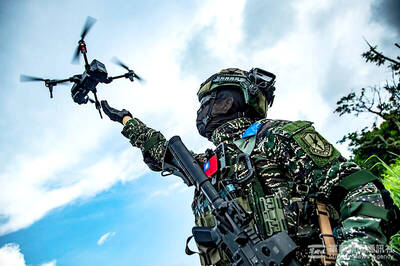
RESILIENCE: Taiwan plays a key role in semiconductors, energy, information infrastructure and advanced manufacturing, AIT Director Raymond Greene said Taiwan’s continued investment in deterrence and resilience remains vital, especially in uncrewed systems and other emerging technologies, American Institute in Taiwan (AIT) Director Raymond Greene said yesterday. Greene made the remarks at the annual National Strategic Summit on Supply Chain Resilience held by the Research Institute for Democracy, Society and Emerging Technology (DSET), a government-backed think tank. As Taiwan last year became the US’ fourth-largest trading partner and supply chain security is becoming more important, cooperation in emerging technologies continues to deepen between the two countries, he said. The US is committed to accelerating innovation, building key infrastructure, strengthening cooperation

The National Chungshan Institute of Science and Technology yesterday showcased its locally developed variants of the Vision 60 robotic patrol dog, which it plans to deploy on the nation’s outlying territories in the South China Sea. The variants were produced under the Joint Lab project — created by the institute and domestic companies — and assembled with domestically produced motors, lenses and artificial intelligence (AI) systems alongside licensed tech from the US, Missile and Rocket Systems Research Division deputy director Jen Kuo-kang (任國光) told the media event at a military base in Taipei’s Dazhi (大直) area. Taiwan has built up its strengths

RIGHT DIRECTION: Taiwan’s efforts to prevent forced labor include a proposal to ‘fully prohibit’ employers from withholding workers’ documents, an official said Taiwan is to establish a mechanism to restrict imports of goods linked to forced labor, the Executive Yuan said yesterday, after the US proposed imposing additional tariffs on Taiwanese goods over labor concerns. “The Ministry of Labor and the Ministry of Economic Affairs are to establish an interministerial review procedure,” Executive Yuan spokesperson Michelle Lee (李慧芝) said at a news briefing in Taipei. “The government is to use the Foreign Trade Act [貿易法] as the legal basis to restrict imports of goods produced with forced labor” and bring its supply chain governance more in line with international standards on human rights, resilience

NOT IMMEDIATE: Taiwan has a chance to appeal the proposed 10 percent tariff before it starts, while other countries face a 12.5 percent tariff from the trade office Taiwan is among 60 economies determined by the US to have failed to impose or enforce a ban on the importation of goods produced with forced labor, according to a notice released on Tuesday by the Office of the US Trade Representative (USTR), which proposed imposing an additional 10 percent or more tariff on them. The USTR in a statement said that following an investigation, it had determined under Section 301 of the Trade Act of 1974 that the failure of the 60 economies to impose and effectively enforce a prohibition on the importation of goods produced with forced labor is


 RSS
RSS