


Some of the world's brightest technologists hail from this south Indian city, burnishing Bangalore's reputation as the Silicon Valley of the East.
Yet for most Indians, whose average income is US$450 a year, a computer is a foreign word. Ownership is a distant dream.
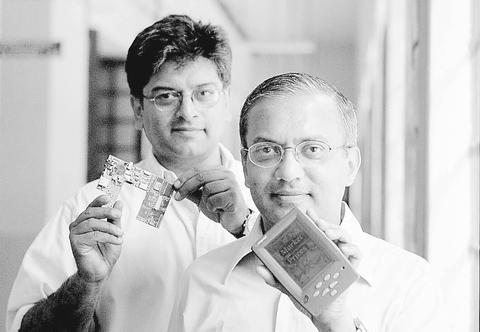
PHOTO: AP
A group of seven Indian computer scientists think they can help.
They've built a simple, inexpensive handheld computer -- they call it the Simputer -- that in the words of co-developer Vinay Deshpande "could truly take the benefits of information technology to the underserved of the world."
Fewer than 1 percent of India's more than 1 billion people have personal computers.
More than 40 percent of the population is illiterate, and one in four Indians lives in abject poverty.
The idea for the Simputer, which is slated for launch by year's end, emerged from the India Institute of Science and Encore Software Ltd after both were asked by the government to devise ways to deliver information technology's benefits to rural India, where some 75 percent of the country's population lives.
Inspired by the transistor radio, which opened an information spigot to India's villages in the 1970s, the team designed a 7.5cm by 12.5cm telecommunications-ready machine.
They envision Indian farmers using it to get on the Internet via public telephones and check produce prices, government tax and land records.
Although it was designed with Indians in mind, the hope is that the Simputer will be attractive to governments, banks, relief agencies and schools in other developing countries.
"It is a big boost for Indian pride," said Deshpande, the chairman of Encore Software, one of two companies that hold the manufacturing license.
"It proves what we've been saying all along: That we can do it here. This is 100 percent India."
Swami Manohar, another of the developers and a computer science professor at IIS, said the Simputer's initial price would be around US$320. Eventually, they intend to sell it in volume at US$190.
That's still expensive for most Indians.
So the Simputer would accommodate smart cards, which each cost about US$4.25. That would enable farmers, villages or schools to share a single device, and use individual smart cards to store data.
The Simputer runs on a version of the Linux operating system, whose source code is free on the Internet. It has a 320-by-240-pixel monochrome display, is powered by a 200Mhz StrongArm processor and has a hard polymer shell.
The current prototype has 32MB of random access memory, runs on three AAA nickel metal hydride batteries, includes a built-in speaker, a microphone and a telephone jack, and USB and smart card connectors. Into the software bundle are a built-in Internet browser, e-mail program, MP3 player and a modem.
Because it runs on Linux, programmers working through the nonprofit Simputer Trust can improve on the machine's codes and capabilities. On their Web site, the developers say the trust aims to promote the Simputer "as an evolving platform for social change.''
Since many of its users would be illiterate, the Simputer has text-to-speech capability and voicemail.
It is designed to break down written words into basic sounds, then put them back together and speak out in English, Hindi, Tamil and Kannada.
Users can also enter text on a soft screen keyboard, one character at a time, or with a stylus using a handwriting recognition program the designers call "Tapatap"' -- (akin to Graffiti in the Palm OS).
The Simputer Trust does not intend to manufacture the device, only license its design. It plans to charge US$25,000 to commercial producers in developing countries and US$250,000 to manufacturers in developed nations.
"This is a world-class product, ahead of anything being done anywhere else in the world," said Kenneth Keniston, director of the India Program at the Massachusetts Institute of Technology.
The Simputer is not, however, the only cheap computer out there.
In Brazil, computer scientists at Federal University of Minas Gerais have developed a prototype of a PC for the people -- dubbed the Volkscomputer -- which they envision will sell for US$300.
But it's not portable, making it more difficult to share among communities.
The Simputer's developers scrounged for grants and credit the university for giving them lab space and research and development time.
And they don't pretend they don't hope to get rich off the Simputer one day.
The men who built the handheld put in much of their own time and money, and the four computer scientists at the Indian Institute of Science, considered the MIT of the East, earn some US640 monthly and have put most of their other research on hold.
"Not to mention that we haven't seen our families," said V. Vinay, one of the professors. "We're not looking at the retail market, but we're not going to ignore it either."
Deshpande, the software and marketing man of Simputer, agrees: "We hope to make money in the long run."

NO HUMAN ERROR: After the incident, the Coast Guard Administration said it would obtain uncrewed aerial vehicles and vessels to boost its detection capacity Authorities would improve border control to prevent unlawful entry into Taiwan’s waters and safeguard national security, the Mainland Affairs Council (MAC) said yesterday after a Chinese man reached the nation’s coast on an inflatable boat, saying he “defected to freedom.” The man was found on a rubber boat when he was about to set foot on Taiwan at the estuary of Houkeng River (後坑溪) near Taiping Borough (太平) in New Taipei City’s Linkou District (林口), authorities said. The Coast Guard Administration’s (CGA) northern branch said it received a report at 6:30am yesterday morning from the New Taipei City Fire Department about a

IN BEIJING’S FAVOR: A China Coast Guard spokesperson said that the Chinese maritime police would continue to carry out law enforcement activities in waters it claims The Philippines withdrew its coast guard vessel from a South China Sea shoal that has recently been at the center of tensions with Beijing. BRP Teresa Magbanua “was compelled to return to port” from Sabina Shoal (Xianbin Shoal, 仙濱暗沙) due to bad weather, depleted supplies and the need to evacuate personnel requiring medical care, the Philippine Coast Guard (PCG) spokesman Jay Tarriela said yesterday in a post on X. The Philippine vessel “will be in tiptop shape to resume her mission” after it has been resupplied and repaired, Philippine Executive Secretary Lucas Bersamin, who heads the nation’s maritime council, said

CHINA POLICY: At the seventh US-EU Dialogue on China, the two sides issued strong support for Taiwan and condemned China’s actions in the South China Sea The US and EU issued a joint statement on Wednesday supporting Taiwan’s international participation, notably omitting the “one China” policy in a departure from previous similar statements, following high-level talks on China and the Indo-Pacific region. The statement also urged China to show restraint in the Taiwan Strait. US Deputy Secretary of State Kurt Campbell and European External Action Service Secretary-General Stefano Sannino cochaired the seventh US-EU Dialogue on China and the sixth US-EU Indo-Pacific Consultations from Monday to Tuesday. Since the Indo-Pacific consultations were launched in 2021, references to the “one China” policy have appeared in every statement apart from the

More than 500 people on Saturday marched in New York in support of Taiwan’s entry to the UN, significantly more people than previous years. The march, coinciding with the ongoing 79th session of the UN General Assembly, comes close on the heels of growing international discourse regarding the meaning of UN Resolution 2758. Resolution 2758, adopted by the UN General Assembly in 1971, recognizes the People’s Republic of China (PRC) as the “only lawful representative of China.” It resulted in the Republic of China (ROC) losing its seat at the UN to the PRC. Taiwan has since been excluded from


 RSS
RSS