


The TAIEX yesterday moved sharply higher to close above 10,300 points as a strong showing on US markets overnight sparked buying, dealers said.
The bellwether electronics sector helped drive the local bourse, with “Apple concept stocks” attracting strong buying after Monday’s gains by shares of Apple Inc, which offset the losses suffered by Boeing Co shares, they said.
The TAIEX closed up 93.05 points, or 0.91 percent, at 10,343.33, after moving between 10,294.37 and 10,382.12. Turnover totaled NT$109.871 billion (US$3.56 billion) during the session.
The market opened up 0.43 percent in a knee-jerk reaction to the gains on US markets, where the Dow Jones Industrial Average soared more than 200 points, or 0.79 percent, and the tech-heavy NASDAQ jumped 2.02 percent, dealers said.
Buying helped push the TAIEX past 10,300 points, led by contract chipmaker Taiwan Semiconductor Manufacturing Co (台積電), a supplier of processors for iPhones.
The electronics sector rose more than 1.08 percent by the end of the session as investors were encouraged by the strong gains of tech stocks in the US market, they said.
Concerns over a slower pace of global economic growth are expected to continue to affect market sentiment, while volatility is still possible on US markets, despite their strong showing on Monday.
Shares of Largan Precision Co (大立光), a supplier of smartphone camera lenses to Apple, rose 2.9 percent to close at NT$4,620.
Shares of iPhone assembler Hon Hai Precision Industry Co (鴻海) added 1.14 percent to close at NT$71.2.
Bucking the upturn on the broader market, shares of Delta Electronics Inc (台達電), a power management solution provider, fell 5.26 percent to close at NT$144.
Buying was also seen in the old economy sector, with Formosa Plastics Corp (台塑) shares rising 1.46 percent to close at NT$104.5 and Far Eastern New Century Corp (遠東新世紀) shares gaining 1.51 percent to close at NT$30.3.
Foreign institutional investors bought a net NT$3.08 billion of shares on the main board, after a net sell-off of NT$10.36 billion the previous day, Taiwan Stock Exchange data showed.

Apple Inc increased iPhone production in India by about 53 percent last year and now makes a quarter of its marquee devices there, reflecting the US company’s efforts to avoid tariffs on China. The company assembled about 55 million iPhones in India last year, up from 36 million a year earlier, people familiar with the matter said, asking not to be named because the numbers aren’t public. Apple makes about 220 million to 230 million iPhones a year globally, with India’s share of the total increasing rapidly. Apple has accelerated its expansion in the world’s most populous country in recent years, bolstered
HEADWINDS: The company said it expects its computer business, as well as consumer electronics and communications segments to see revenue declines due to seasonality Pegatron Corp (和碩) yesterday said it aims to grow its artificial intelligence (AI) server revenue more than 10-fold this year from last year, driven by orders from neocloud solutions clients and large cloud service providers. The electronics manufacturing service provider said AI server revenue growth would be driven primarily by the Nvidia Corp GB300 server platform. Server shipments are expected to increase each quarter this year, with the second half likely to outperform the first half, it said. The AI server market is expected to broaden this year as more inference applications emerge, which would drive demand for system-on-chip, application-specific integrated circuits
Taiwan Semiconductor Manufacturing Co’s (TSMC, 台積電) share of the global foundry market rose to almost 70 percent last year amid booming demand for artificial intelligence (AI), market information advisory firm TrendForce Corp (集邦科技) said on Thursday. The contract chipmaker posted US$122.54 billion in revenue, up 36.1 percent from a year earlier, accounting for 69.9 percent of the global market, TrendForce said. Its share was up from 64.4 percent in 2024, it said. TSMC’s closest rival, Samsung Electronics, was a distant second, posting US$12.63 billion in sales, down 3.9 percent from a year earlier, for a 7.2 percent share of the global market. In the
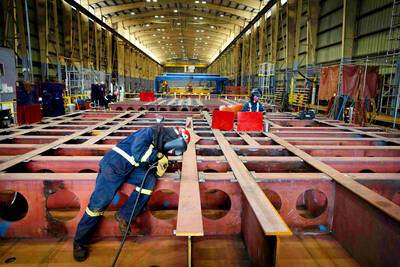
At a massive shipyard in North Vancouver, Canadian workers grind metal beams for a powerful new icebreaker crucial to cementing the country’s presence in the increasingly contested arctic. Icebreakers are specialized, expensive vessels able to navigate in the frozen far north. And “this is the crown jewel,” said Eddie Schehr, vice president of production at the Seaspan shipyard. For Canadian Prime Minister Mark Carney, who heads to Norway next Friday to observe arctic defense drills involving troops from 14 NATO states, Canada’s extreme north has emerged as a strategic priority. “Canada is and forever will be an Arctic nation,” he said ahead of


 RSS
RSS