


Chunghwa Telecom Co (中華電信) on Friday announced it has been awarded a NT$58 billion (US$1.93 billion) contract by state-run Taiwan Power Co (Taipower, 台電) to build a solar power plant with a capacity of 100 megawatts, which would be the largest of its kind in Taiwan.
The solar power plant is to be located in Changhua Coastal Industrial Park (彰濱工業區), Chunghwa Telecom said in a statement, adding that the project is to cover about 140 hectares.
The plant is expected to be ready for a trial run after about 15 months of construction, the company said, adding that the whole project is to be completed in 2019.
Wang Hui-min (王惠民), president of the company’s southern Taiwan business group, said in the statement that Chunghwa Telecom has been developing solar, wind and biogas energy since 2015, in line with the government’s policy of promoting the development of “green” energy in Taiwan.
As of September, Chunghwa Telecom had completed 373 “green” energy projects, with total power generation of 103 megawatts, Wang said.
The company’s most recent “green” energy project was completed in March, when it teamed up with Kingstone Energy Technology Corp (國軒) to install rooftop photovoltaic systems at Chih Lien Industrial Co Ltd’s (志聯工業) steel plant in Taoyuan.
The project’s first phase — 500-kilowatt photovoltaic (PV) systems — at the Chih Lien steel plant began operations on April 10 and the second phase — 1,800-kilowatt PV systems — is being planned, Chunghwa Telecom said.
Local media reported that the Taipower project in Changhua is a turnkey project, in which Chunghwa Telecom collaborates with other firms to provide the design, procurement, contracting and construction for the entire project.
Chunghwa Telecom’s subcontractors on the project are reported to include Neo Solar Energy Corp (新日光能源), Fortune Electric Co (華城電機), Star Energy Corp (星能) and Oriental Union Chemical Corp (東聯).
The project is expected to contribute to company revenue in 2019 to 2020, chief financial officer Harrison Kuo (郭水義) said.
In the first 10 months of the year, Chunghwa Telecom reported revenue of NT$185.42 billion, down 2.6 percent year-on-year, with net income decreasing 5 percent annually to NT$33.5 billion, or earnings per share of NT$4.32, the company said on Nov. 10.

HORMUZ ISSUE: The US president said he expected crude prices to drop at the end of the war, which he called a ‘minor excursion’ that could continue ‘for a little while’ The United Arab Emirates (UAE) and Kuwait started reducing oil production, as the near-closure of the crucial Strait of Hormuz ripples through energy markets and affects global supply. Abu Dhabi National Oil Co (ADNOC) is “managing offshore production levels to address storage requirements,” the company said in a statement, without giving details. Kuwait Petroleum Corp said it was lowering production at its oil fields and refineries after “Iranian threats against safe passage of ships through the Strait of Hormuz.” The war in the Middle East has all but closed Hormuz, the narrow waterway linking the Persian Gulf to the open seas,

Apple Inc increased iPhone production in India by about 53 percent last year and now makes a quarter of its marquee devices there, reflecting the US company’s efforts to avoid tariffs on China. The company assembled about 55 million iPhones in India last year, up from 36 million a year earlier, people familiar with the matter said, asking not to be named because the numbers aren’t public. Apple makes about 220 million to 230 million iPhones a year globally, with India’s share of the total increasing rapidly. Apple has accelerated its expansion in the world’s most populous country in recent years, bolstered

HEADWINDS: The company said it expects its computer business, as well as consumer electronics and communications segments to see revenue declines due to seasonality Pegatron Corp (和碩) yesterday said it aims to grow its artificial intelligence (AI) server revenue more than 10-fold this year from last year, driven by orders from neocloud solutions clients and large cloud service providers. The electronics manufacturing service provider said AI server revenue growth would be driven primarily by the Nvidia Corp GB300 server platform. Server shipments are expected to increase each quarter this year, with the second half likely to outperform the first half, it said. The AI server market is expected to broaden this year as more inference applications emerge, which would drive demand for system-on-chip, application-specific integrated circuits
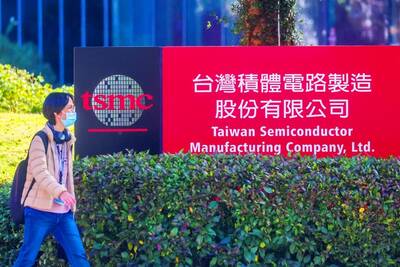
PROJECTION: TSMC said it expects strong growth this year, with revenue in US dollars projected to grow by about 30 percent, outperforming the industry Taiwan Semiconductor Manufacturing Co (TSMC, 台積電) yesterday reported consolidated sales last month reached NT$317.66 billion (US$9.98 billion), the highest ever for the month of February, driven by robust demand for chips built using the company’s advanced 3-nanometer (3nm) process. Last month’s figure was up 22.2 percent from a year earlier, but fell 20.8 percent from January, the world’s largest contract chipmaker said in a statement. For the first two months of the year, TSMC posted cumulative sales of NT$718.91 billion, up 29.9 percent from a year earlier. Analysts attributed the growth to sustained global demand for artificial intelligence (AI) products


 RSS
RSS