


Cambodia launched its new national airline, Cambodia Angkor Air, at a ceremony yesterday, giving the southeast Asian country its first flag carrier since a previous effort folded in 2001.
It is hoped the airline, a joint venture between the government and Vietnam Airlines, will encourage tourism and promote the country, Cambodian Prime Minister Hun Sen said during the ceremony at Phnom Penh International Airport.
Hun Sen urged airline officials to compete hard with other carriers to “make Cambodia Angkor Air successful and ensure national revenue.”
The last national carrier, Royal Air Cambodge, folded in 2001 after running up losses of US$30 million.
Cambodian Deputy Prime Minister Sok An said Cambodia Angkor Air, which has capitalization of US$100 million, will officially begin flights today, traveling to tourist hub Siem Reap and Vietnam’s Ho Chi Minh City.
Sok An said that the airline was expected to boost his country’s tourism sector, but “the government will be not responsible for any loss and debt.”
After the opening ceremony, Cambodian and Vietnamese officials flew to seaside resort Sihanoukville and Siem Reap, the gateway to the famed Angkor Wat temples.
Tourism is one of the only sources of foreign exchange for impoverished Cambodia, which is recovering from nearly three decades of conflict that ended in 1998. The kingdom aims to lure 3 million tourists annually by next year. More than 20 foreign airlines, including Japan Airlines and Qatar Airways, currently operate direct flights to Cambodia.

AI SERVER DEMAND: ‘Overall industry demand continues to outpace supply and we are expanding capacity to meet it,’ the company’s chief executive officer said Hon Hai Precision Industry Co (鴻海精密) yesterday reported that net profit last quarter rose 27 percent from the same quarter last year on the back of demand for cloud services and high-performance computing products. Net profit surged to NT$44.36 billion (US$1.48 billion) from NT$35.04 billion a year earlier. On a quarterly basis, net profit grew 5 percent from NT$42.1 billion. Earnings per share expanded to NT$3.19 from NT$2.53 a year earlier and NT$3.03 in the first quarter. However, a sharp appreciation of the New Taiwan dollar since early May has weighed on the company’s performance, Hon Hai chief financial officer David Huang (黃德才)
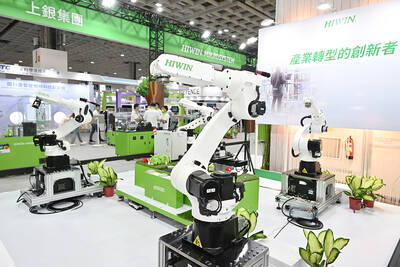
The Taiwan Automation Intelligence and Robot Show, which is to be held from Wednesday to Saturday at the Taipei Nangang Exhibition Center, would showcase the latest in artificial intelligence (AI)-driven robotics and automation technologies, the organizer said yesterday. The event would highlight applications in smart manufacturing, as well as information and communications technology, the Taiwan Automation Intelligence and Robotics Association said. More than 1,000 companies are to display innovations in semiconductors, electromechanics, industrial automation and intelligent manufacturing, it said in a news release. Visitors can explore automated guided vehicles, 3D machine vision systems and AI-powered applications at the show, along
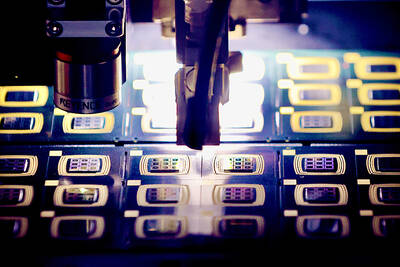
FORECAST: The greater computing power needed for emerging AI applications has driven higher demand for advanced semiconductors worldwide, TSMC said The government-supported Industrial Technology Research Institute (ITRI) has raised its forecast for this year’s growth in the output value of Taiwan’s semiconductor industry to above 22 percent on strong global demand for artificial intelligence (AI) applications. In its latest IEK Current Quarterly Model report, the institute said the local semiconductor industry would have output of NT$6.5 trillion (US$216.6 billion) this year, up 22.2 percent from a year earlier, an upward revision from a 19.1 percent increase estimate made in May. The strong showing of the local semiconductor industry largely reflected the stronger-than-expected performance of the integrated circuit (IC) manufacturing segment,
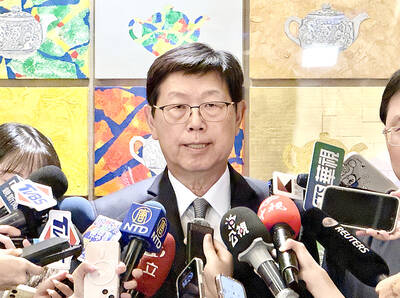
COLLABORATION: Softbank would supply manufacturing gear to the factory, and a joint venture would make AI data center equipment, Young Liu said Hon Hai Precision Industry Co (鴻海精密) would operate a US factory owned by Softbank Group Corp, setting up what is in the running to be the first manufacturing site in the Japanese company’s US$500 billion Stargate venture with OpenAI and Oracle Corp. Softbank is acquiring Hon Hai’s electric-vehicle plant in Ohio, but the Taiwanese company would continue to run the complex after turning it into an artificial intelligence (AI) server production plant, Hon Hai chairman Young Liu (劉揚偉) said yesterday. Softbank would supply manufacturing gear to the factory, and a joint venture between the two companies would make AI data


 RSS
RSS