


Hon Hai Precision Industry Co (鴻海精密), the world’s biggest electronics contract manufacturer, said yesterday its short-term economic outlook was not as bad as had been anticipated following a recent flood of rush orders from brand-name vendors.
The company’s outlook for the next one or two months “is still looking good, but it does not in anyway mean a full economic recovery,” Hon Hai chairman Terry Gou (郭台銘) said at a media briefing yesterday.
Speaking at a signing ceremony with IBM Corp for cooperation on a green technology project in Tucheng (土城), Taipei County, yesterday, Gou confirmed that Hon Hai’s Chinese factories are increasing their workforce by 5 percent to handle the last-minute orders.
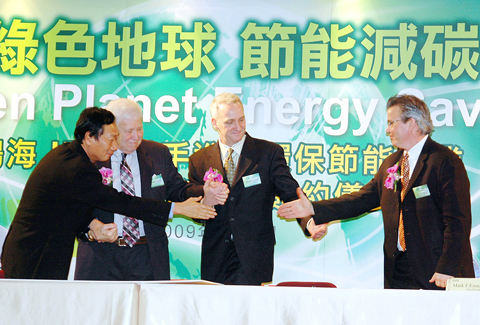
PHOTO: CNA
On Dec. 19, Gou said the economic downturn was three times worse than expected. He said at the time that Hon Hai would reduce its worldwide workforce to be able to deal with the global slump.
Hon Hai currently has a workforce of about 600,000 in China.
Without discussing his long-term outlook, Gou said a period of market correction was still needed.
Shares of Hon Hai rose NT$3.80, or 5.58 percent, to NT$71.90 yesterday in response to Gou’s remarks.
Hon Hai’s subsidiary Foxconn International Holdings Ltd (富士康) yesterday signed an agreement with IBM, Enterprise Information Management Inc and C-Lock Technology Inc as the Taiwanese firm ventures into green technology.
The team of companies will jointly deliver and deploy GreenCert, billed as the world’s first greenhouse gas emission measurement enterprise system. This is the first time GreenCert technology, which provides computational algorithms for measuring and verifying carbon emissions reduction credits that can be bought or sold on global carbon markets, will be available in the Asia-Pacific region.
“GreenCert can help enterprises collect pollutant emission data and allows them to conduct carbon trading and follow environmental protection rules in their countries,” said Mark Easton, vice president of IBM’s software sales division. “Through partnership with an environmentally conscious company, it greatly enhances GreenCert’s ability to help enterprises in the Asia-Pacific reduce greenhouse gases.”
In the initial stages, Foxconn will base its green engineering operations in the Kaohsiung Software Technology Park (高雄軟體科技園區) to support the government’s agenda on diversifying industries across the nation, Gou said.
He estimated the initial investment at between US$1 million and several million dollars.
Total capital expenditure is likely to reach US$300 million to US$500 million in three to five years’ time, he said.
Gou said that he expected Foxconn’s green technology endeavor in Kaohsiung to create 100 to 200 software engineering jobs.
As local contract manufacturers face tighter margins amid slackening consumer demand and slowing customer orders, Gou said he was not abandoning his roots in contract manufacturing, but simply creating a more innovative and environmentally friendly manufacturing strategy as part of his global enterprise strategy.
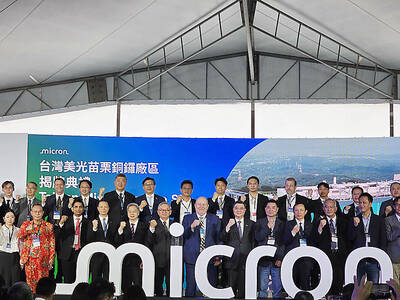
UNPRECEDENTED PACE: Micron Technology has announced plans to expand manufacturing capabilities with the acquisition of a new chip plant in Miaoli Micron Technology Inc unveiled a newly acquired chip plant in Miaoli County yesterday, as the company expands capacity to meet growing demand for advanced DRAM chips, including high-bandwidth memory chips amid the artificial intelligence boom. The plant in Miaoli County’s Tongluo Township (銅鑼), which Micron acquired from Powerchip Semiconductor Manufacturing Corp (力積電) for US$1.8 billion, is expected to make a sizeable capacity contribution to the company from fiscal 2028, the company said in a statement. It would be an extended production site of Micron’s large-scale manufacturing hub in Taichung, the company said. As the global semiconductor industry is racing to reach US$1 trillion
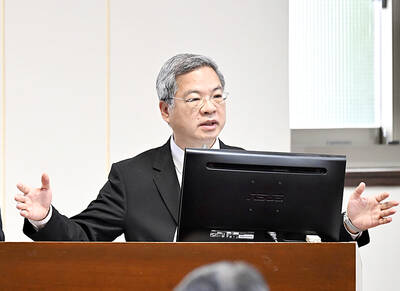
ABOVE LEGAL REQUIREMENT: The Ministry of Economic Affairs is prepared if LNG supply is disrupted, with more than the legal requirement of 11 days of inventory Taiwan has largely secured liquefied natural gas (LNG) supplies through May and arranged about half of June’s supply, Minister of Economic Affairs Kung Ming-hsin (龔明鑫) said yesterday. Since the Middle East conflict began on Feb. 28, Taiwan’s LNG inventories have remained more than 12 days, exceeding the legal requirement of 11 days, indicating no major supply concerns for domestic gas and electricity, Kung said at a meeting of the legislature’s Economics Committee in Taipei. The ministry aims to increase the figure to 14 days by the end of next year, he said. While one or two LNG or crude oil shipments for May

Taiwan’s food delivery market could undergo a major shift if Singapore-based Grab Holdings Ltd completes its planned acquisition of Delivery Hero SE’s Foodpanda business in Taiwan, industry experts said. Grab on Monday last week announced it would acquire Foodpanda’s Taiwan operations for US$600 million. The deal is expected to be finalized in the second half of this year, with Grab aiming to complete user migration to its platform by the first half of next year. A duopoly between Uber Eats and Foodpanda dominates Taiwan’s delivery market, a structure that has remained intact since the Fair Trade Commission (FTC) blocked Uber Technologies Inc’s

Memory chip stocks extended their losses yesterday after Alphabet Inc’s Google publicized research that could allow more efficient use of the storage needed for artificial intelligence (AI) development. SK Hynix Inc and Samsung Electronics Co, South Korean leaders in the market, fell more than 6 percent and about 5 percent respectively in Seoul. In the US, Micron Technology Inc, Western Digital Corp and Sandisk Corp slid more than 2 percent in pre-market trading, after they all closed lower on Wednesday. Memory companies have been on a tear in recent months as the rapid development of AI infrastructure triggered a spike in chip


 RSS
RSS