

Amid rising international commodity prices, motorbike prices will likely increase by NT$1,000 (US$32.86) to NT$2,000 next month.
The nation’s major motorbike producers raised their prices around NT$1,000 at the beginning of this year in a bid to reflect the rise in international commodity prices and domestic motor vehicle disposal fees.
“The price increase in the motorbike market this year is the most serious I have encountered,” Ho Ming-chang (何明昌), owner of a motorbike shop in Taipei, said yesterday.
Ho said the future price increase is inevitable as most of Taiwan’s motorbike components are imported from overseas.
Furthermore, the increasing costs have squeezed the profit margins of new motorbikes to almost zero.
The latest data provided by the Ministry of Transportation and Communications showed that the number of applicants for license plates for locally made motorbikes, — a figure used as an indicator of new motorbike sales — declined 10.63 percent last month from a year earlier to 64,936 units, a report in the Chinese-language Commercial Times said on Friday.
The decline in last month’s sales also put a halt to sales growth in the nation’s motorbike market for five consecutive months up to last month.
The total number of new motorbikes being sold in the first quarter of this year, at 170,308 units, saw a slight 0.49 percent decrease from the same period a year earlier, the paper reported.
Meanwhile, Hotai Motor Co (和泰汽車), Taiwan’s largest auto maker that also distributes both Lexus and Toyota models, said automobile sales last month dropped between 15 percent and 16 percent from a year earlier, to 22,000 units.
“The decline in sales is mainly due to the macroeconomic environment and has less to do with the presidential election [last month],” Hotai spokesman Steven Yang (楊湘泉), said by telephone yesterday.
Yang said that weakening consumer confidence is the main reason behind the declining automobile sales. He said that it would take some time for the market to recover.
In addition, Yang said the soaring international crude oil prices would not greatly impact domestic automobile sales, as Taiwan’s fuel prices are still low compared to other countries.

Taiwan Semiconductor Manufacturing Co (TSMC, 台積電) yesterday dismissed concerns about a deeper correction of the artificial intelligence (AI) market, saying that soaring global demand AI applications continues to outstrip its supply of advanced chips. The world’s largest contract chipmaker said in a statement that it continues to observe challenges facing the consumer and price-sensitive end-market segments posed by rising component prices and economic uncertainties, TSMC chairman and chief executive officer C.C. Wei’s (魏哲家) remarks during an earnings conference on Oct. 15. “Global demand for AI continues to grow, with its long-term outlook remaining upbeat,” TSMC said in the statement. “Demand
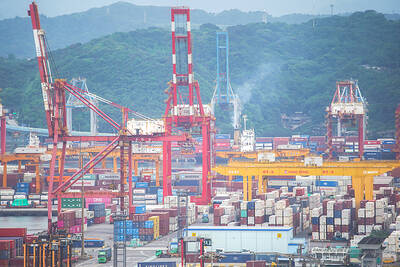
BOOM DRIVEN: The third-quarter current account surplus was the second-highest on record, well up from last year, and lagging only behind last year’s fourth quarter Taiwan’s current account surplus in the third quarter of this year reached its second-highest level on record, as exports hit new highs on the back of robust global demand for artificial intelligence (AI)-related applications, the central bank said on Friday. The surplus rose by US$22.04 billion from a year earlier to US$68.79 billion in the third quarter, second only to the US$69.69 billion recorded in the fourth quarter of last year, the bank said. The current account mainly measures a country’s transactions in goods and services, as well as primary and secondary income flows with the rest of the world. Taiwan’s merchandise trade

CHINA LEANING? The US has greenlit the sale of less-than-cutting-edge Nvidia chips to China, amidst national security and technology control concerns US Secretary of the Treasury Scott Bessent said on Friday that no more restrictions on the sale of older Nvidia Corp chips to China were needed following US President Donald Trump administration’s move earlier last week to block China’s remote access to the latest semiconductors. The ability of Chinese tech firms to access Nvidia’s technology came under scrutiny after CEO Jensen Huang (黃仁勳) stepped down amid allegations of his affair with an executive at Megaspeed International Pte Ltd, a Singapore-based company that uses advanced chips to generate computing power that Chinese firms access remotely. “The proper chip restrictions are in place,” Bessent

China’s Z.AI Co (智譜) has fallen behind schedule on its next flagship artificial intelligence (AI) model, while rival Moonshot AI Technology Co (月之暗面) expects the interval between major releases could double from six months to a year or longer if it loses access to overseas computing power, people familiar with the matter said. The previously unreported details show how efforts by US AI companies OpenAI and Anthropic PBC to prevent distillation, a technique in which developers train models using answers generated by more capable ones, have slowed Chinese AI development. Washington’s latest chip restrictions threaten further delays. The measures jeopardize a key


 RSS