

China appears to be not particularly committed ahead of a WTO meeting in Hong Kong in the middle of the month that aims to negotiate a liberalization of global trade.
The new WTO member country, accepted to the organization in 2001, apparently sees itself as being in a transitional period.
Meanwhile, the expectations for the summit have been lowered almost every day, and for China, like the US and the EU, the motto seems to be, "Not failing is a success."
Not even as host of the summit in the former British colony of Hong Kong, which was returned to Chinese sovereignty in 1997 and which can now once again shine as a beacon of world trade, is the Chinese government displaying any particular zest.
While it has been said that the world's largest developing country harbors intentions of establishing itself as the advocate of the globe's poor countries, India and Brazil appear to be much more active in this respect.
"I don't see any signs that China wants to take on a leading role amongst developing countries," said Liang Yanfen, a trade expert attached to the Chinese trade ministry's research institute in Beijing.
China wants to help make this new summit more successful than previous ones, but doesn't necessarily want to put its own proposals on the negotiating table, Liang said.
The main focus of the summit is after all the demand by developing countries that the US and EU relinquish their export subsidies and trade barriers on agricultural produce.
This demand, however, seems to be of precious little concern for China. But it is easily overlooked that the existing offers by the EU and US for removing subsidies rely heavily on movement and a continued market liberalization of the industry and service sectors.
This aspect is indeed of concern for China, which although it has lowered various duties considerably since joining the WTO, has kept other duties -- for example in the automotive manufacturing sector -- high.
Further hurdles have to be overcome in the financial and insurance sectors: Germany and other European nations as well as the US say that China will have to offer a lot more here.
But the upcoming talks in Hong Kong will mostly focus on the agricultural sector anyway, which is comparatively unimportant for China as the country is not a major exporter of agricultural products.
The country's agricultural sector only contributes 15 percent to GDP. But the remainder of China's dramatically growing economy, which as the factory of the globalized world profits heavily from its exports, would without doubt be the big winner if more trade barriers fell.

Taiwan Semiconductor Manufacturing Co (TSMC, 台積電) yesterday dismissed concerns about a deeper correction of the artificial intelligence (AI) market, saying that soaring global demand AI applications continues to outstrip its supply of advanced chips. The world’s largest contract chipmaker said in a statement that it continues to observe challenges facing the consumer and price-sensitive end-market segments posed by rising component prices and economic uncertainties, TSMC chairman and chief executive officer C.C. Wei’s (魏哲家) remarks during an earnings conference on Oct. 15. “Global demand for AI continues to grow, with its long-term outlook remaining upbeat,” TSMC said in the statement. “Demand
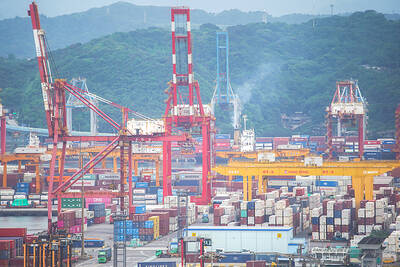
BOOM DRIVEN: The third-quarter current account surplus was the second-highest on record, well up from last year, and lagging only behind last year’s fourth quarter Taiwan’s current account surplus in the third quarter of this year reached its second-highest level on record, as exports hit new highs on the back of robust global demand for artificial intelligence (AI)-related applications, the central bank said on Friday. The surplus rose by US$22.04 billion from a year earlier to US$68.79 billion in the third quarter, second only to the US$69.69 billion recorded in the fourth quarter of last year, the bank said. The current account mainly measures a country’s transactions in goods and services, as well as primary and secondary income flows with the rest of the world. Taiwan’s merchandise trade
CHINA LEANING? The US has greenlit the sale of less-than-cutting-edge Nvidia chips to China, amidst national security and technology control concerns US Secretary of the Treasury Scott Bessent said on Friday that no more restrictions on the sale of older Nvidia Corp chips to China were needed following US President Donald Trump administration’s move earlier last week to block China’s remote access to the latest semiconductors. The ability of Chinese tech firms to access Nvidia’s technology came under scrutiny after CEO Jensen Huang (黃仁勳) stepped down amid allegations of his affair with an executive at Megaspeed International Pte Ltd, a Singapore-based company that uses advanced chips to generate computing power that Chinese firms access remotely. “The proper chip restrictions are in place,” Bessent
China’s Z.AI Co (智譜) has fallen behind schedule on its next flagship artificial intelligence (AI) model, while rival Moonshot AI Technology Co (月之暗面) expects the interval between major releases could double from six months to a year or longer if it loses access to overseas computing power, people familiar with the matter said. The previously unreported details show how efforts by US AI companies OpenAI and Anthropic PBC to prevent distillation, a technique in which developers train models using answers generated by more capable ones, have slowed Chinese AI development. Washington’s latest chip restrictions threaten further delays. The measures jeopardize a key


 RSS