


Halliburton Co workers may have taken kickbacks from a Kuwaiti subcontractor supplying US troops in Iraq, causing a potential US$6 million overcharge to US taxpayers, the company said on Friday.
Moving to blunt the firestorm of criticism, the company said late on Friday it had sent a US$6.3-million check to the US Army Materiel Command, its customer, to cover potential overbilling.
"We will bear the cost of the overcharge, not the government," Randy Harl, chief executive of Halliburton's Kellogg, Brown & Root unit, or KBR, said in a statement.
Auditors at the Houston-based company found the questionable payments and potential overbilling and alerted Pentagon Inspector General Joseph Schmitz, said a company spokeswoman, Wendy Hall.
Halliburton, once headed by Vice President Dick Cheney, is the largest contractor in Iraq with over US$8 billion in potential work doing everything from laundry for US occupation forces to repairing damaged oil fields.
Democrats in Congress have been pressing to find out if the company traded on political contacts to get lucrative deals. Cheney was its chief executive from 1995 until mid-2000, when he stepped down to become George W. Bush's running mate.
The president's spokesman, Scott McClellan, said of the suspected kickbacks: "If something like this happened [Bush] expects the Department of Defense to look into it fully, get to the bottom of it and make sure that money is repaid if Halliburton overcharged."
Senate Democratic leader Tom Daschle of South Dakota urged on the Senate floor that no new contracts be granted to the company until doubts have been "resolved."
Senator Frank Lautenberg, a New Jersey Democrat, said Cheney still receives "deferred salary" from Halliburton and called for all of its government contracts to be terminated.
US Representative Henry Waxman of California, the top Democrat on the House of Representatives Committee on Government Reform, called for hearings on "fraud, waste and abuse" in the billions being spent on Iraq reconstruction since the US-led ousting of former Iraqi President Saddam Hussein.
Halliburton said one or two former employees had been involved in the suspected kickbacks, without naming them. Such abuses could lead to criminal charges. Hall, the spokeswoman, declined to specify whether they had been fired or had left on other terms.
The matter is not the first involving a Halliburton contract to be referred to the Pentagon's inspector general.
On Jan. 13, the Pentagon's Defense Contract Audit Agency asked the in-house watchdog to investigate whether KBR overcharged for fuel deliveries to Iraq under a different contract.
In that case, a routine draft audit by Pentagon auditors found evidence KBR might have overbilled by more than US$61 million to bring fuel into Iraq through Altanmia Commercial Marketing Co, a Kuwaiti subcontractor.
The nonpartisan Congressional Research Service said in a report released by Lautenberg on Sept. 25 that, contrary to Cheney's assertions, he continues to have what amounts to a financial relationship with Halliburton.
In December 1998, Cheney elected to defer compensation earned in calendar year 1999 for his services as the company's chief executive. This was to be paid in fixed annual installments, with interest, in the five years after the vice president's retirement from Halliburton, the White House said in an April 11, 2003, statement.
That choice became "final and unalterable" before Cheney left Halliburton, it said, adding: "The amount of deferred compensation received by the vice president is fixed and not affected by Halliburton's current economic performance or earnings in any way."
So far, Halliburton has collected about US$3.8 billion under the the "Logistics Civil Augmentation Program," or LOGCAP, contract, awarded after competitive bidding in 2001, said a spokeswoman for the Army office that administers it.
Renewable for up to 10 years, the LOGCAP contract requires KBR to deploy within 72 hours of a request to set up anything from mess halls to base camps for US forces worldwide.
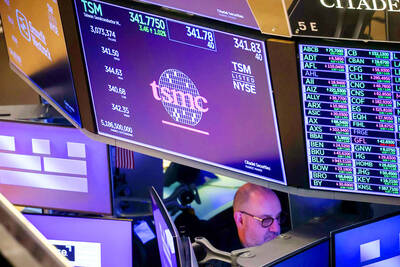
STRONG INTEREST: Analysts have pointed to optimism in TSMC’s growth prospects in the artificial intelligence era as the cause of the rising number of shareholders The number of people holding shares of chipmaker Taiwan Semiconductor Manufacturing Co (TSMC, 台積電) hit a new high last week despite a decline in its stock price, the Taiwan Depository and Clearing Corp (TDCC, 台灣集保) said. The number of TSMC shareholders rose to 2.46 million as of Friday, up 75,536 from a week earlier, TDCC data showed. The stock price fell 1.34 percent during the same week to close at NT$1,840 (US$57.55). The decline in TSMC’s share price resulted from volatility in global tech stocks, driven by rising international crude oil prices as the war against Iran continues. Dealers said
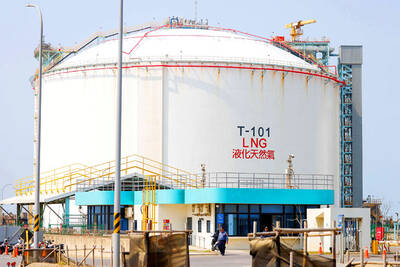
Taiwan’s natural gas supply remains stable through the end of May, despite rising concerns about potential disruptions to Qatari liquefied natural gas (LNG) supplies due to escalating conflicts in the Middle East, the Ministry of Economic Affairs said yesterday. The ministry in a statement said that Taiwan has completed preparations for natural gas supply and shipping schedules through the end of May. It has also made plans to increase natural gas imports from regions outside the Middle East in June to ensure a stable supply, it added. Taiwan sources natural gas from 14 countries and is not solely dependent on the Middle East,
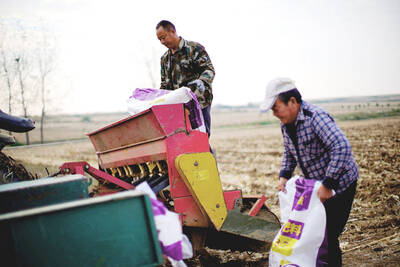
China is clamping down on fertilizer exports to protect its domestic market, industry sources said, putting an additional strain on global markets that were already grappling with shortages caused by the US-Israeli war on Iran. China is among the largest fertilizer exporters — shipping more than US$13 billion of it last year — and it has a history of controlling exports to keep prices low for farmers. Shipments through the war-blocked Strait of Hormuz account for about one-third of the sea-borne supply. This month, Beijing banned exports of nitrogen-potassium fertilizer blends and certain phosphate varieties, sources said. The ban, which has not
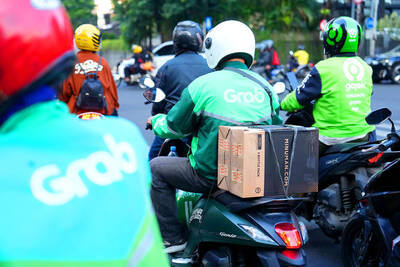
Grab Holdings Ltd agreed to buy Delivery Hero SE’s Foodpanda operations in Taiwan for US$600 million, a deal that marks its first foray outside of its Southeast Asian base. The cash acquisition will allow Grab to expand into 21 cities across Taiwan, the Singapore-based ride-hailing and delivery company said in a statement yesterday. Grab expects the transaction to be completed in the second half, subject to regulatory approvals. The purchase will give Grab a presence on the island of about 23 million people, helping it to expand beyond its intensely competitive home market. Grab has seen growth slow dramatically as it takes


 RSS
RSS