


Taiwan High Speed Rail Corp (THSRC, 台灣高鐵) yesterday said it would raise more than NT$21.7 billion through the sale of preferred shares within a year, and will use the proceeds for investment in the yet-to-be-built north-south high-speed railway.
Construction of the railway is scheduled to be completed in October 2005.
"Construction of the high-speed railway is getting inten-sive, requiring huge capital to support it," THSRC chairwoman Nita Ing (
With THSRC finding it difficult to raise funds for the rail project, the company has been seeking since January to sell preferred shares to raise capital in light of the attractiveness of their stable return guarantees and tax deductibility.
THSRC will sell its preferred shares to a designated group of investors including banks, trust companies and THSRC's board members.
Investors in the preferred shares are guaranteed a 9.5-percent dividend annually for the first two years, which is much more attractive than other investment instruments.
After three years, these investors have the right to change their preferred shares to common shares and will enjoy preferential tax rates, according to regulators.
If THSRC turns a profit in the future, investors can convert their preferred shares into common shares and share in THSRC's profits. Under the plan, the company will redeem the preferred shares after four years at the issue price, which is NT$9.3 per share.
The company plans to raise NT$100 billion out of NT$380 billion for the project from private investors.
So far, the company has held six rounds of fundraising, attracting NT$78.23 billion in investments, according to the company.
THSRC shares rose 2.56 percent to NT$6.7 per share yesterday at the Emerging Stock Market (
The company plans to list on the benchmark TAIEX after it completes testing of the southern track in the third quarter of next year, according to Arthur Chiang (江金山), the company's vice president of public affairs.
Ing yesterday said the company is sticking to its timetable to begin operations in October 2005. THSRC had completed 49.92 percent of the project as of September this year.
The railway will be nation's first to operate bullet trains, running at a top speed of 350kph between Taipei and Kaohsiung.
Travel time between the two cities will be 90 minutes, with some trains also stopping in Taoyuan, Hsinchu, Taichung, Chiayi and Tainan.
THSRC expects to transport 147,000 passengers per day in the first year of operation, and 330,000 per day after the service matures, said Edward Lin (
Lin added that the company expects to break even after 16 years.
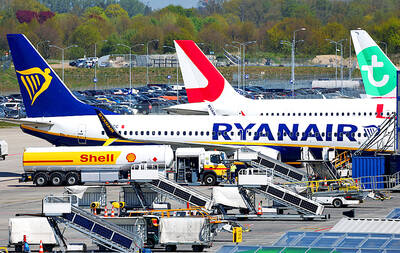
Ryanair, Transavia, Volotea and other low-cost airlines are feeling the financial pain from high jet fuel prices as a result of the Middle East war and are cutting flights. The closure of the Strait of Hormuz has taken a huge chunk of oil supplies off the market, sending the price of jet fuel soaring and triggering fears of shortages that could force airlines to cancel flights. Airlines are not waiting for a lack of supplies to react. “Travel alert: Airlines are cutting thousands of flights right now,” Travel Therapy host Karen Schaler said in an Instagram reel this past weekend.
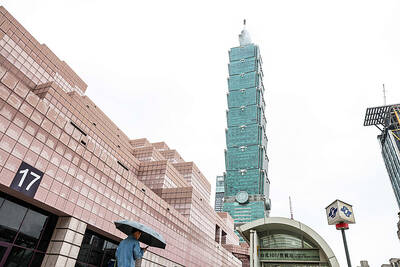
MANAGING RISKS: Taiwan has secured LNG sufficient to cover 95 percent of electricity demand for next month, UBS said, describing the government’s approach as proactive UBS Group AG has raised its forecast for Taiwan’s economic growth this year to 8 percent, up from 6.9 percent previously, and said expansion could reach as high as 8.6 percent if external energy shocks are avoided. The upgrade reflects a stronger-than-expected first-quarter performance and sustained momentum in artificial intelligence (AI)-driven exports, which UBS said are providing a firm foundation for growth despite geopolitical and energy risks. Taiwan’s GDP expanded 13.69 percent year-on-year in the first quarter, the fastest growth since the second quarter of 1987, the Directorate-General of Budget, Accounting and Statistics (DGBAS) reported on Thursday. On a seasonally

The Fair Trade Commission’s (FTC) ongoing review of Grab Holdings Ltd’s US$600 million acquisition of Foodpanda Taiwan’s operations, announced on March 23, has taken on fresh urgency as industry experts warn that the transaction could embed significant Chinese cybersecurity vulnerabilities into Taiwan’s digital infrastructure through Grab’s deep ties to autonomous-driving firm WeRide (文遠知行). Less than 16 months after the FTC blocked Uber Eats’ direct attempt to acquire Foodpanda Taiwan — citing potential combined market shares of 80 to 90 percent — the emergence of Grab as the buyer has prompted questions about whether the same competitive harm is simply being rerouted

The list of Asian stocks that benefit from business partnership with Nvidia Corp is getting longer, as the region further integrates into the artificial intelligence (AI) chip giant’s business ecosystem. Just in the past week, South Korea’s LG Electronics Inc, Taiwan’s Nanya Technology Corp (南亞科技), as well as China’s Huizhou Desay SV Automotive Co (德賽西威) and Pateo Connect Technology Shanghai Corp (博泰車聯) have become the latest to rally on news of tie-ups, supply-chain participation or product collaboration with the US chip designer. Asian suppliers account for about 90 percent of Nvidia’s production costs, up from about 65 percent last year, data compiled


 RSS
RSS