


Bangladesh’s densely populated capital, infamous for grinding gridlock, has launched its first artificial intelligence (AI) powered traffic enforcement system in a bid to bring order to one of the world’s most congested cities.
Across Dhaka, buses, cars, motorcycles and pedal rickshaws jostle for space, treating traffic signals, pedestrian crossings and even traffic police as obstacles to overcome.
On-the-spot police fines often spark arguments, confrontations are common and officers are sometimes struck by vehicles refusing to obey commands.
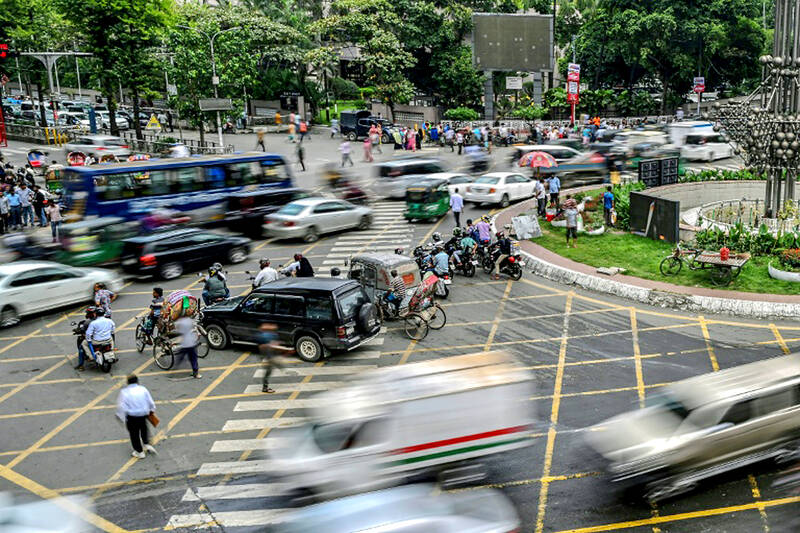
Photo: AFP
“Those who violate the rules turn against us,” traffic officer Sergeant Nazim Uddin said.
“But since AI was introduced, people behind the wheel have started obeying the law — and we have been spared the everyday quarrels.”
Despite repeated attempts to modernize traffic management, the city of more than 22 million people had remained reliant on manual control, with officers stretching ropes across roads before traffic lights turned green.
In April, Dhaka police linked traffic cameras to AI software designed to automatically detect violations.
Motorist Hannan Rahman Jibon was among the first drivers caught.
“I ran a red light and the owner of my car, who was sitting at home, received a text message saying that the vehicle had violated traffic rules,” said Jibon, who was hit with an automatic 2,000 taka (US$16) fine. “I am more careful now, with cameras installed in many different parts.”
Getting results
One study, by the US National Bureau of Economic Research, ranked Dhaka as the “slowest city” in the world.
With an average speed of just 4.8kph, according to a World Bank and Bangladesh University of Engineering and Technology study, it is quicker to walk.
City police spokesman N.M. Nasiruddin said the AI system used traffic-monitoring camera feeds — with the software identifying offences ranging from signal and lane violations to illegal parking.
Coverage does not stretch across all the city and manual traffic enforcement would be phased out over time, but police say it is changing behavior.
“We have started getting results,” Nasiruddin said. “We have prosecuted at least 300 vehicles.”
Inside a control room at police headquarters, analyst Sharmin Afroze, monitored a bank of live traffic feeds, plugged into the AI system, where violations it flags are checked by humans.
“Before, police used to stop vehicles, check papers and determine fines,” Afroze said, adding that in a single day, the system recorded about 800 traffic violations. At present, police are only fining the worst offenders, while giving the others a warning.
Do not follow rules
Still, officials admit the technology faces hurdles.
“We are facing some challenges too,” Afroze said. “For example, some number plates are blurred or too small to identify.”
Police are working with the road transport authority to address the issue, while support targeting certain traffic violations, such as vehicles driving on footpaths, would be added soon.
The system targets only motor vehicles, and police are still considering how to regulate Dhaka’s vast fleet of pedal rickshaws, a defining feature of the city’s traffic.
Hasib Mohammed Ahsan, a professor at Bangladesh University of Engineering and Technology, said the long-term success of the system would depend less on technology — and more on whether authorities consistently enforce the rules.
“We have spent huge amounts of money on traffic signals and their upgrades, but those efforts were never sustained,” Ahsan said. “We do not follow rules, there is no consistency in our planning and there is no accountability for failure.”
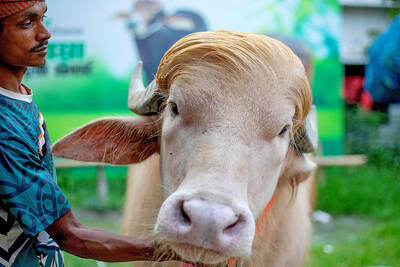
Crowds in Bangladesh are flocking to snap photographs with an unlikely social media star — an albino buffalo with flowing blond hair nicknamed “Donald Trump” that is due to be sacrificed within days. Owner Zia Uddin Mridha, 38, said his brother named the 700kg bull over its flowing helmet of hair resembling the signature look of the US president. “My younger brother picked this name because of the buffalo’s extraordinary hair,” he said at his farm in Narayanganj, just outside the capital, Dhaka. Mridha said that a constant stream of curious visitors — social media fans, onlookers and children — have come throughout

It began as a satirical online project. Now millions of young people in India are flocking to it as an outlet for their frustration. A parody political party called the Cockroach Janta Party, with the insect as its symbol, has exploded across India’s social media by turning absurdist humor into protest. Memes and short videos mocking corruption, joblessness and political dysfunction have flooded social media sites, where millions of users are embracing the cockroach — known for its ability to survive harsh conditions — as a tongue-in-cheek symbol of endurance. The online movement’s rise has been unusually rapid. The Cockroach Janta Party (CJP)
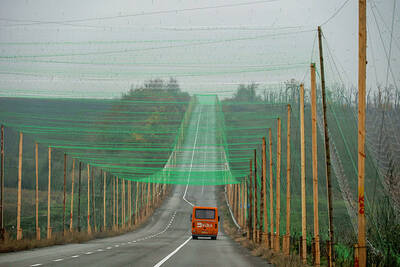
BIGGER ROLE: Beijing has said it maintains an impartial stance on the war in Ukraine, but by training Russian troops, China is far more involved than previously known China’s armed forces secretly trained about 200 Russian military personnel in China late last year, and some have since returned to fight in Ukraine, according to three European intelligence agencies and documents seen by Reuters. While China and Russia have held a number of joint military exercises since Moscow’s full-scale invasion of Ukraine in 2022, Beijing has repeatedly said that it is neutral in the conflict and presents itself as a peace mediator. The covert training sessions, which predominantly focused on the use of drones, were outlined in a dual-language Russian-Chinese agreement signed by senior Russian and Chinese officers in Beijing on
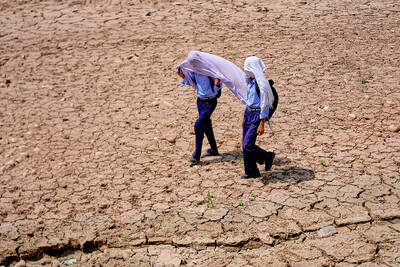
HOTTER: While Indians are accustomed to summer heat, climate change has caused northwestern India to warm faster than other parts of the country, an academic said Roads and markets have emptied during afternoons and some farmers have switched to nighttime work to avoid scorching temperatures as a heat wave grips large parts of India. The India Meteorological Department forecast maximum temperatures for yesterday of about 45°C in the capital, New Delhi, where authorities have opened temporary “cooling zones” to help people cope. The weather department warned that conditions would likely persist across several northern regions in the coming days, with temperatures staying well above seasonal averages. Authorities urged people to stay indoors during the hottest hours and take precautions against heat-related illnesses. India declares a heat wave whenever maximum temperatures


 RSS
RSS