


For construction worker Yogendra Tundre, life at a building site on the outskirts of the Indian capital New Delhi is hard enough. This year, record high temperatures are making it unbearable.
As India grapples with an unprecedented heat wave, the country’s vast majority of poor workers, who generally work outdoors, are vulnerable to the scorching temperatures.
“There is too much heat, and if we won’t work, what will we eat?” Tundre said. “For a few days, we work and then we sit idle for a few days because of tiredness and heat.”

Photo: Reuters
Temperatures in the New Delhi area have touched 45°C this year, often causing Tundre and his wife, Lata, who works at the same construction site, to become sick. That in turn means they lose income.
“Because of heat, sometimes I don’t go to work. I take days off... many times, fall sick from dehydration and then require glucose bottles [intravenous fluids],” Lata said while standing outside their house, a temporary shanty with a tin roof.
Scientists have linked the early onset of intense summers to climate change, and say more than 1 billion people in India and neighboring Pakistan are at risk from the extreme heat.
India suffered its hottest March in more than 100 years, and parts of the country experienced their highest temperatures on record last month.
Many places, including New Delhi, saw the temperature exceed 40°C. More than two dozen people have died of suspected heat strokes since late March, and power demand has hit multi-year highs.
Indian Prime Minister Narendra Modi has called on state governments to draft measures to mitigate the effects of the extreme heat.
Tundre and Lata live with their two young children in a slum near a construction site in Noida, a satellite city of New Delhi. They moved from their home state of Chhattisgarh in central India to seek work and higher wages around the capital.
On the construction site, laborers scale up walls, lay concrete and carry heavy loads, using ragged scarves around their heads as protection against the sun.
Even when the couple finish their day’s work, they have little respite as their home is hot, having absorbed the heat of the sun all day long.
Avikal Somvanshi, an urban environment researcher from India’s Centre for Science and Environment, said that heat stress was the most common cause of death from natural forces, after lightning, in the past 20 years.
“Most of these deaths occur in men aged 30 to 45. These are working class, blue-collar men who have no option but to be working in the scorching heat,” Somvanshi said.
There are no laws in India to prevent outdoor activity when temperatures exceed a certain level, unlike in some Middle-Eastern countries, Somvanshi said.

Republican US lawmakers on Friday criticized US President Joe Biden’s administration after sanctioned Chinese telecoms equipment giant Huawei unveiled a laptop this week powered by an Intel artificial intelligence (AI) chip. The US placed Huawei on a trade restriction list in 2019 for contravening Iran sanctions, part of a broader effort to hobble Beijing’s technological advances. Placement on the list means the company’s suppliers have to seek a special, difficult-to-obtain license before shipping to it. One such license, issued by then-US president Donald Trump’s administration, has allowed Intel to ship central processors to Huawei for use in laptops since 2020. China hardliners

DISADVANTAGE: Erin O’Toole, who led the Conservatives during the election campaign in 2021, estimated that the interference cost his party as many as nine legislative seats Canada’s domestic spy agency on Monday concluded that China interfered in the past two elections, an official probe heard, the firmest evidence so far of suspected Chinese meddling in Canadian politics. Canadian Prime Minister Justin Trudeau’s Liberal Party won both the elections, held in 2019 and 2021. Under pressure from opposition lawmakers unhappy about media reports on China’s possible role, Trudeau set up a commission into foreign interference. The commission was shown a slide on Monday containing an extract of a briefing in February last year from the Canadian Security Intelligence Service (CSIS). “We know that the PRC [People’s Republic of China] clandestinely
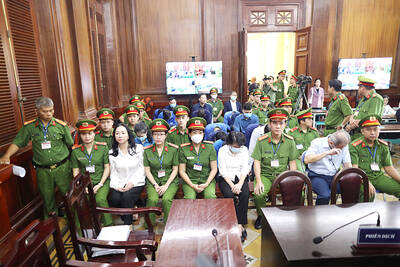
A top Vietnamese property tycoon was on Thursday sentenced to death in one of the biggest corruption cases in history, with an estimated US$27 billion in damages. A panel of three hand-picked jurors and two judges rejected all defense arguments by Truong My Lan, chair of major developer Van Thinh Phat, who was found guilty of swindling cash from Saigon Commercial Bank (SCB) over a decade. “The defendant’s actions ... eroded people’s trust in the leadership of the [Communist] Party and state,” read the verdict at the trial in Ho Chi Minh City. After the five-week trial, 85 others were also sentenced on

‘DELUSIONAL’: Targeting the families of Hamas’ leaders would not push the group to change its position or to give up its demands for Palestinians, Ismail Haniyeh said Israeli aircraft on Wednesday killed three sons of Hamas’ top political leader in the Gaza Strip, striking high-stakes targets at a time when Israel is holding delicate ceasefire negotiations with the militant group. Hamas said four of the leader’s grandchildren were also killed. Ismail Haniyeh’s sons are among the highest-profile figures to be killed in the war so far. Israel said they were Hamas operatives, and Haniyeh accused Israel of acting in “the spirit of revenge and murder.” The deaths threatened to strain the internationally mediated ceasefire talks, which appeared to gain steam in recent days even as the sides remain far


 RSS
RSS