


Right-winger Petr Fiala was yesterday named the Czech Republic’s new prime minister in an unusual ceremony, with wheelchair-bound Czech President Milos Zeman speaking from behind a plastic barrier because he has COVID-19.
Fiala, a bearded, bespectacled former political scientist, is to face the urgent task of grappling with one of the world’s highest COVID-19 infection rates, including a case of the new Omicron variant.
“I am convinced we will soon have a strong and stable government,” Fiala said at the ceremony.

Photo: Reuters
Zeman said he aimed to wrap up meetings with possible ministers by Dec. 13, “and we can then prepare the appointment of the government.”
Fiala teamed up his Civic Democratic Party with two smaller parties to form the Together alliance, which came first in last month’s general election.
The grouping, which includes the centrist Christian Democrats and the center-right TOP 09 parties, narrowly beat the ANO movement of outgoing populist billionaire Czech Prime Minister Andrej Babis.
The alliance has since forged a coalition with two centrist parties — the Mayors and Independents, and the Pirate Party — to secure a majority of 108 votes in the 200-seat parliament.
The five parties have agreed on the composition of the future government and on a policy statement.
Post-election talks were held without the 77-year-old president, who was taken to hospital by ambulance on Oct. 10, a day after the election, to be treated for liver problems.
Zeman, a left-winger with a soft spot for Russia and China, had been expected to name Fiala as prime minister on Friday, a day after he was released from Prague’s military hospital, but he was rushed back on the same day after testing positive for COVID-19.
Zeman was discharged again on Saturday.
Under the Czech constitution, Zeman also has to name the government.
Fiala has said that Zeman should name the government by mid-December as the EU member of 10.7 million people is grappling with record daily COVID-19 infections.
The surge led the outgoing government to announce new restrictions on Thursday, including the closure of restaurants, bars and discos at night, but observers say stricter measures might be needed.
Hospitals in the east are running out of capacity and some have begun to move patients to less congested facilities elsewhere in the country.
The country is also struggling with unprecedented growth in energy prices and soaring inflation, which have thrown many people into uncertainty before Christmas.

‘IN A DIFFERENT PLACE’: The envoy first visited Shanghai, where he attended a Chinese basketball playoff match, and is to meet top officials in Beijing tomorrow US Secretary of State Antony Blinken yesterday arrived in China on his second visit in a year as the US ramps up pressure on its rival over its support for Russia while also seeking to manage tensions with Beijing. The US diplomat tomorrow is to meet China’s top brass in Beijing, where he is also expected to plead for restraint as Taiwan inaugurates president-elect William Lai (賴清德), and to raise US concerns on Chinese trade practices. However, Blinken is also seeking to stabilize ties, with tensions between the world’s two largest economies easing since his previous visit in June last year. At the
Nearly half of China’s major cities are suffering “moderate to severe” levels of subsidence, putting millions of people at risk of flooding, especially as sea levels rise, according to a study of nationwide satellite data released yesterday. The authors of the paper, published by the journal Science, found that 45 percent of China’s urban land was sinking faster than 3mm per year, with 16 percent at more than 10mm per year, driven not only by declining water tables, but also the sheer weight of the built environment. With China’s urban population already in excess of 900 million people, “even a small portion

UNSETTLING IMAGES: The scene took place in front of TV crews covering the Trump trial, with a CNN anchor calling it an ‘emotional and unbelievably disturbing moment’ A man who doused himself in an accelerant and set himself on fire outside the courthouse where former US president Donald Trump is on trial has died, police said yesterday. The New York City Police Department (NYPD) said the man was declared dead by staff at an area hospital. The man was in Collect Pond Park at about 1:30pm on Friday when he took out pamphlets espousing conspiracy theories, tossed them around, then doused himself in an accelerant and set himself on fire, officials and witnesses said. A large number of police officers were nearby when it happened. Some officers and bystanders rushed
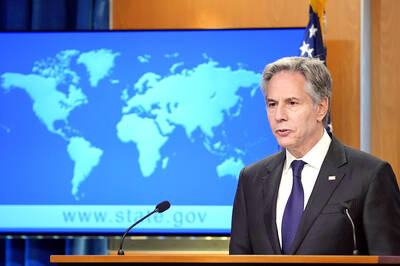
Beijing is continuing to commit genocide and crimes against humanity against Uyghurs and other Muslim minorities in its western Xinjiang province, U.S. Secretary of State Antony Blinken said in a report published on Monday, ahead of his planned visit to China this week. The State Department’s annual human rights report, which documents abuses recorded all over the world during the previous calendar year, repeated language from previous years on the treatment of Muslims in Xinjiang, but the publication raises the issue ahead of delicate talks, including on the war in Ukraine and global trade, between the top U.S. diplomat and Chinese


 RSS
RSS