


Lausanne, the capital of Olympic sport overlooking Lake Geneva in Switzerland, is reeling after discovering that much of its soil is polluted with toxic compounds belched out by an old incinerator.
The situation, which has troubling implications for children and eating home-grown food, is unprecedented in the wealthy country, which prides itself on its pristine mountains, lakes and pastures.
A domestic waste incineration plant in the Alpine nation’s fourth-biggest city — closed in 2005 — is being blamed for the dioxin fallout.
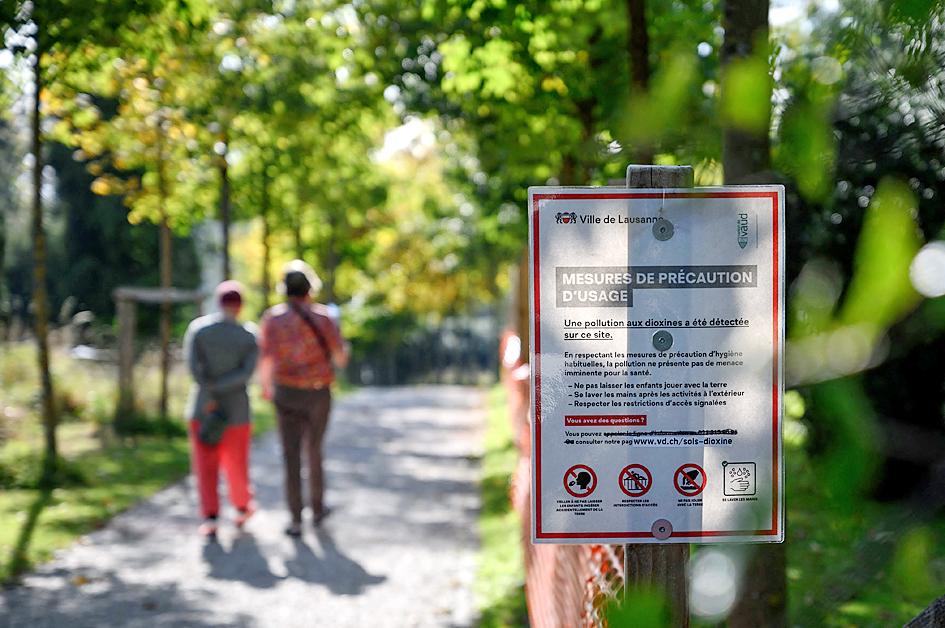
Photo: AFP
Dioxins, which belong to the so-called “dirty dozen” dangerous chemicals known as persistent organic pollutants, have the potential to be highly toxic. They have been shown to affect several organs and systems.
The problem was discovered by sheer chance between January and May at a planned new ecological allotment in the city.
For years, pollution monitoring had focused on air and water.
“As we did not look for dioxins, we never found them,” said Natacha Litzistorf, the city councilor for the environment.
The discovery triggered soil analysis measurements at 126 sites across the city. Experts also looked at the risks associated with exposure to polluted soils.
This week, Lausanne announced that those studies found the dioxin levels, and the expanse of the affected area, were much worse than previously thought.
The city has issued a map showing four concentric rings, with zones containing concentrations in the soil of 20 to 50 nanograms (ng) per kilogram, 50 to 100ng, 100 to 200ng and then more than 200ng in the middle. A peak of 640ng per kilogram was recorded in the city center. The affected zone stretches 5.25km inland and measures about 3.6km across.
People have been instructed to wash fruit and vegetables grown in gardens and allotments and wash their hands after touching the soil.
Parents must also stop children under the age of four from ingesting soil, for example by touching their mouths after playing on the ground. Warning signs have been installed around the city’s parks and playgrounds.
“We quickly suspected the cause was linked to a former incinerator,” Litzistorf said.
The Vallon plant opened in 1958 and was initially welcomed as a way of dealing with the city’s garbage.
“At the time, it was thought much better to site waste incinerators in the city center to protect agriculture in the countryside,” Litzistorf said.
The dioxin pollution dates from 1958 to 1982, when the Vallon filters were upgraded to environmental norms.
Didier Burgi, who owns a vegetable garden plot, said the discovery has sparked questions among veteran home growers.
“We are not going to eat the squashes. We don’t have a lot of them, but there was specific information about them and we’re not going to tempt the devil,” he said.
The major Chatelard allotment, near the new soccer stadium on the edge of the city, heard on Thursday that it had readings under 20ng.
Plot holder Jose Torres compared his imperfect tomatoes to the flawless ones in supermarkets.
“Everything you buy is full of chemicals,” he said. “From my plot, I know what I’m eating.”
Jacqueline Felder, tilling her beans, spinach, lettuce and carrots in the afternoon sunshine, said: “I’ve been growing vegetables for 15 years. We are not worried.”
“People are afraid of everything these days,” she said. “The Earth is our mother. Respect it.”
The WHO says short-term exposure to high levels of dioxins can result in skin lesions and altered liver function.
Long-term exposure is linked to impairment of the immune system, the developing nervous system, the endocrine system and reproductive functions.
Litzistorf said she was not aware of anyone coming forward with physical conditions linked to dioxin pollution.
However, the question of potential liability remains unresolved, as does the issue of what to do next, as the dioxin hunt expands.
Whether the soil can be cleaned up, on such a wide scale, “is the question that everyone is asking,” said Litzistorf — along with who should do it, how, and how much it might cost.

Republican US lawmakers on Friday criticized US President Joe Biden’s administration after sanctioned Chinese telecoms equipment giant Huawei unveiled a laptop this week powered by an Intel artificial intelligence (AI) chip. The US placed Huawei on a trade restriction list in 2019 for contravening Iran sanctions, part of a broader effort to hobble Beijing’s technological advances. Placement on the list means the company’s suppliers have to seek a special, difficult-to-obtain license before shipping to it. One such license, issued by then-US president Donald Trump’s administration, has allowed Intel to ship central processors to Huawei for use in laptops since 2020. China hardliners

Conjoined twins Lori and George Schappell, who pursued separate careers, interests and relationships during lives that defied medical expectations, died this month in Pennsylvania, funeral home officials said. They were 62. The twins, listed by Guinness World Records as the oldest living conjoined twins, died on April 7 at the Hospital of the University of Pennsylvania, obituaries posted by Leibensperger Funeral Homes of Hamburg said. The cause of death was not detailed. “When we were born, the doctors didn’t think we’d make 30, but we proved them wrong,” Lori said in an interview when they turned 50, the Philadelphia Inquirer reported. The
RAMPAGE: A Palestinian man was left dead after dozens of Israeli settlers searching for a missing 14-year-old boy stormed a village in the Israeli-occupied West Bank US President Joe Biden on Friday said he expected Iran to attack Israel “sooner, rather than later” and warned Tehran not to proceed. Asked by reporters about his message to Iran, Biden simply said: “Don’t,” underscoring Washington’s commitment to defend Israel. “We are devoted to the defense of Israel. We will support Israel. We will help defend Israel and Iran will not succeed,” he said. Biden said he would not divulge secure information, but said his expectation was that an attack could come “sooner, rather than later.” Israel braced on Friday for an attack by Iran or its proxies as warnings grew of

A prominent Christian leader has allegedly been stabbed at the altar during a Mass yesterday in southwest Sydney. Bishop Mar Mari Emmanuel was saying Mass at Christ The Good Shepherd Church in Wakeley just after 7pm when a man approached him at the altar and allegedly stabbed toward his head multiple times. A live stream of the Mass shows the congregation swarm forward toward Emmanuel before it was cut off. The church leader gained prominence during the COVID-19 pandemic, amassing a large online following, Officers attached to Fairfield City police area command attended a location on Welcome Street, Wakeley following reports a number


 RSS
RSS