


Afghan teenager Amena saw dozens of classmates killed when her girls’ school was targeted by an Islamic State bomb attack in May, but she was determined to continue her education.
Now, like most secondary school girls in the country, she is banned from lessons altogether after the Taliban government excluded them from returning to class one month ago.
“I wanted to study, see my friends and have a bright future, but now I am not allowed,” 16-year-old Amena told reporters at her home in western Kabul. “This situation makes me feel awful. Since the Taliban arrived, I am very sad and angry.”
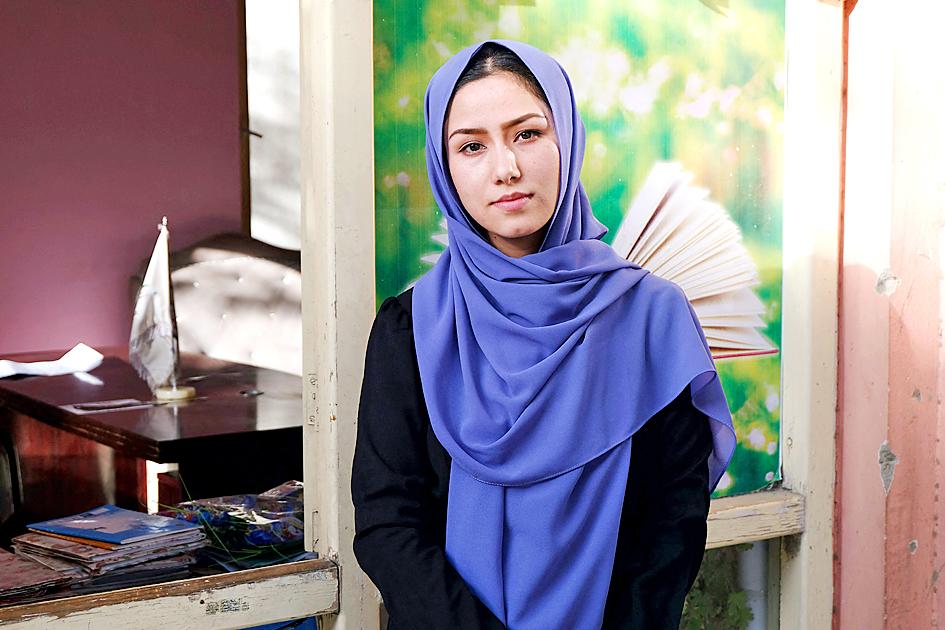
Photo: AFP
On Sept. 18, Afghanistan’s new Islamist rulers ordered male teachers and boys aged 13 and over back to secondary schools, picking up an academic year already cut short by violence and the COVID-19 pandemic.
However, there was no mention of female teachers or girl pupils.
The Taliban later said older girls can return to secondary schools, which were already mostly split by gender, but only once security and stricter segregation under their interpretation of Islamic law could be ensured.
Reports have emerged of girls going back to a few high schools — such as in Kunduz Province where the Taliban promoted the return with a stage-managed rally.
The de facto Taliban education minister told the UN International Children’s Emergency Fund (UNICEF) that a framework to allow all girls to go to secondary school would be announced soon, a senior UNICEF executive said on Friday.
However, for now, the vast majority are barred from lessons across the country of about 39 million people, including in the capital, Kabul.
Meanwhile, primary schools have reopened for all children and women can go to private universities, although with tough restrictions on their clothes and movement.
Amena lives just a short walk from her Sayed Al-Shuhada High School, where 85 people — mainly young girls — perished in the May bomb attack.
“Innocent girls were killed,” Amena said, her eyes welling up. “I saw with my own eyes the dying and wounded girls. However, I still wanted to go to school again.”
Amena would be in grade 10 studying her favorite subjects such as biology, but instead is stuck inside with a handful of books doing “nothing special.”
The teenager said she dreamt of becoming a journalist, but now has “no hope in Afghanistan.”
Her siblings help her at home, and occasionally she gets lessons from a psychologist who comes to see her younger sister, still traumatized by the school attack.
“They say: ‘Study if you cannot go to school — study at home so that you may become someone in the future,’” Amena said.
“My brother brings home storybooks and I read them,” she said. “And I always watch the news.”
However, she does not understand why boys are allowed to study and girls are not.
“Half of the society is made up of girls and the other half is made up of boys. There is no difference between them,” she said. “Why can’t we study? Are we not part of society? Why should only boys have a future?”
After US-led forces ousted the Taliban in 2001, progress was made in girls’ education.
The number of schools tripled and female literacy nearly doubled to 30 percent, but the change was largely limited to the cities.
“Afghan women have made great achievements in the past 20 years,” said Nasrin Hasani, a 21-year-old teacher at a Kabul secondary school who helps out with primary pupils.
However, the current situation has “lowered both our and the students’ morale,” she said, questioning the Taliban’s reasoning.
“As far as we all know, the religion of Islam has never hindered the education and work of women,” she said.
Hasani said she has not experienced any direct threats from the Taliban.
However, Amnesty International reported that one high-school teacher received death threats and was summoned for prosecution because she used to teach coeducational sport.
Hasani said she was clinging to hope that the Taliban will be “a little different” from their brutal 1996-2001 regime, when women were not even allowed out of their homes unchaperoned.
Born years after 2001, Zainab has no memories of that period and loved going to school until the Taliban directive.
The 12-year-old was stuck looking out of the window with a “terrible feeling” last month when boys went back to school.
“It is quite obvious that things get worse day by day,” said Zainab, whose name has been changed to protect her identity.
Her 16-year-old sister, Malalay, said tearfully that she had “feelings of despair and fear.”
Malalay, whose name has also been changed, passes her time helping around the house, cleaning, washing dishes and doing laundry.
She said she tries not to cry in front of her mother, “because there are a lot of pressures on her.”
The teen had dreams of promoting women’s rights and speaking out against the men depriving her of her rights.
“My rights are to go to school and university,” she said. “All my dreams and plans are now buried.”

Republican US lawmakers on Friday criticized US President Joe Biden’s administration after sanctioned Chinese telecoms equipment giant Huawei unveiled a laptop this week powered by an Intel artificial intelligence (AI) chip. The US placed Huawei on a trade restriction list in 2019 for contravening Iran sanctions, part of a broader effort to hobble Beijing’s technological advances. Placement on the list means the company’s suppliers have to seek a special, difficult-to-obtain license before shipping to it. One such license, issued by then-US president Donald Trump’s administration, has allowed Intel to ship central processors to Huawei for use in laptops since 2020. China hardliners

Conjoined twins Lori and George Schappell, who pursued separate careers, interests and relationships during lives that defied medical expectations, died this month in Pennsylvania, funeral home officials said. They were 62. The twins, listed by Guinness World Records as the oldest living conjoined twins, died on April 7 at the Hospital of the University of Pennsylvania, obituaries posted by Leibensperger Funeral Homes of Hamburg said. The cause of death was not detailed. “When we were born, the doctors didn’t think we’d make 30, but we proved them wrong,” Lori said in an interview when they turned 50, the Philadelphia Inquirer reported. The
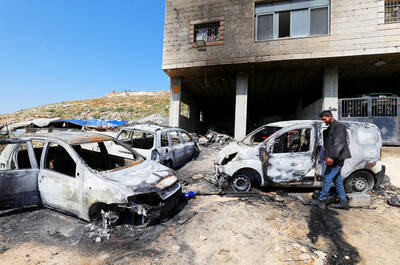
RAMPAGE: A Palestinian man was left dead after dozens of Israeli settlers searching for a missing 14-year-old boy stormed a village in the Israeli-occupied West Bank US President Joe Biden on Friday said he expected Iran to attack Israel “sooner, rather than later” and warned Tehran not to proceed. Asked by reporters about his message to Iran, Biden simply said: “Don’t,” underscoring Washington’s commitment to defend Israel. “We are devoted to the defense of Israel. We will support Israel. We will help defend Israel and Iran will not succeed,” he said. Biden said he would not divulge secure information, but said his expectation was that an attack could come “sooner, rather than later.” Israel braced on Friday for an attack by Iran or its proxies as warnings grew of

IN PURSUIT: Israel’s defense minister said the revenge attacks by Israeli settlers would make it difficult for security forces to find those responsible for the 14-year-old’s death Israeli Prime Minister Benjamin Netanyahu on Saturday condemned the “heinous murder” of an Israeli teenager in the occupied West Bank as attacks on Palestinian villages intensified following news of his death. After Benjamin Achimeir, 14, was reported missing near Ramallah on Friday, hundreds of Jewish settlers backed by Israeli forces raided nearby Palestinian villages, torching vehicles and homes, leaving at least one villager dead and dozens wounded. The attacks escalated in several villages on Saturday after Achimeir’s body was found near the Malachi Hashalom outpost. Agence France-Presse correspondents saw smoke rising from burned houses and fields. Mayor Amin Abu Alyah, of the


 RSS
RSS