


As the sound of gunfire erupts near her office, Celia Umenza takes the briefest of pauses from discussing her battle against farming expansion and mining that threaten indigenous land and water in Colombia.
Death is a constant companion for indigenous defenders of nature in the violence-ridden nation and Umenza has already survived three attempts on her life.
While speaking to Agence France-Presse, bursts of gunfire and explosions reverberate in the mountains near her office in Toribio, in the rural Cauca department.
She stops speaking for just a moment, before resuming the interview, seemingly indifferent to the looming threat that has become a part of life for many in Colombia.
Non-governmental organization Global Witness in a report released on Sunday said that Colombia last year was the most dangerous nation for land and environment defenders for the second consecutive year, accounting for 65 of the 227 killings reported worldwide.
“We have the threat of government repression, of retaliation by the guerrillas and also by the paramilitaries,” Umenza, 48, said.
The most recent attack on her life was in 2014.
“A neighbor was driving me in a van ... they riddled the van with bullets,” she said.
Global Witness said that last year was the deadliest on record for environmentalists since 2012, when its records begin.
One-third of deadly attacks were on indigenous peoples, and many were linked to opposition to logging, mining, agribusiness, hydroelectric dams and other infrastructure threatening natural resources that communities have relied on for generations.
Since the 1970s, the indigenous peoples of the Cauca region of southwest Colombia have been fighting an expansion by sugarcane growers they say is driving them from the fertile lowlands they rely on for their survival, and destroying the forest.
“We no longer have those forests that used to exist, we no longer have that fauna, that flora. It is really worrying,” Umenza said.
The dispute is also about water. Unlike the native vegetation, the sugar cane “draws a lot of water and little by little” has been drying up the streams, she said.
In its report, Global Witness said 17 people worldwide were killed last year for their activism against agribusiness, and 20 in disputes over water and dams.
“Companies have been acting irresponsibly for decades, contributing to, and benefiting from, attacks on land and environmental defenders,” the report said.
Near Toribio, where Umenza lives and works, illegal gold mining contaminates water with mercury. Further north, pesticides used in the cultivation of marijuana poison the soil.
Both illegal activities finance dissident Revolutionary Armed Forces of Colombia (FARC) guerillas, who rejected a peace pact with the government in 2016 to end a near six-year civil war, as well as fighters of the last remaining rebel group the National Liberation Army, and paramilitary forces that are still active.
Paramilitary and criminal groups have increased their control of rural areas through violence, the Global Witness report said.
“Those seeking to protect their land and environment are increasingly being caught up in the crosshairs of this violence — with those protecting indigenous land particularly at risk,” it said.
Frequently the victims are community members seeking to benefit from a government program to convert illegal coca crops, from which cocaine is derived, into legal ones.
The situation was worsened by the COVID-19 pandemic, with lockdowns leading to defenders being targeted in their homes while government protection measures were being cut.
To make matters even more complicated, Umenza said legal companies benefit from the illegal gold extraction, buying at low prices.
She is protected by the Indigenous Guard, a self-defense organization that confronts perceived intruders armed with batons and two-way radios, but no guns.
“In the indigenous territories we have fortunately managed to keep mining out,” Umenza said.
However, the price is high, with one member of the guard killed every week so far this year, she said.
Umenza said that she has received countless death threats since 2001.
The first attempt on her life came in 2005, by FARC guerillas, who shot at her while she was walking in the countryside, she said.
Five years later, continued threats forced her to move — the first of several involuntary relocations, the most recent of which was in January.
The Colombian National Protection Unit in 2011 assigned a vehicle escort to protect Umenza and four other threatened people in the Toribio region.
A few months ago, it offered her a bodyguard and a bullet-proof vest.
Umenza “did not accept because walking around in the vest makes me feel more vulnerable,” like a moving target, she said.
Since 2009, Umenza’s three children have been living far away for their own safety, and she says their father left her because he “could not stand” the constant threats, attacks and regular uprooting.
She has a new partner — but is realistic about her happy ever after.
“It is not easy living with someone who today takes you on the run and tomorrow, who knows,” she said.

Republican US lawmakers on Friday criticized US President Joe Biden’s administration after sanctioned Chinese telecoms equipment giant Huawei unveiled a laptop this week powered by an Intel artificial intelligence (AI) chip. The US placed Huawei on a trade restriction list in 2019 for contravening Iran sanctions, part of a broader effort to hobble Beijing’s technological advances. Placement on the list means the company’s suppliers have to seek a special, difficult-to-obtain license before shipping to it. One such license, issued by then-US president Donald Trump’s administration, has allowed Intel to ship central processors to Huawei for use in laptops since 2020. China hardliners

Conjoined twins Lori and George Schappell, who pursued separate careers, interests and relationships during lives that defied medical expectations, died this month in Pennsylvania, funeral home officials said. They were 62. The twins, listed by Guinness World Records as the oldest living conjoined twins, died on April 7 at the Hospital of the University of Pennsylvania, obituaries posted by Leibensperger Funeral Homes of Hamburg said. The cause of death was not detailed. “When we were born, the doctors didn’t think we’d make 30, but we proved them wrong,” Lori said in an interview when they turned 50, the Philadelphia Inquirer reported. The
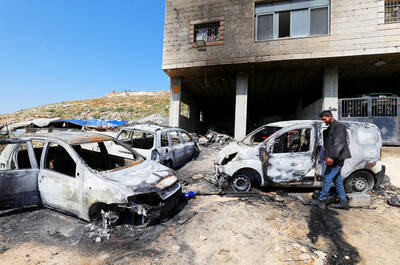
RAMPAGE: A Palestinian man was left dead after dozens of Israeli settlers searching for a missing 14-year-old boy stormed a village in the Israeli-occupied West Bank US President Joe Biden on Friday said he expected Iran to attack Israel “sooner, rather than later” and warned Tehran not to proceed. Asked by reporters about his message to Iran, Biden simply said: “Don’t,” underscoring Washington’s commitment to defend Israel. “We are devoted to the defense of Israel. We will support Israel. We will help defend Israel and Iran will not succeed,” he said. Biden said he would not divulge secure information, but said his expectation was that an attack could come “sooner, rather than later.” Israel braced on Friday for an attack by Iran or its proxies as warnings grew of

IN PURSUIT: Israel’s defense minister said the revenge attacks by Israeli settlers would make it difficult for security forces to find those responsible for the 14-year-old’s death Israeli Prime Minister Benjamin Netanyahu on Saturday condemned the “heinous murder” of an Israeli teenager in the occupied West Bank as attacks on Palestinian villages intensified following news of his death. After Benjamin Achimeir, 14, was reported missing near Ramallah on Friday, hundreds of Jewish settlers backed by Israeli forces raided nearby Palestinian villages, torching vehicles and homes, leaving at least one villager dead and dozens wounded. The attacks escalated in several villages on Saturday after Achimeir’s body was found near the Malachi Hashalom outpost. Agence France-Presse correspondents saw smoke rising from burned houses and fields. Mayor Amin Abu Alyah, of the


 RSS
RSS