


India struggled to contain one of the world’s worst COVID-19 outbreaks with nearly 400,000 new infections reported yesterday, as more international aid arrived in the South Asian nation to help end the crisis.
Surges in Brazil and Canada also highlighted the persistent threat of the COVID-19 pandemic, with the virus’ death toll approaching 3.2 million even as many nations ramp up their vaccination drives.
India expanded its vaccination program to all adults on Saturday, but many of its states are struggling with shortages, despite an export freeze for shots produced in the country.

Photo: AP
Long queues were seen at vaccination centers in cities across India last weekend, with people desperate to be inoculated against a disease that has overwhelmed the country’s healthcare system, and even crematoriums and graveyards.
“We are here early in the morning to get vaccinated... I left my three-year-old at home to get vaccinated,” Megha Srivastava, 35, said at a private vaccination center in New Delhi. “It is a necessity now. We are seeing so many people testing positive.”
Social media platforms have been flooded with desperate pleas from people looking for oxygen cylinders, medicines and hospital beds as the COVID-19 wave causes widespread shortages.
India yesterday reported more than 392,000 new cases and nearly 3,700 COVID-19 deaths.
The dire situation prompted many nations including Taiwan, the US and the UK to dispatch emergency supplies including oxygen generators, masks and vaccines.
Yesterday, aid from France reached India, including eight oxygen generator plants and 28 ventilators, adding to the 120 ventilators from Germany that arrived on the day before.
New Delhi, one of the hardest-hit parts of the country, on Saturday extended its lockdown by a week.
US National Institute of Allergy and Infectious Diseases Director Anthony Fauci said that India should go into lockdown to fight this wave.
However, Indian Prime Minister Narendra Modi’s government has resisted imposing a national shutdown, despite many states and territories having imposed restrictions.
Known global infections are approaching 152 million, and fresh waves have also shaken many countries in the Americas.
Brazil, the worst-hit Latin American nation, has crossed 400,000 COVID-19 deaths — second only to the US, with many of its hospitals pushed to the brink of collapse.
A case surge in Canada’s most populous province of Ontario has been so intense that Ottawa sent the military and the Red Cross to the most affected areas to help care for critical patients.
Ontario’s healthcare system is nearing the breaking point, said Farial Faquiry, an intensive care nurse at Toronto’s Humber River Hospital.
“We’re stretched thin,” Faquiry said. “We’re tired and exhausted. Just exhausted.”
Many health professionals and caregivers are also frustrated with people who have not followed precautions.
“I think we all feel we have been let down a little bit by society,” said Jamie Spiegelman, a physician at the hospital.
Canada’s vaccine rollout has also stumbled because of supply issues, unlike its southern neighbor, the US, which has given at least one dose to more than half its adult population.
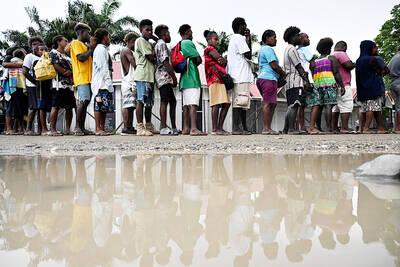
SEEKING CHANGE: A hospital worker said she did not vote in previous elections, but ‘now I can see that maybe my vote can change the system and the country’ Voting closed yesterday across the Solomon Islands in the south Pacific nation’s first general election since the government switched diplomatic allegiance from Taiwan to Beijing and struck a secret security pact that has raised fears of the Chinese navy gaining a foothold in the region. The Solomon Islands’ closer relationship with China and a troubled domestic economy weighed on voters’ minds as they cast their ballots. As many as 420,000 registered voters had their say across 50 national seats. For the first time, the national vote also coincided with elections for eight of the 10 local governments. Esther Maeluma cast her vote in the
Nearly half of China’s major cities are suffering “moderate to severe” levels of subsidence, putting millions of people at risk of flooding, especially as sea levels rise, according to a study of nationwide satellite data released yesterday. The authors of the paper, published by the journal Science, found that 45 percent of China’s urban land was sinking faster than 3mm per year, with 16 percent at more than 10mm per year, driven not only by declining water tables, but also the sheer weight of the built environment. With China’s urban population already in excess of 900 million people, “even a small portion

UNSETTLING IMAGES: The scene took place in front of TV crews covering the Trump trial, with a CNN anchor calling it an ‘emotional and unbelievably disturbing moment’ A man who doused himself in an accelerant and set himself on fire outside the courthouse where former US president Donald Trump is on trial has died, police said yesterday. The New York City Police Department (NYPD) said the man was declared dead by staff at an area hospital. The man was in Collect Pond Park at about 1:30pm on Friday when he took out pamphlets espousing conspiracy theories, tossed them around, then doused himself in an accelerant and set himself on fire, officials and witnesses said. A large number of police officers were nearby when it happened. Some officers and bystanders rushed

HYPOCRISY? The Chinese Ministry of Foreign Affairs yesterday asked whether Biden was talking about China or the US when he used the word ‘xenophobic’ US President Joe Biden on Wednesday called for a hike in steel tariffs on China, accusing Beijing of cheating as he spoke at a campaign event in Pennsylvania. Biden accused China of xenophobia, too, in a speech to union members in Pittsburgh. “They’re not competing, they’re cheating. They’re cheating and we’ve seen the damage here in America,” Biden said. Chinese steel companies “don’t need to worry about making a profit because the Chinese government is subsidizing them so heavily,” he said. Biden said he had called for the US Trade Representative to triple the tariff rates for Chinese steel and aluminum if Beijing was


 RSS
RSS