


In the eight years that Basudev Pokharel has worked as a forest guard, he has rarely seen a fire as huge as the one that raged through his village in western Nepal last month.
Hundreds of such fires have been spreading across the country since November last year, in the worst wildfire season Nepal has seen in a decade.
The night the blaze reached Pokharel’s village of Sungure, in Dang District, a neighbor woke him to warn him.
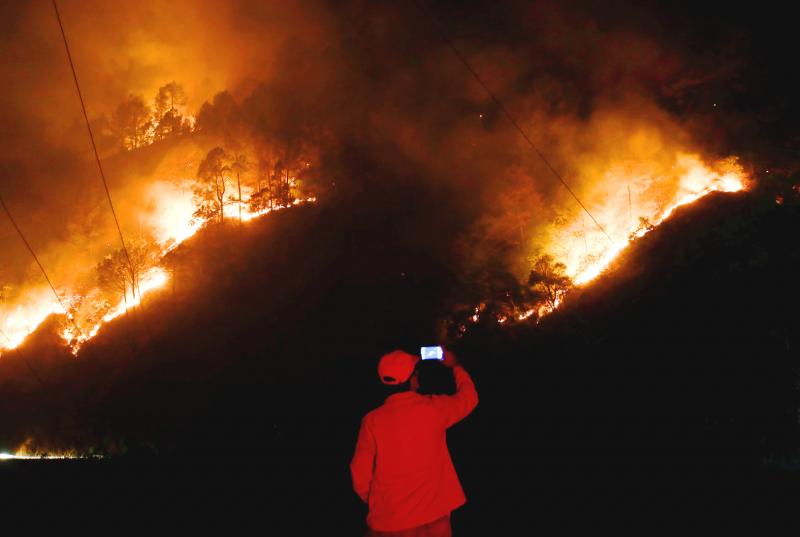
Photo: Reuters
“We tried to control the fire, but it spread so rapidly that we were helpless,” the 55-year-old said. “The fire came very close to my house and burned all the hay that I had piled up to feed the animals. Luckily, I could save my house.”
The government sent a fire control expert to direct the villagers as they tackled the blaze, and by the next day it was out — but only after destroying more than 80 hectares of forest.
“That night, I couldn’t sleep the whole night,” Pokharel said, as he worried that another fire would make its way to Sungure — one the villagers could not fight.
As large swathes of Nepal and some northern parts of neighboring India continue to burn, the smoke and ash have caused air pollution levels to spike, with experts saying that increasingly frequent droughts linked to climate change could make massive wildfires more common.
Pokharel said the fire reached his village through the surrounding forest, where a lack of significant rainfall for the past six months has left leaves tinder dry.
Villagers said the fire has been a disaster for the 460 households who live near the forest and rely on it for food and fuel, in a country that prides itself on its community-managed forests.
“Many people here depend on firewood as their cooking fuel and much of it has been destroyed by the forest fire,” said Bimal Kumar Bhusal, one of the villagers.
“We are also going to face a shortage of grass [for animals], as it has all been burned down,” he added.
Bijay Raj Subedi, a forest officer in Dang, said wildfires in Nepal are most often caused by humans, either internationally or by accident, such as when a cigarette is carelessly discarded.
Villagers regularly set fire to trees to create charcoal, to scare animals out of hiding so they can hunt them, or to clear areas in the hope of encouraging the growth of mushrooms or new flushes of grass.
However, an unusually dry winter this year has meant smaller fires can more easily spread out of control, Subedi said.
“There had been almost no forest fire incidents in Dang last year, as we had good rainfall,” he said, adding that this year there have been more than 20 major forest fires in the district.
Figures from the Nepalese Department of Hydrology and Meteorology show there has been about 15mm of rain in Nepal this winter, 75 percent less than average.
The Nepalese Disaster Risk Reduction and Management Agency says that more than 2,700 fire incidents were recorded between the middle of November last year and late last month, a period that covers most of the dry season.
This is the worst fire season in terms of number of fires since the country started keeping records in 2012, and more than double the previous high of 989 wildfires in the 2015-2016 dry season.
The air quality index (AQI) has recorded pollution levels in Dang above 100 most days since last month. An AQI level below 50 is considered good.
Last week, levels in the capital, Kathmandu, were above 470, which is categorized as hazardous.
Schools across Nepal were closed for four days at the end of last month, as students complained of irritation in their eyes and throats from the smoke.
Although schools are open now, “students are [still] missing class due to different health issues,” said Bhakta Bahadur Marsangi Magar, vice principal of Saraswati Higher Secondary School in Pyuthan, a district next to Dang.
“Those who are attending are not concentrating much, as almost everyone is having issues such as burning eyes,” Magar said.
However, there was no point to closing schools again, “as we are not sure when the pollution level will come down,” he said.
Nearly half of China’s major cities are suffering “moderate to severe” levels of subsidence, putting millions of people at risk of flooding, especially as sea levels rise, according to a study of nationwide satellite data released yesterday. The authors of the paper, published by the journal Science, found that 45 percent of China’s urban land was sinking faster than 3mm per year, with 16 percent at more than 10mm per year, driven not only by declining water tables, but also the sheer weight of the built environment. With China’s urban population already in excess of 900 million people, “even a small portion

UNSETTLING IMAGES: The scene took place in front of TV crews covering the Trump trial, with a CNN anchor calling it an ‘emotional and unbelievably disturbing moment’ A man who doused himself in an accelerant and set himself on fire outside the courthouse where former US president Donald Trump is on trial has died, police said yesterday. The New York City Police Department (NYPD) said the man was declared dead by staff at an area hospital. The man was in Collect Pond Park at about 1:30pm on Friday when he took out pamphlets espousing conspiracy theories, tossed them around, then doused himself in an accelerant and set himself on fire, officials and witnesses said. A large number of police officers were nearby when it happened. Some officers and bystanders rushed

Beijing is continuing to commit genocide and crimes against humanity against Uyghurs and other Muslim minorities in its western Xinjiang province, U.S. Secretary of State Antony Blinken said in a report published on Monday, ahead of his planned visit to China this week. The State Department’s annual human rights report, which documents abuses recorded all over the world during the previous calendar year, repeated language from previous years on the treatment of Muslims in Xinjiang, but the publication raises the issue ahead of delicate talks, including on the war in Ukraine and global trade, between the top U.S. diplomat and Chinese

‘IN A DIFFERENT PLACE’: The envoy first visited Shanghai, where he attended a Chinese basketball playoff match, and is to meet top officials in Beijing tomorrow US Secretary of State Antony Blinken yesterday arrived in China on his second visit in a year as the US ramps up pressure on its rival over its support for Russia while also seeking to manage tensions with Beijing. The US diplomat tomorrow is to meet China’s top brass in Beijing, where he is also expected to plead for restraint as Taiwan inaugurates president-elect William Lai (賴清德), and to raise US concerns on Chinese trade practices. However, Blinken is also seeking to stabilize ties, with tensions between the world’s two largest economies easing since his previous visit in June last year. At the


 RSS
RSS