


There would be no quick answers concerning the origins of COVID-19, one of the WHO experts on a mission to the virus’ ground zero in central China said.
Hung Nguyen-Viet, who is visiting various sites in the city of Wuhan with the team, said that starting the investigation more than one year after the COVID-19 pandemic began was not ideal, but added that the mission was progressing well.
The politically sensitive trip — which Beijing had delayed throughout the first year of the pandemic — aims to explore how COVID-19 first jumped from animals to humans before killing millions worldwide since it first emerged in Wuhan in late 2019.
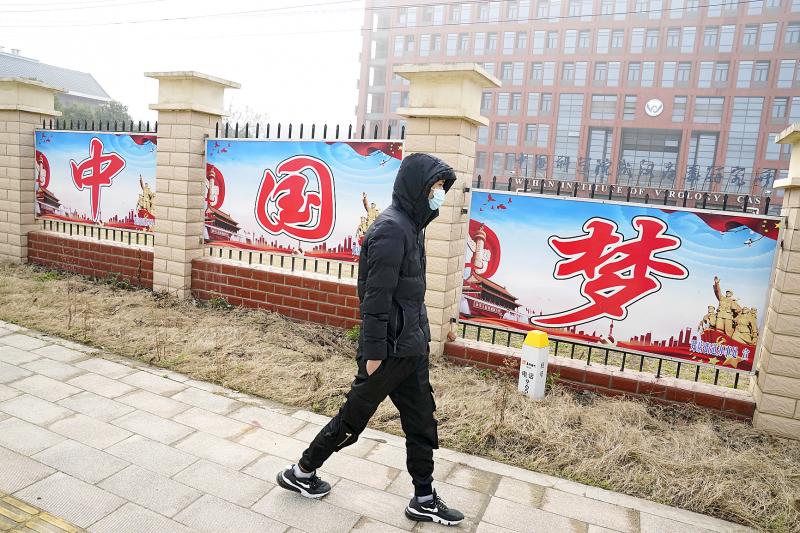
Photo: AP
Nguyen-Viet said in a video interview that it was a “difficult question and a difficult study,” and the world should not expect quick answers.
“It is very unlikely that [in] such a short mission, [we] would have a very advanced understanding or definite answers to the question,” he said. “I think that we need to be patient. We are in a process, and we need time and effort to understand it.”
Nguyen-Viet, coleader of the animal and human health program at the International Livestock Research Institute in Nairobi, also said that it would have been preferable for the team to have visited Wuhan earlier.
“Obviously, it is ideal to do the study at that time or right after,” he said.
More than a year has elapsed since the first infections with the then-unknown coronavirus emerged in Wuhan, and the WHO team is only expected to spend about two weeks in total on the ground.
Since arriving in Wuhan, the group has been to a number of key sites — including hospitals that treated early COVID-19 infections and the now-infamous Huanan Seafood Market where the first cluster of infections emerged.
“We learned about the background, different cases at the market, so it helped me to construct the story and understand better the context of that market,” Nguyen-Viet said.
On Wednesday, the group visited the Wuhan Institute of Virology — another much-watched spot since its high-security laboratory has been linked with a number of conspiracy theories about the origin of the virus. There was speculation early in the pandemic that it could have leaked from the institute, although there is no evidence to back up that theory.
Nguyen-Viet, an animal health specialist, said that the team has already held meetings with institute deputy director Shi Zhengli (石正麗), a key figure dubbed “China’s bat woman” for her extensive research into bat coronaviruses.
However, he said that the team would not visit the remote caves in southwestern Yunnan Province, where the closest relative to the virus — called RaTG13 — was, according to Shi, found in bat droppings in 2013.
Scientists think that COVID-19 originated in bats and was likely transmitted to people via another mammal.
Bats have been a key topic of discussions during the WHO trip, Nguyen-Viet said.
Beijing is keen to shift focus from the early days of the pandemic to its recovery, and the WHO team spent several hours touring a propaganda exhibition celebrating China’s success against the virus.
However, Nguyen-Viet — who said that the team felt the global political pressure — tried to downplay expectations of any quick results.
“It’s an ongoing process,” he said. “We focus on our work and we will see what comes out from this mission.”

Republican US lawmakers on Friday criticized US President Joe Biden’s administration after sanctioned Chinese telecoms equipment giant Huawei unveiled a laptop this week powered by an Intel artificial intelligence (AI) chip. The US placed Huawei on a trade restriction list in 2019 for contravening Iran sanctions, part of a broader effort to hobble Beijing’s technological advances. Placement on the list means the company’s suppliers have to seek a special, difficult-to-obtain license before shipping to it. One such license, issued by then-US president Donald Trump’s administration, has allowed Intel to ship central processors to Huawei for use in laptops since 2020. China hardliners

Conjoined twins Lori and George Schappell, who pursued separate careers, interests and relationships during lives that defied medical expectations, died this month in Pennsylvania, funeral home officials said. They were 62. The twins, listed by Guinness World Records as the oldest living conjoined twins, died on April 7 at the Hospital of the University of Pennsylvania, obituaries posted by Leibensperger Funeral Homes of Hamburg said. The cause of death was not detailed. “When we were born, the doctors didn’t think we’d make 30, but we proved them wrong,” Lori said in an interview when they turned 50, the Philadelphia Inquirer reported. The
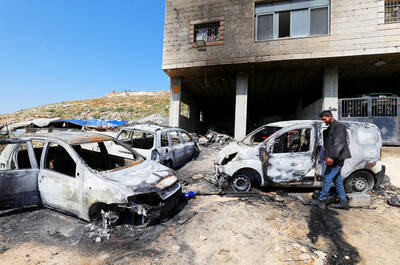
RAMPAGE: A Palestinian man was left dead after dozens of Israeli settlers searching for a missing 14-year-old boy stormed a village in the Israeli-occupied West Bank US President Joe Biden on Friday said he expected Iran to attack Israel “sooner, rather than later” and warned Tehran not to proceed. Asked by reporters about his message to Iran, Biden simply said: “Don’t,” underscoring Washington’s commitment to defend Israel. “We are devoted to the defense of Israel. We will support Israel. We will help defend Israel and Iran will not succeed,” he said. Biden said he would not divulge secure information, but said his expectation was that an attack could come “sooner, rather than later.” Israel braced on Friday for an attack by Iran or its proxies as warnings grew of

IN PURSUIT: Israel’s defense minister said the revenge attacks by Israeli settlers would make it difficult for security forces to find those responsible for the 14-year-old’s death Israeli Prime Minister Benjamin Netanyahu on Saturday condemned the “heinous murder” of an Israeli teenager in the occupied West Bank as attacks on Palestinian villages intensified following news of his death. After Benjamin Achimeir, 14, was reported missing near Ramallah on Friday, hundreds of Jewish settlers backed by Israeli forces raided nearby Palestinian villages, torching vehicles and homes, leaving at least one villager dead and dozens wounded. The attacks escalated in several villages on Saturday after Achimeir’s body was found near the Malachi Hashalom outpost. Agence France-Presse correspondents saw smoke rising from burned houses and fields. Mayor Amin Abu Alyah, of the


 RSS
RSS