


Australian military ships and aircraft would continue to patrol the South China Sea amid warnings from China that a declaration of independence by Taiwan would “mean war.”
With Taiwan reporting an increase in Chinese military aircraft in its air defense zones, and with Beijing warning independence forces against “playing with fire,” the Australian government is closely monitoring developments in the region.
The US military last weekend announced that a US aircraft carrier group had entered the South China Sea in a bid to promote “freedom of the seas.”
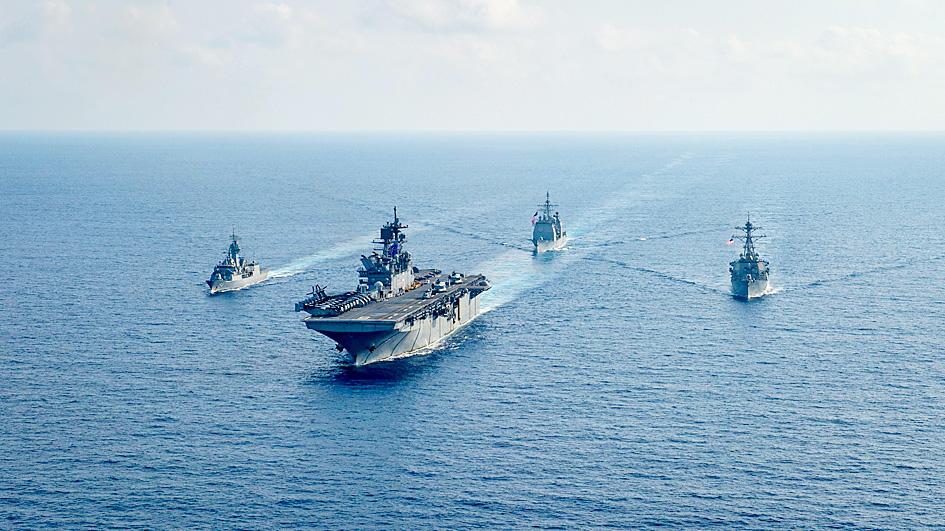
Photo: Reuters
“Australian vessels and aircraft will continue to exercise rights under international law to freedom of navigation and overflight, including in the South China Sea, and we support others doing the same,” a spokesperson for the Australian Department of Defense said. “On Taiwan, we are aware of the situation and continue to monitor developments.”
The comments were in response to questions about the US aircraft carrier group’s arrival, and whether the administration of US President Joe Biden had asked Australia to join it in the South China Sea or whether it would carry out its own exercises soon.
The Australian government believes that it has a substantial interest in the stability of the South China Sea, in part because of the vast volume of trade that flows through it.
While Australia routinely operates alongside the US and other partners, Canberra sticks to the position of not commenting on the specific details of Australian Defense Force operations.
Chinese Ministry of Defense spokesman Wu Qian (吳謙) on Thursday said that Taiwan was “an inalienable part of China” and the Chinese military activities in the Taiwan Strait were “a solemn response to the interference of external forces and the provocations by ‘Taiwan independence’ forces.”
According to a ministry summary of the monthly news conference, Wu also said he wanted to warn independence forces “that those who play with fire will set themselves on fire, and seeking ‘Taiwan independence’ means nothing but war.”
It is understood that the Australian government’s position is to support a peaceful resolution of differences over Taiwan and other regional issues through dialogue, and without the threat or use of force or coercion.
Canberra also maintains that US leadership in the Indo-Pacific is welcome to uphold rules, norms and standards.
Australian Minister of Defence Linda Reynolds said after her first telephone call with US Secretary of Defense Lloyd Austin on Wednesday that Australia and the US would “continue to work side by side with allies and partners to maintain a region that is secure, prosperous, inclusive and rules-based.”
The Pentagon issued a statement saying that the secretary of defense had “emphasized the importance of maintaining a free and open Indo-Pacific, founded on existing international law and norms in a region free of malign behavior.”
Neither the Pentagon nor Reynolds directly mentioned China, but Australia has been at odds with its largest trading partner over a range of issues, including Beijing’s militarization of disputed features in the South China Sea and a crackdown on dissent in Hong Kong.
Australian Secretary of the Department of Defense Greg Moriarty last month said that China had acted in a “disturbing” manner and complicated Australia’s security environment through its activities in the South China Sea.
Some countries in the Indo-Pacific were deeply anxious about the prospects for peace and stability, Moriarty said, adding that the great powers should conduct themselves in a way that reassured the region.
The Australian government has been seeking a resumption of ministerial and leader-level talks with China after Canberra’s call for a global inquiry into COVID-19 triggered a freeze in such dialogue.
‘IN A DIFFERENT PLACE’: The envoy first visited Shanghai, where he attended a Chinese basketball playoff match, and is to meet top officials in Beijing tomorrow US Secretary of State Antony Blinken yesterday arrived in China on his second visit in a year as the US ramps up pressure on its rival over its support for Russia while also seeking to manage tensions with Beijing. The US diplomat tomorrow is to meet China’s top brass in Beijing, where he is also expected to plead for restraint as Taiwan inaugurates president-elect William Lai (賴清德), and to raise US concerns on Chinese trade practices. However, Blinken is also seeking to stabilize ties, with tensions between the world’s two largest economies easing since his previous visit in June last year. At the
Nearly half of China’s major cities are suffering “moderate to severe” levels of subsidence, putting millions of people at risk of flooding, especially as sea levels rise, according to a study of nationwide satellite data released yesterday. The authors of the paper, published by the journal Science, found that 45 percent of China’s urban land was sinking faster than 3mm per year, with 16 percent at more than 10mm per year, driven not only by declining water tables, but also the sheer weight of the built environment. With China’s urban population already in excess of 900 million people, “even a small portion

UNSETTLING IMAGES: The scene took place in front of TV crews covering the Trump trial, with a CNN anchor calling it an ‘emotional and unbelievably disturbing moment’ A man who doused himself in an accelerant and set himself on fire outside the courthouse where former US president Donald Trump is on trial has died, police said yesterday. The New York City Police Department (NYPD) said the man was declared dead by staff at an area hospital. The man was in Collect Pond Park at about 1:30pm on Friday when he took out pamphlets espousing conspiracy theories, tossed them around, then doused himself in an accelerant and set himself on fire, officials and witnesses said. A large number of police officers were nearby when it happened. Some officers and bystanders rushed

Beijing is continuing to commit genocide and crimes against humanity against Uyghurs and other Muslim minorities in its western Xinjiang province, U.S. Secretary of State Antony Blinken said in a report published on Monday, ahead of his planned visit to China this week. The State Department’s annual human rights report, which documents abuses recorded all over the world during the previous calendar year, repeated language from previous years on the treatment of Muslims in Xinjiang, but the publication raises the issue ahead of delicate talks, including on the war in Ukraine and global trade, between the top U.S. diplomat and Chinese


 RSS
RSS