


Two military helicopters evacuating wounded soldiers from fighting in southern Afghanistan collided on Wednesday, killing nine people on board, the Afghan government said.
The crash happened as the helicopters were taking off in Helmand Province, where clashes have erupted between Afghan forces and the Taliban, provincial governor spokesman Omar Zawak said.
The Afghan Ministry of Defence said that the collision was due to “technical issues.”
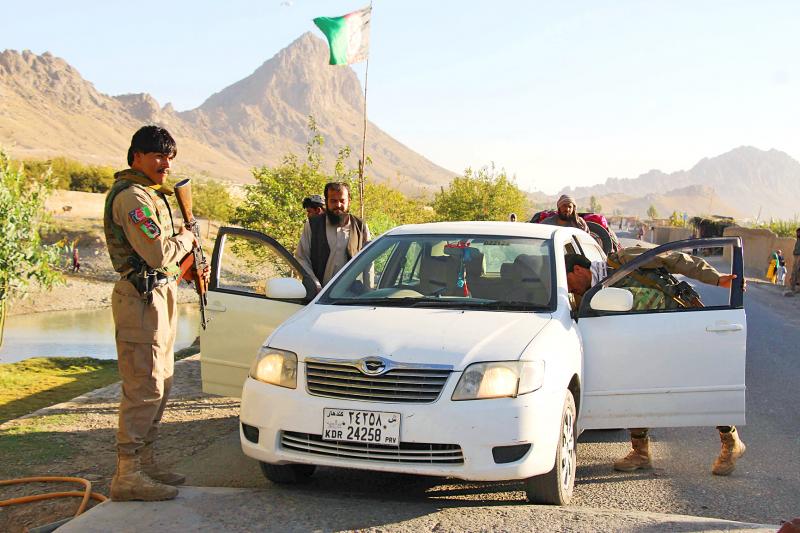
Photo: EPA-EFE
The incident followed heavy fighting in the province’s capital, Lashkar Gah, where Taliban militants launched a series of attacks on Sunday in an attempt to capture the city.
It prompted US forces to call in airstrikes to defend Afghan troops.
The clashes have triggered an exodus of 30,000 people, said Sayed Mohammad Ramin, director of the Helmand refugees department.
“Some families are still living in the open in the streets in Lashkar Gah, we don’t have tents to give them,” Ramin told reporters.
Those fleeing crammed onto motorcycles, their belongings strapped on behind them, or into overcrowded taxis and buses.
“The fighting was so intense that I did not have time to take any extra clothes. I only took my family,” said Attaullah Afghan, a farmer who fled with his family of 12.
Local resident Hekmatullah told reporters that he was forced to flee after a mortar hit his neighbor’s house, killing two women.
“I just want some peace to be able to live happily with my children and do my job as a farmer,” another man from the city said.
Afghan forces had repelled the attempted takeover of the city and the security situation would “return to normal soon,” a ministry statement said.
The UN Assistance Mission in Afghanistan said that thousands of people had fled and called on Taliban fighters and security forces “to take all feasible measures to protect civilians” and allow safe passage for those hoping to leave the area.
Helmand — a Taliban stronghold — is where international forces fought some of the bloodiest campaigns of Afghanistan’s 19-year war.
The insurgents pledged to keep violence down and avoid targeting urban areas in a deal signed with Washington in February.
They also agreed to begin peace talks with the Afghan government, in return for a US vow to pull all foreign troops from the country by May next year.
Those talks began last month in Qatar, but appear to be stalled as the Taliban and the Kabul administration have struggled to establish a basic framework for negotiations.
Nearly half of China’s major cities are suffering “moderate to severe” levels of subsidence, putting millions of people at risk of flooding, especially as sea levels rise, according to a study of nationwide satellite data released yesterday. The authors of the paper, published by the journal Science, found that 45 percent of China’s urban land was sinking faster than 3mm per year, with 16 percent at more than 10mm per year, driven not only by declining water tables, but also the sheer weight of the built environment. With China’s urban population already in excess of 900 million people, “even a small portion

UNSETTLING IMAGES: The scene took place in front of TV crews covering the Trump trial, with a CNN anchor calling it an ‘emotional and unbelievably disturbing moment’ A man who doused himself in an accelerant and set himself on fire outside the courthouse where former US president Donald Trump is on trial has died, police said yesterday. The New York City Police Department (NYPD) said the man was declared dead by staff at an area hospital. The man was in Collect Pond Park at about 1:30pm on Friday when he took out pamphlets espousing conspiracy theories, tossed them around, then doused himself in an accelerant and set himself on fire, officials and witnesses said. A large number of police officers were nearby when it happened. Some officers and bystanders rushed

HYPOCRISY? The Chinese Ministry of Foreign Affairs yesterday asked whether Biden was talking about China or the US when he used the word ‘xenophobic’ US President Joe Biden on Wednesday called for a hike in steel tariffs on China, accusing Beijing of cheating as he spoke at a campaign event in Pennsylvania. Biden accused China of xenophobia, too, in a speech to union members in Pittsburgh. “They’re not competing, they’re cheating. They’re cheating and we’ve seen the damage here in America,” Biden said. Chinese steel companies “don’t need to worry about making a profit because the Chinese government is subsidizing them so heavily,” he said. Biden said he had called for the US Trade Representative to triple the tariff rates for Chinese steel and aluminum if Beijing was

Beijing is continuing to commit genocide and crimes against humanity against Uyghurs and other Muslim minorities in its western Xinjiang province, U.S. Secretary of State Antony Blinken said in a report published on Monday, ahead of his planned visit to China this week. The State Department’s annual human rights report, which documents abuses recorded all over the world during the previous calendar year, repeated language from previous years on the treatment of Muslims in Xinjiang, but the publication raises the issue ahead of delicate talks, including on the war in Ukraine and global trade, between the top U.S. diplomat and Chinese


 RSS
RSS