


Jakarta Governor Anies Baswedan yesterday said that he would inform Indonesian President Joko Widodo of protesters’ demand that a polarizing new labor law be repealed, as a growing number of regional leaders come out and oppose the legislation.
Thousands took to the streets of cities across Indonesia this week, part of protests and national strikes against legislation they say undermines workers’ rights and weakens environmental protections.
Clashes erupted in some cities, including in Jakarta, where protesters set fire to public transport facilities and damaged police stations.
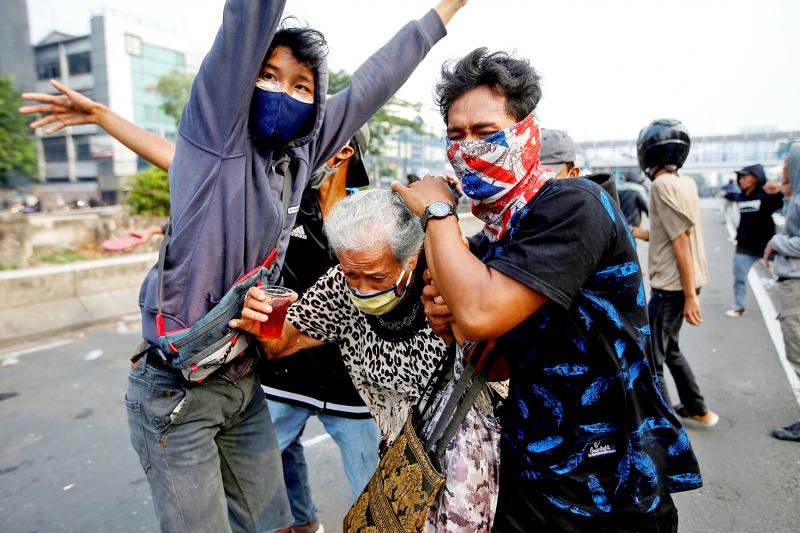
Photo: Reuters
“Yesterday, I also met with the protesters and we had brief discussion with them. I told them that we had listened to your voices and I will convey the message,” Baswedan said.
He did not go as far as saying he would join the call for the legislation to be repealed.
At least four other governors have told protesters that they would write to the president asking for the legislation to be repealed, according to statements and local media reports.
Repealing the law would prevent further clashes “that could create prolonged instability amid a pandemic and an economic recession,” West Kalimantan Govenor Sutarmidji said in a statement.
Widodo has yet to make any public statement following Monday’s passage of the bill into law, but his ministers have defended it, saying that the protests were triggered by fake news and that the legislation would improve people’s welfare by welcoming more investment.
Jakarta police on Thursday detained about 1,000 demonstrators, while hundreds were arrested in other cities.
Most of those detained were released by yesterday morning, Jakarta Police spokesman Yusri Yunus said.
Police did not expect a fourth day of protests in the capital yesterday, he said.
Said Iqbal, president of the trade union KSPI, one of the biggest groups behind the protests, said that there no was planned rally for yesterday, but another union leader on Thursday evening pledged to continue the demonstrations.
Jakarta resident Nathan Tarigan feared that the clashes would escalate.
“I’m afraid if the government and stakeholders of the state aren’t wise, don’t want to listen, something bigger can happen and the state can break,” the 50-year-old said.
Nearly half of China’s major cities are suffering “moderate to severe” levels of subsidence, putting millions of people at risk of flooding, especially as sea levels rise, according to a study of nationwide satellite data released yesterday. The authors of the paper, published by the journal Science, found that 45 percent of China’s urban land was sinking faster than 3mm per year, with 16 percent at more than 10mm per year, driven not only by declining water tables, but also the sheer weight of the built environment. With China’s urban population already in excess of 900 million people, “even a small portion

UNSETTLING IMAGES: The scene took place in front of TV crews covering the Trump trial, with a CNN anchor calling it an ‘emotional and unbelievably disturbing moment’ A man who doused himself in an accelerant and set himself on fire outside the courthouse where former US president Donald Trump is on trial has died, police said yesterday. The New York City Police Department (NYPD) said the man was declared dead by staff at an area hospital. The man was in Collect Pond Park at about 1:30pm on Friday when he took out pamphlets espousing conspiracy theories, tossed them around, then doused himself in an accelerant and set himself on fire, officials and witnesses said. A large number of police officers were nearby when it happened. Some officers and bystanders rushed

HYPOCRISY? The Chinese Ministry of Foreign Affairs yesterday asked whether Biden was talking about China or the US when he used the word ‘xenophobic’ US President Joe Biden on Wednesday called for a hike in steel tariffs on China, accusing Beijing of cheating as he spoke at a campaign event in Pennsylvania. Biden accused China of xenophobia, too, in a speech to union members in Pittsburgh. “They’re not competing, they’re cheating. They’re cheating and we’ve seen the damage here in America,” Biden said. Chinese steel companies “don’t need to worry about making a profit because the Chinese government is subsidizing them so heavily,” he said. Biden said he had called for the US Trade Representative to triple the tariff rates for Chinese steel and aluminum if Beijing was

Beijing is continuing to commit genocide and crimes against humanity against Uyghurs and other Muslim minorities in its western Xinjiang province, U.S. Secretary of State Antony Blinken said in a report published on Monday, ahead of his planned visit to China this week. The State Department’s annual human rights report, which documents abuses recorded all over the world during the previous calendar year, repeated language from previous years on the treatment of Muslims in Xinjiang, but the publication raises the issue ahead of delicate talks, including on the war in Ukraine and global trade, between the top U.S. diplomat and Chinese


 RSS
RSS