


An accident at a nuclear complex in Iran caused significant damage and could slow the production of centrifuges used to enrich uranium, Atomic Energy Organization of Iran (AEOI) spokesman Behrouz Kamalvandi said.
Iranian officials had previously sought to downplay the fire, which erupted early on Thursday, calling it only an “incident” that affected an “industrial shed.”
However, a released photograph and video of the site broadcast by Iranian state television showed a two-story brick building with scorch marks and its roof apparently destroyed.
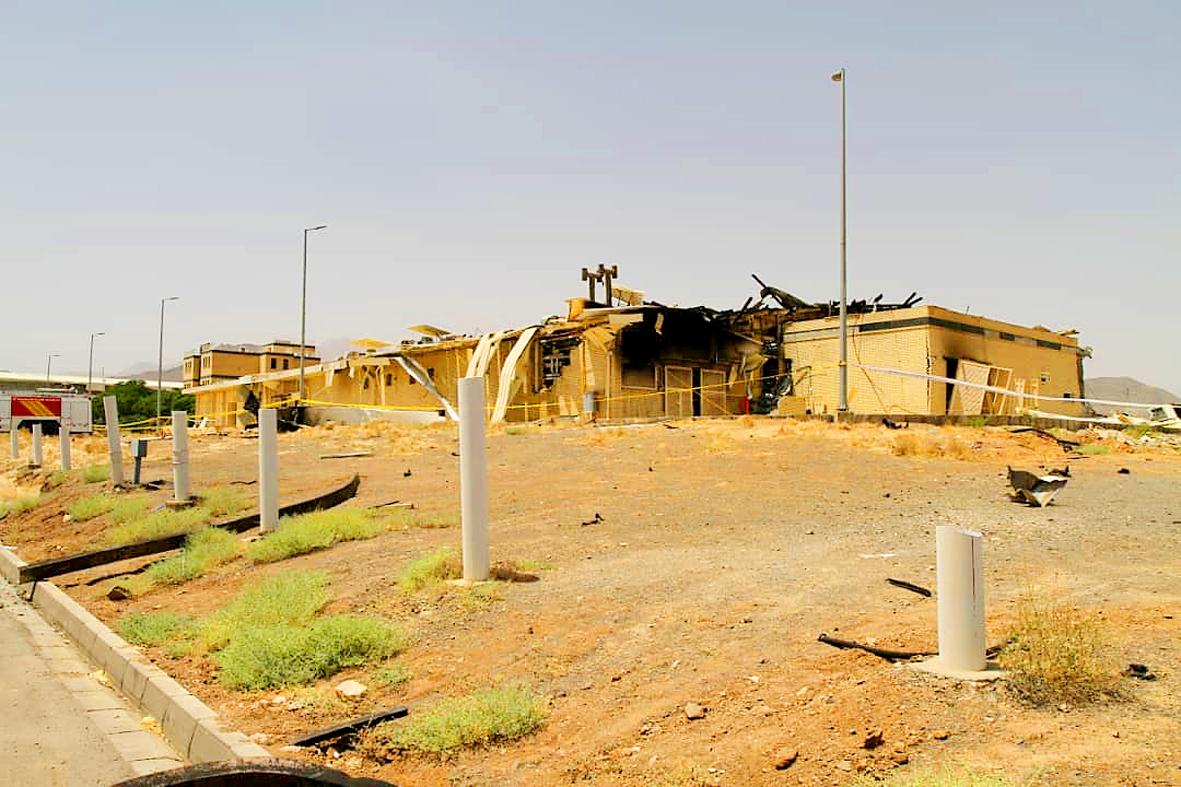
Photo: Reuters / Atomic Energy Organization of Iran / West Asia News Agency
State television later showed the building from a different angle with minor damage to its walls.
The incident happened at a warehouse under construction at the Natanz complex in central Iran, but caused no casualties or radioactive pollution, the agency said.
Security officials called it an accident and said they had determined the cause, without providing any further explanation.
“There were no victims ... but the damage is significant on a financial level,” Kamalvandi said in an interview published on Sunday by the official Islamic Republic News Agency (IRNA).
“God willing, and with constant effort ... we will compensate for this slowdown so that the rebuilt site will have even more capacity than before,” Kamalvandi added.
Kamalvandi said that work had begun on the center in 2013 and it was inaugurated in 2018.
“More advanced centrifuge machines were intended to be built there,” he said, adding that the damage would “possibly cause a delay in development and production of advanced centrifuge machines in the medium term.”
He said that the fire had damaged “precision and measuring instruments,” and that the center had not been operating at full capacity due to restrictions imposed by Tehran’s 2015 nuclear deal with world powers.
Natanz is one of Iran’s main uranium enrichment plants.
Iran began experimenting with advanced centrifuge models in the wake of the US unilaterally withdrawing from the deal two years ago.
An online video and messages purportedly claiming responsibility for the fire were released on Friday.
The multiple, different claims by a self-described group called the “Cheetahs of the Homeland,” as well as the fact that Iran experts have never heard of the group before, raised questions about whether Natanz again had faced sabotage by a foreign nation, as it had during the Stuxnet computer virus outbreak believed to have been engineered by the US and Israel.
The Natanz fire also came less than a week after an explosion in an area east of Tehran that analysts believe hides an underground tunnel system and missile production sites.
Two US-based analysts who spoke to The Associated Press on Friday, relying on released pictures and satellite images, identified the affected building as Natanz’s new Iran Centrifuge Assembly Center.
A satellite image on Friday by Planet Labs, annotated by experts at the James Martin Center for Nonproliferation Studies at Middlebury Institute of International Studies in Monterey, California, shows what appears to be damage done to half of the building.
Destroying a centrifuge assembly facility could greatly impact Iran’s ability to more quickly enrich greater amounts of uranium, which would be a goal for either Israel or the US.

Republican US lawmakers on Friday criticized US President Joe Biden’s administration after sanctioned Chinese telecoms equipment giant Huawei unveiled a laptop this week powered by an Intel artificial intelligence (AI) chip. The US placed Huawei on a trade restriction list in 2019 for contravening Iran sanctions, part of a broader effort to hobble Beijing’s technological advances. Placement on the list means the company’s suppliers have to seek a special, difficult-to-obtain license before shipping to it. One such license, issued by then-US president Donald Trump’s administration, has allowed Intel to ship central processors to Huawei for use in laptops since 2020. China hardliners
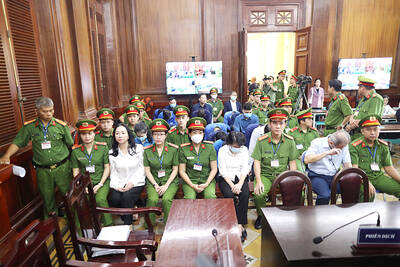
A top Vietnamese property tycoon was on Thursday sentenced to death in one of the biggest corruption cases in history, with an estimated US$27 billion in damages. A panel of three hand-picked jurors and two judges rejected all defense arguments by Truong My Lan, chair of major developer Van Thinh Phat, who was found guilty of swindling cash from Saigon Commercial Bank (SCB) over a decade. “The defendant’s actions ... eroded people’s trust in the leadership of the [Communist] Party and state,” read the verdict at the trial in Ho Chi Minh City. After the five-week trial, 85 others were also sentenced on

‘DELUSIONAL’: Targeting the families of Hamas’ leaders would not push the group to change its position or to give up its demands for Palestinians, Ismail Haniyeh said Israeli aircraft on Wednesday killed three sons of Hamas’ top political leader in the Gaza Strip, striking high-stakes targets at a time when Israel is holding delicate ceasefire negotiations with the militant group. Hamas said four of the leader’s grandchildren were also killed. Ismail Haniyeh’s sons are among the highest-profile figures to be killed in the war so far. Israel said they were Hamas operatives, and Haniyeh accused Israel of acting in “the spirit of revenge and murder.” The deaths threatened to strain the internationally mediated ceasefire talks, which appeared to gain steam in recent days even as the sides remain far

The Taliban’s reclusive supreme leader made a rare public appearance yesterday, an Afghan government spokesman said, leading thousands of worshipers in prayers marking Eid al-Fitr. Hibatullah Akhundzada has made only a handful of public appearances since inheriting the leadership of the Taliban in 2016 and leading the movement back to power with the withdrawal of US forces in 2021. Taliban government spokesman Zabihullah Mujahid said prayer in the largest mosque in Kandahar was “performed under the leadership of the supreme leader.” In a statement on X, he said the early-morning service “was attended by thousands of compatriots” in the southern province considered the


 RSS
RSS