


Tokyo prosecutors yesterday said that a request has been filed for the extradition of two Americans arrested in the US for allegedly helping former Nissan chairman Carlos Ghosn flee Japan while he was on bail.
“We express our deepest gratitude for the cooperation the US authorities have shown to our request,” the Tokyo District Prosecutors’ Office said in a statement. “We plan to cooperate in all ways possible so the extradition procedures for the two can be carried out quickly.”
The completion of the extradition request does not immediately mean Michael Taylor, a 59-year-old former Green Beret and private security specialist, and his son. Peter Taylor, 27, would be handed over.

Photo: EPA-EFE
Arrested in May in Massachusetts, they are accused of helping Ghosn flee to Lebanon in December last year while he was awaiting trial on financial misconduct charges.
While their lawyer has argued that jumping bail is technically not a crime in Japan, prosecutors have rebuffed that argument, saying that Japan has arrest warrants out for the Taylors for allegedly helping a criminal escape, which is a crime under Japanese law.
The prosecutors have also been trying to bring Ghosn back to Japan, but Lebanon, unlike the US, does not have an extradition treaty with the nation.
If convicted in Japan, the Taylors could face a maximum penalty of three years in prison and a ¥300,000 (US$2,800) fine.
Authorities say the Taylors helped fly Ghosn out of Japan on a private jet, with the former Nissan chairman hidden in a large box.
Ghosn has repeatedly said that he is innocent.
Ghosn says that he fled because he believes he could not expect a fair trial in Japan.
He faced charges of under-reporting future income and breach of trust in diverting Nissan money for personal gain.
Ghosn says that the compensation was never decided on or received, and that the payments were legitimate.

Republican US lawmakers on Friday criticized US President Joe Biden’s administration after sanctioned Chinese telecoms equipment giant Huawei unveiled a laptop this week powered by an Intel artificial intelligence (AI) chip. The US placed Huawei on a trade restriction list in 2019 for contravening Iran sanctions, part of a broader effort to hobble Beijing’s technological advances. Placement on the list means the company’s suppliers have to seek a special, difficult-to-obtain license before shipping to it. One such license, issued by then-US president Donald Trump’s administration, has allowed Intel to ship central processors to Huawei for use in laptops since 2020. China hardliners
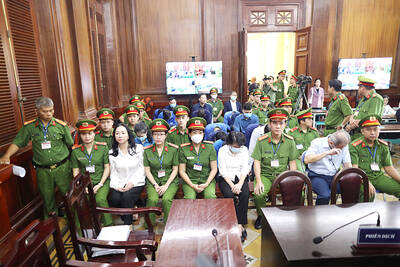
A top Vietnamese property tycoon was on Thursday sentenced to death in one of the biggest corruption cases in history, with an estimated US$27 billion in damages. A panel of three hand-picked jurors and two judges rejected all defense arguments by Truong My Lan, chair of major developer Van Thinh Phat, who was found guilty of swindling cash from Saigon Commercial Bank (SCB) over a decade. “The defendant’s actions ... eroded people’s trust in the leadership of the [Communist] Party and state,” read the verdict at the trial in Ho Chi Minh City. After the five-week trial, 85 others were also sentenced on

Conjoined twins Lori and George Schappell, who pursued separate careers, interests and relationships during lives that defied medical expectations, died this month in Pennsylvania, funeral home officials said. They were 62. The twins, listed by Guinness World Records as the oldest living conjoined twins, died on April 7 at the Hospital of the University of Pennsylvania, obituaries posted by Leibensperger Funeral Homes of Hamburg said. The cause of death was not detailed. “When we were born, the doctors didn’t think we’d make 30, but we proved them wrong,” Lori said in an interview when they turned 50, the Philadelphia Inquirer reported. The

RAMPAGE: A Palestinian man was left dead after dozens of Israeli settlers searching for a missing 14-year-old boy stormed a village in the Israeli-occupied West Bank US President Joe Biden on Friday said he expected Iran to attack Israel “sooner, rather than later” and warned Tehran not to proceed. Asked by reporters about his message to Iran, Biden simply said: “Don’t,” underscoring Washington’s commitment to defend Israel. “We are devoted to the defense of Israel. We will support Israel. We will help defend Israel and Iran will not succeed,” he said. Biden said he would not divulge secure information, but said his expectation was that an attack could come “sooner, rather than later.” Israel braced on Friday for an attack by Iran or its proxies as warnings grew of


 RSS
RSS