


Pakistan was plunged into darkness after a key power transmission line broke down early yesterday in an incident blamed on a rebel attack, the latest reminder of the country’s crippling energy crisis.
The power failure, one of the worst Pakistan has experienced, caused electricity to be cut in major cities throughout the country, including the capital, Islamabad.
It was later restored in much of the country, with the national power company saying normal distribution would resume within hours.
Officials said the blackout began after midnight, when a transmission line connecting a privately-run power plant to the national grid was damaged.
A senior official at the national grid station in Islamabad said about 80 percent of the country was hit by the power breakdown.
A reporter in the eastern city of Lahore said the airport was also affected by the breakdown. Minister of State for Water and Power Abid Sher Ali later issued an apology and said electricity had been restored in most of the country, blaming the breakdown on rebels blowing up the line in the Naseerabad district, which lies in southwestern Baluchistan province.
A spokesman for the national power company said that “electricity has been restored in all parts of the country.”
“Some 6,000 megawatts of electricity have been added to the national system and within a couple of hours distribution will be normal,” the spokesman said.
Pakistan’s electricity distribution system is a complex — and delicate — web, and a major fault at one section often leads to chain reactions and breakdowns of power generation and transmission.
In addition to chronic infrastructure problems, the energy sector is also trapped into a vicious “circular debt” brought on by the dual effect of the government setting low electricity prices and customers failing to pay for it.
State utilities therefore lose money, and cannot pay private power generating companies, which in turn cannot pay the oil and gas suppliers, who cut off the supply.
Earlier this week, Pakistani Prime Minister Nawaz Sharif canceled his trip to the World Economic Forum in Davos to deal with a severe petroleum shortage at home.
The fuel crisis began last week, when Pakistan State Oil was forced to slash imports because banks refused to extend any more credit to the government-owned company, which supplies 80 percent of the country’s oil.
Solving Pakistan’s energy crisis was a key campaign pledge for Sharif in the run-up to the 2013 general election, and the shortage is heaping fresh pressure on his government.

A new online voting system aimed at boosting turnout among the Philippines’ millions of overseas workers ahead of Monday’s mid-term elections has been marked by confusion and fears of disenfranchisement. Thousands of overseas Filipino workers have already cast their ballots in the race dominated by a bitter feud between President Ferdinand Marcos Jr and his impeached vice president, Sara Duterte. While official turnout figures are not yet publicly available, data from the Philippine Commission on Elections (COMELEC) showed that at least 134,000 of the 1.22 million registered overseas voters have signed up for the new online system, which opened on April 13. However,

EUROPEAN FUTURE? Albanian Prime Minister Edi Rama says only he could secure EU membership, but challenges remain in dealing with corruption and a brain drain Albanian Prime Minister Edi Rama seeks to win an unprecedented fourth term, pledging to finally take the country into the EU and turn it into a hot tourist destination with some help from the Trump family. The artist-turned-politician has been pitching Albania as a trendy coastal destination, which has helped to drive up tourism arrivals to a record 11 million last year. US President Donald Trump’s son-in-law, Jared Kushner, also joined in the rush, pledging to invest US$1.4 billion to turn a largely deserted island into a luxurious getaway. Rama is expected to win another term after yesterday’s vote. The vote would
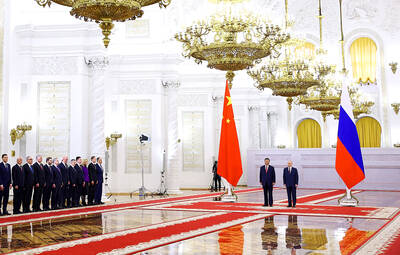
ALLIES: Calling Putin his ‘old friend,’ Xi said Beijing stood alongside Russia ‘in the face of the international counter-current of unilateralism and hegemonic bullying’ Chinese President Xi Jinping (習近平) yesterday was in Moscow for a state visit ahead of the Kremlin’s grand Victory Day celebrations, as Ukraine accused Russia’s army of launching air strikes just hours into a supposed truce. More than 20 foreign leaders were in Russia to attend a vast military parade today marking 80 years since the defeat of Nazi Germany in World War II, taking place three years into Russia’s offensive in Ukraine. Putin ordered troops into Ukraine in February 2022 and has marshaled the memory of Soviet victory against Nazi Germany to justify his campaign and rally society behind the offensive,
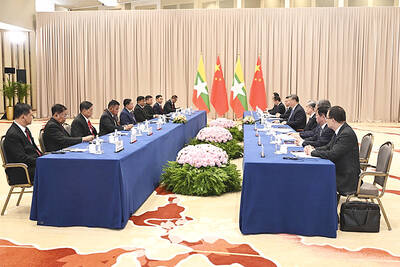
Myanmar’s junta chief met Chinese President Xi Jinping (習近平) for the first time since seizing power, state media reported yesterday, the highest-level meeting with a key ally for the internationally sanctioned military leader. Senior General Min Aung Hlaing led a military coup in 2021, overthrowing Myanmar’s brief experiment with democracy and plunging the nation into civil war. In the four years since, his armed forces have battled dozens of ethnic armed groups and rebel militias — some with close links to China — opposed to its rule. The conflict has seen Min Aung Hlaing draw condemnation from rights groups and pursued by the


 RSS
RSS