


As he ponders the future of the free world, the fate of social security or the state of the brush on his Crawford ranch, US President George W. Bush can turn to one source for solace: his iPod.
A birthday present from his daughters last year, the Bush iPod contains just 250 songs, from the knockabout comedy of Joni Mitchell's (You're So Square) Baby, I Don't Care to the straight ahead country blues of Stevie Ray Vaughn's The House Is Rockin.
Although Bush doesn't do anything so vulgar as download the songs himself -- that duty is performed by an aide -- the selection of music has analysts scrambling to deconstruct the contents of the presidential iPod.
What, for example, to make of the inclusion of The Knack's chirpy yet sleazy My Sharona, a staple of US college life for the last 20 years?
But that is about as risky as it gets.
"If any president limited his music selection to pro-establishment musicians, it would be a pretty slim collection," Mark McKinnon, Bush's chief media strategist last year, cycling buddy and fellow iPod enthusiast, told the New York Times.
But even the patriots on the Bush iPod are troubled souls. Country singers George Jones and Alan Jackson make the list, while Texan band The Gourds are best known for their zydeco cover of Snoop Dogg's Gin and Juice.
His selection, said Joe Levy of Rolling Stone magazine, "tells you that the president knows a thing or two about country music and is serious about his love of country music."
"This is basically boomer rock'n'roll and more recent music out of Nashville made for boomers. It's safe, it's reliable, it's loving ... It's feelgood music. The Sex Pistols it's not," Levy said.
The presidential iPod was first spotted in a photograph published in January which showed a pair of hands said to be Bush's holding one of the distinctive boxes. The song on the screen, showing Bush's sensitive side, was Van Morrison's plaintive Brown Eyed Girl.

Republican US lawmakers on Friday criticized US President Joe Biden’s administration after sanctioned Chinese telecoms equipment giant Huawei unveiled a laptop this week powered by an Intel artificial intelligence (AI) chip. The US placed Huawei on a trade restriction list in 2019 for contravening Iran sanctions, part of a broader effort to hobble Beijing’s technological advances. Placement on the list means the company’s suppliers have to seek a special, difficult-to-obtain license before shipping to it. One such license, issued by then-US president Donald Trump’s administration, has allowed Intel to ship central processors to Huawei for use in laptops since 2020. China hardliners
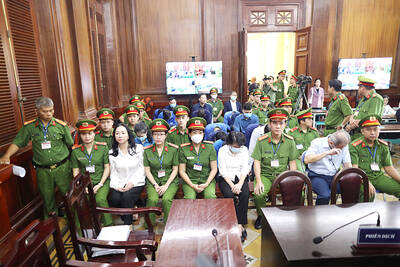
A top Vietnamese property tycoon was on Thursday sentenced to death in one of the biggest corruption cases in history, with an estimated US$27 billion in damages. A panel of three hand-picked jurors and two judges rejected all defense arguments by Truong My Lan, chair of major developer Van Thinh Phat, who was found guilty of swindling cash from Saigon Commercial Bank (SCB) over a decade. “The defendant’s actions ... eroded people’s trust in the leadership of the [Communist] Party and state,” read the verdict at the trial in Ho Chi Minh City. After the five-week trial, 85 others were also sentenced on

‘DELUSIONAL’: Targeting the families of Hamas’ leaders would not push the group to change its position or to give up its demands for Palestinians, Ismail Haniyeh said Israeli aircraft on Wednesday killed three sons of Hamas’ top political leader in the Gaza Strip, striking high-stakes targets at a time when Israel is holding delicate ceasefire negotiations with the militant group. Hamas said four of the leader’s grandchildren were also killed. Ismail Haniyeh’s sons are among the highest-profile figures to be killed in the war so far. Israel said they were Hamas operatives, and Haniyeh accused Israel of acting in “the spirit of revenge and murder.” The deaths threatened to strain the internationally mediated ceasefire talks, which appeared to gain steam in recent days even as the sides remain far
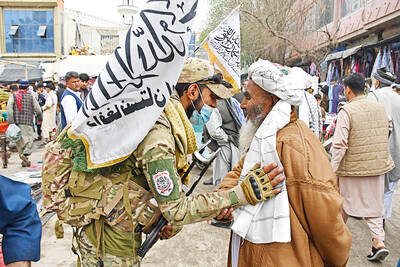
The Taliban’s reclusive supreme leader made a rare public appearance yesterday, an Afghan government spokesman said, leading thousands of worshipers in prayers marking Eid al-Fitr. Hibatullah Akhundzada has made only a handful of public appearances since inheriting the leadership of the Taliban in 2016 and leading the movement back to power with the withdrawal of US forces in 2021. Taliban government spokesman Zabihullah Mujahid said prayer in the largest mosque in Kandahar was “performed under the leadership of the supreme leader.” In a statement on X, he said the early-morning service “was attended by thousands of compatriots” in the southern province considered the


 RSS
RSS