


The Centers for Disease Control (CDC) yesterday reported this year’s first cases of Japanese encephalitis and paratyphoid fever.
CDC Deputy Director-General and spokeswoman Tseng Shu-hui (曾淑慧) said that a woman in her 60s living in southern Taiwan was diagnosed with Japanese encephalitis after developing symptoms including a fever and altered consciousness earlier this month.
“CDC monitoring data show that May to October is usually the peak transmission season of Japanese encephalitis, with the peak usually in June or July, so people should get vaccinated and prevent mosquito bites,” Tseng said.
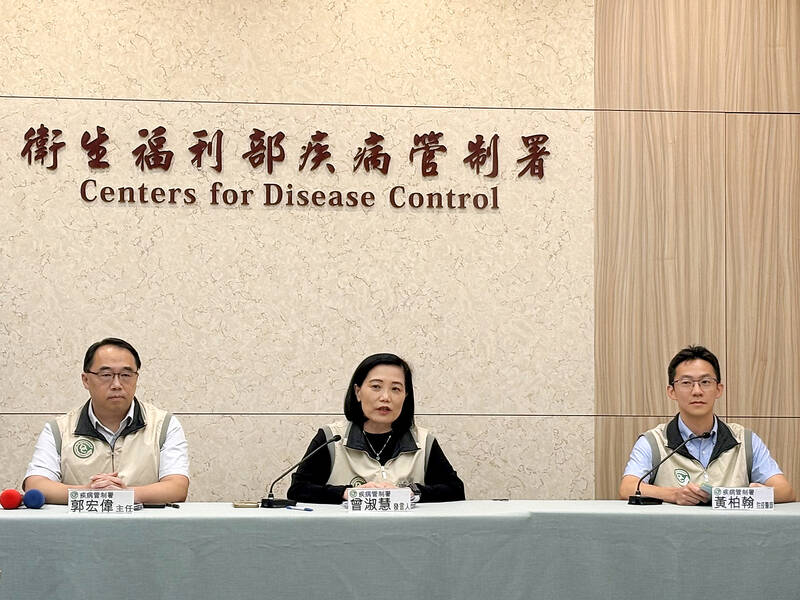
Photo: Hou Chia-yu, Taipei Times
CDC physician Huang Po-han (黃柏翰) said that the woman has diabetes, no record of vaccination against Japanese encephalitis and she did not travel abroad recently.
The woman’s symptoms began with a headache and vomiting, followed by fever and loss of consciousness, so she was rushed to an emergency room, where she was found with a stiff neck, an elevated white blood cell count and inflammatory markers, Huang said, adding that she was admitted to an intensive care unit.
She was reported as a suspected case, and a laboratory test confirmed it, Huang said, adding that six family members who she lives with did not develop symptoms.
There are high-risk environments — including rice fields, irrigation ditches, pig farms and poultry farms — near her home and places she frequents, so the local health department has installed mosquito traps in the area and promoted mosquito prevention measures, he said.
The childhood immunization schedule recommends that infants get the first dose of a Japanese encephalitis vaccine at 15 months old and the second dose 12 months afterward, he said.
Adults who live near high-risk areas can consult travel medicine doctors to assess whether they need a booster shot, he added.
Tseng said that a man in his 50s living in northern Taiwan diagnosed with paratyphoid fever developed symptoms including a fever, chills and general muscle soreness late last month.
The man did not travel abroad during the incubation period, Huang said, adding that he first sought treatment at a clinic and received medicine for his symptoms.
As the symptoms were not relieved after three days, he sought treatment at a hospital, where he underwent testing and returned home to rest, Huang said.
Blood tests showed that bacteria was causing paratyphoid fever and he was hospitalized when he returned for a follow-up appointment, Huang said, adding that the man recovered after eight days of treatment.
The man did not eat raw food or drink unboiled water, and people living with him and his coworkers tested negative, so the source of his infection is not yet clear, Huang said.
Paratyphoid fever is primarily transmitted via the fecal-oral route, so people should drink water that has been boiled and eat sufficiently cooked food, separate raw and cooked food to avoid contamination, and wash their hands frequently with soap, he said.
CDC Epidemic Intelligence Center Director Guo Hung-wei (郭宏偉) said there were 5,576 hospital visits for enterovirus infection last week, about the same as the previous week, although the longer-term trend is upward.
Enterovirus activity in Vietnam remains severe, while it has been rapidly increasing in China and Hong Kong, and to a lesser extent in Thailand, South Korea and Japan, Guo said.
COVID-19 activity is still low, but cases have been gradually increasing for three consecutive weeks, so high-risk groups should get vaccinated and seek immediate medical treatment if they experience difficulty breathing or other signs of severe illness, he said.

UPGRADE: The Kang Ding-class frigate is replacing its Chaparall missiles with Tien Chien II and Hua Yang VLS, which would provide it with long-range, 360° air defense Taiwan plans to produce 1,200 to 1,376 Hai Chien II missiles (海劍二, Sea Sword II) — also known as TC-2N — to serve as the standard air defense system of the navy’s surface combatant fleet, a source said yesterday. Last week, the Hai Chien II, the naval version of the Tien Kung II missile (天劍二, Sky Sword II), completed a live-fire test in waters off the National Chungshan Institute of Science and Technology’s Jiupeng facility (九鵬) in Pingtung County’s Manjhou Township (滿州). The MIM72 Chaparral and other dated air defense missiles that currently arm Taiwanese ships have inadequate range to combat Chinese

REASONS FOR TRAVEL: An assistant professor said that proposed amendments to penalize drivers if they used drugs overseas would not deter people from traveling People who operate a motor vehicle under the influence of marijuana would have their driver’s license revoked, even if they used the substance while overseas, the Ministry of Transportation and Communications said yesterday, citing proposed amendments to the Road Traffic Management and Penalty Act (道路交通管理處罰條例). The amendments would also authorize the government to revoke the licenses of people determined to have used Category 1 or Category 2 narcotics, even if they were not operating a vehicle while under the influence of drugs, as well as ban them from taking the license test for three years, the ministry said. People aged 18 or

Shih Hsin University President Chen Ching-he (陳清河) yesterday issued a public apology for comments made in his commencement speech last week, stating that he has asked the school to suspend his duties and halt his wages for two months as a show of contrition. At the commencement ceremony on May 30, Chen said, “If you don’t manage your time well, or your own emotions, or your health, then I am telling every one of you — put a quick end to ‘you,’ because the world has no need for ‘you.’” The comments have sparked significant controversy online, and Chen through an open
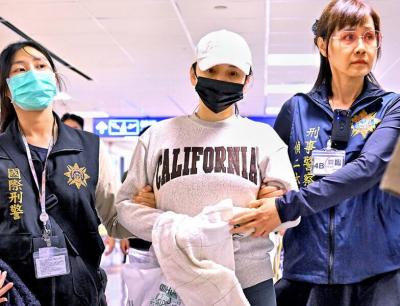
Johanne Liou (劉喬安), a Taiwanese woman who shot to unwanted fame during the Sunflower movement protests in 2014, returned to Taiwan last night after being deported from the US. She is to stand trial in Taiwan for charges involving embezzlement, fraud and drug crimes. The Criminal Investigation Bureau (CIB) said it took her into custody at Taiwan Taoyuan International Airport and would first question her before transferring her to the New Taipei District Prosecutors’ Office. She was arrested upon disembarking a flight from San Francisco that landed shortly before 7pm. Liou absconded to the US in 2019 after jumping bail


 RSS
RSS