


Security experts yesterday urged the military to retain frequency hopping as a required feature paired with other technologies for next-generation radios to increase counter-electronic warfare capabilities and interoperability with US forces.
In a solicitation that has since been withdrawn, the army included frequency shift keying as an acceptable feature in new radios, retired air force colonel Chou Yu-ping (周宇平) said at an event cohosted by the Strategy and Public Research Institute of Taiwan.
Procuring frequency-shifting radios would represent a 30-year step backward, while frequency hopping equipment is standard for Taiwanese and US armed forces, said Chou, a researcher at the institute.
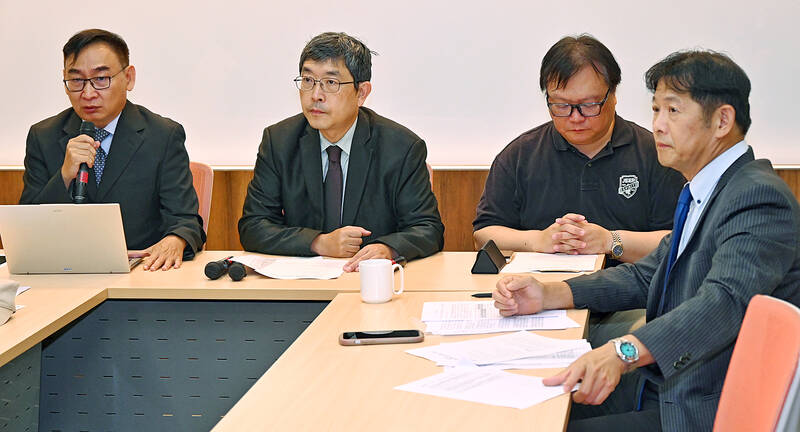
Photo: Liu Hsin-de, Taipei Times
The army’s attempt to switch back to frequency-shift technology would degrade its survivability and interoperability, Chou said.
The Ministry of National Defense must ensure that procurements would upgrade existing technologies, instead of downgrading equipment, he said.
Taiwan National Security Institute deputy secretary-general Ho Cheng-hui (何澄輝) said the integration of frequency-hopping encryption and a military mobile ad hoc network is essential for the armed forces’ ability to withstand damage and meet future joint warfare requirements.
Frequency-shifting radio users have extremely low survivability in the intense electronic warfare environment expected in modern warfare, he said.
Real-world combat experience and technological trends suggest that a force must use a dispersed communications network to avoid single-point failures in its command structure, Ho said.
Achieving the national strategic goal of obtaining asymmetric warfare capabilities means being able to share a common operational picture across branches, Taiwan Industrial Technology Association vice chairman Lin Chien-cheng (林健正) said.
Frequency-hopping equipment is standard in the US and adopting frequency shift technology would hinder interoperability, he said.
The government should consider buying strategic-level communication systems from the US and rely on the domestic tech industry to furnish tactical-level devices to expedite force building, he said.
The annual Han Kuang military exercises should incorporate real jamming to test the combat forces’ ability to operate in a contested electronic warfare environment, Lin said.
Public discourse surrounding Washington’s political will to send troops to defend Taiwan misses the matter of what the US forces could do and how they would do it, said Jing Yuan-chou (荊元宙), associate professor at Tamkang University’s College of International Affairs.
The Chinese People’s Liberation Army would surely utilize electronic warfare capabilities against Taiwan in an attempt to overwhelm the defenders’ command structure, and utilization of frequency-shifting radios would invite failure, he said.

UPGRADE: The Kang Ding-class frigate is replacing its Chaparall missiles with Tien Chien II and Hua Yang VLS, which would provide it with long-range, 360° air defense Taiwan plans to produce 1,200 to 1,376 Hai Chien II missiles (海劍二, Sea Sword II) — also known as TC-2N — to serve as the standard air defense system of the navy’s surface combatant fleet, a source said yesterday. Last week, the Hai Chien II, the naval version of the Tien Kung II missile (天劍二, Sky Sword II), completed a live-fire test in waters off the National Chungshan Institute of Science and Technology’s Jiupeng facility (九鵬) in Pingtung County’s Manjhou Township (滿州). The MIM72 Chaparral and other dated air defense missiles that currently arm Taiwanese ships have inadequate range to combat Chinese

REASONS FOR TRAVEL: An assistant professor said that proposed amendments to penalize drivers if they used drugs overseas would not deter people from traveling People who operate a motor vehicle under the influence of marijuana would have their driver’s license revoked, even if they used the substance while overseas, the Ministry of Transportation and Communications said yesterday, citing proposed amendments to the Road Traffic Management and Penalty Act (道路交通管理處罰條例). The amendments would also authorize the government to revoke the licenses of people determined to have used Category 1 or Category 2 narcotics, even if they were not operating a vehicle while under the influence of drugs, as well as ban them from taking the license test for three years, the ministry said. People aged 18 or

Shih Hsin University President Chen Ching-he (陳清河) yesterday issued a public apology for comments made in his commencement speech last week, stating that he has asked the school to suspend his duties and halt his wages for two months as a show of contrition. At the commencement ceremony on May 30, Chen said, “If you don’t manage your time well, or your own emotions, or your health, then I am telling every one of you — put a quick end to ‘you,’ because the world has no need for ‘you.’” The comments have sparked significant controversy online, and Chen through an open
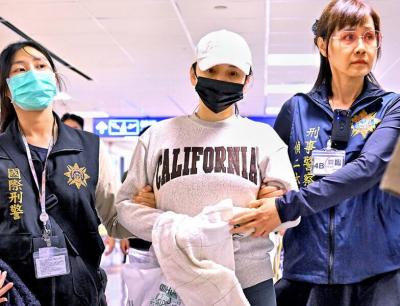
Johanne Liou (劉喬安), a Taiwanese woman who shot to unwanted fame during the Sunflower movement protests in 2014, returned to Taiwan last night after being deported from the US. She is to stand trial in Taiwan for charges involving embezzlement, fraud and drug crimes. The Criminal Investigation Bureau (CIB) said it took her into custody at Taiwan Taoyuan International Airport and would first question her before transferring her to the New Taipei District Prosecutors’ Office. She was arrested upon disembarking a flight from San Francisco that landed shortly before 7pm. Liou absconded to the US in 2019 after jumping bail


 RSS
RSS