


President William Lai (賴清德) has departed Eswatini following a surprise trip to Africa in defiance of Beijing’s efforts to thwart his diplomatic outreach, a source said yesterday.
Lai is returning to Taiwan by again using the private plane of Eswatini’s monarch, a person familiar with his plans said, asking not to be identified because of the sensitivity of the travel.
Lai’s planned departure to Eswatini on April 22 was postponed after the Seychelles, Mauritius and Madagascar revoked overflight permits for the president’s chartered plane, moves that Lai’s office attributed to China’s “economic coercion” of the African nations.
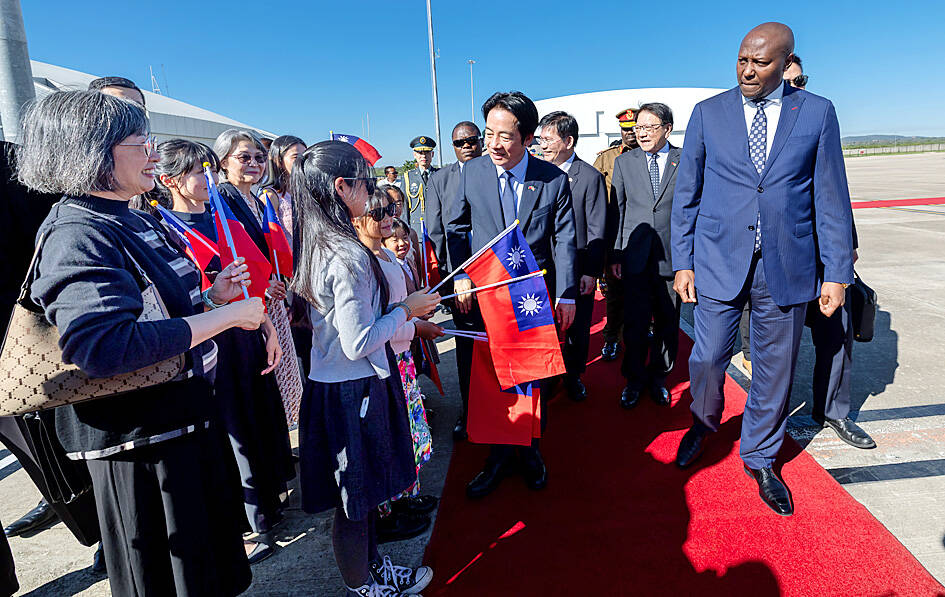
Photo: screen grab from the Presidential Office’s Flickr page
Local media reported that the president traveled to Eswatini on Saturday aboard King Mswati III’s private jet, flying directly from Taipei to Eswatini.
In Taipei yesterday, Chinese Nationalist Party (KMT) Legislator Hsu Yu-chen (許宇甄) said Lai traveling to the Kingdom of Eswatini on a chartered plane provided by the African diplomatic ally raises national security concerns.
While consolidating diplomatic ties is important and Lai deserves recognition for his efforts, the king’s jet lacks the secure communications equipment of Taiwan’s presidential aircraft, which is equipped with a military-standard encrypted command-and-control system to ensure real-time communication with the Hengshan Military Command Center, Hsu said.
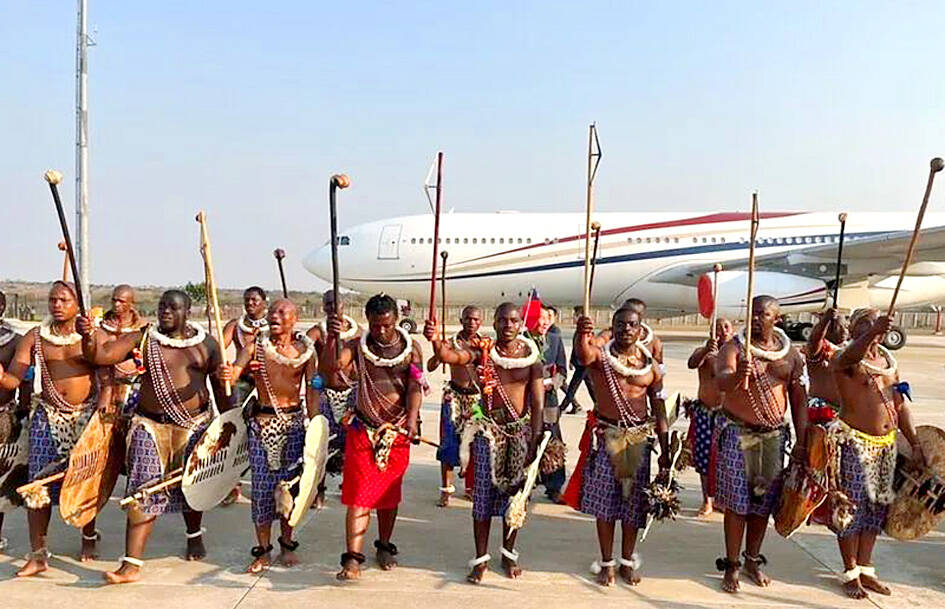
Photo from James Jseng’s Facebook
“If a cross-strait emergency were to arise mid-flight, would the president be left relying on a civilian satellite phone to issue commands?” she said.
“While the government says it maintains real-time control over national security, the absence of military-grade encrypted communications means the 14-hour journey [to Eswatini] could have effectively become a ‘command vacuum,’ leaving national security in a highly uncertain state,” she said.
The concerns remain for the return flight, Hsu added.
She also disagreed with Deputy Minister of Foreign Affairs Francois Wu’s (吳志中) defense of the “arrive then announce” strategy for world leaders traveling abroad, which Wu said had been used by US President Donald Trump, as well as former US presidents.
“That is utterly misleading,” Hsu said.
US presidential trips are kept confidential until arrival only when the head of state is visiting conflict zones, such as in Iraq, Afghanistan or Ukraine, to avoid security risks, she said.
However, Eswatini is an ally, making the unannounced arrival not only disrespectful to the African nation, but also a deliberate move to foment a quasi-war atmosphere in Taiwan, she said.
In some cases, it is “more justifiable” for heads of state to make diplomatic visits aboard charter flights of a foreign nation, such as when Ukrainian President Volodymyr Zelenskiy visited the US aboard a US military aircraft, or when North Korean leader Kim Jong-un traveled to Singapore on a charter plane of Chinese state-run Air China, Hsu said.
However, the Republic of China (ROC) has its own presidential aircraft, which flies the national flag to demonstrate the nation’s sovereignty, she said.
It creates a diplomatic predicament when the commander-in-chief of Taiwan’s armed forces has to rely on a foreign charter plane to visit an allied country, she said.
From an international law perspective, a head-of-state aircraft is typically regarded as a mobile extension of a sovereign territory, entitled to full immunity and jurisdictional protections, she said.
However, the king’s Airbus A340-313 used by Lai is owned by the Eswatini government and operated by foreign pilots, Hsu said.
If a technical incident or legal dispute were to occur during the president’s 14-hour return flight, primary jurisdiction would lie with Eswatini rather than the ROC, she said.
“Entrusting the head of state’s legal and physical security entirely to a foreign crew operating under a fundamentally different legal system represents a significant constitutional risk, which could be seen as diminishing the nation’s standing and effectively ceding a measure of sovereignty,” she said.

FUKUOKA SITUATION: Japanese media reported that the pathogen is expected to be identified by the summer, while the CDC downplayed the idea that it was hMPV A “mysterious cold-like illness” reported in Japan’s Fukuoka Prefecture does not seem to be a new disease, but Japanese authorities have been asked about the situation, the Centers for Disease Control (CDC) said yesterday. The Fukuoka Prefectural Medical Association on Wednesday told a news conference that a “mystery cold” that has become a hot topic on social media is “highly likely to be caused by some kind of viral infection,” Japan’s KBC News reported. “Many people are experiencing symptoms starting with a sore throat, followed by a runny nose, phlegm and a severe cough,” KBC News reported, citing association officials. Health authorities are

Nvidia Corp CEO Jensen Huang (黃仁勳) arrived in Taiwan yesterday ahead of upcoming AI and technology events, saying he plans to meet with clients and Taiwan Semiconductor Manufacturing Co Chairman C.C. Wei (魏哲家) during his visit. After landing at Taipei Songshan Airport, Huang posed for photos with fans and handed out Yakult drinks to reporters and supporters waiting at the scene, saying he has “a lot to do” during the trip. Asked about reports that Nvidia’s planned headquarters site in Taipei’s Beitou Shilin Technology Park could break ground on May 27, Huang said that if the company holds an event, he would

The Ministry of Finance this afternoon announced the winning numbers for the March-April uniform invoice lottery. The winning number for the NT$10 million (US$318,060) special prize is 19531471, and the winning number for the NT$2 million grand prize is 85941329. Three numbers were drawn for the NT$200,000 first prize: 07225810, 20231230 and 83518781. Those with receipts matching the last seven digits of any of the first-prize numbers will win the NT$40,000 second prize, while those matching the last six digits will win the NT$10,000 third prize. Those whose receipts match the last five digits of the first-prize numbers can claim the NT$4,000 fourth prize,
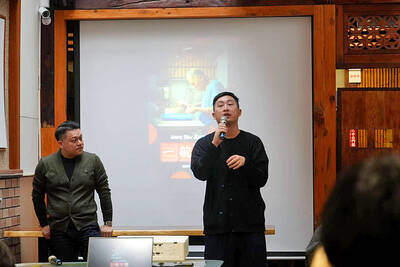
Taiwan Travelogue (臺灣漫遊錄), which earlier this week became the first Taiwanese novel to win the International Booker Prize, is to be adapted into a television series through a Taiwan-Japan coproduction, producer Chang Chen-yu (張辰漁) said yesterday. Chang, a producer at World Softest Production Film Co, wrote on Facebook that the company had been searching for projects with international appeal that retain a strong Taiwanese identity after colleagues and Japanese partners strongly recommended the novel. After reading the book, Chang said he immediately decided to pursue the screen rights. “A great story has the power to transcend time and borders, and connect countless people,”


 RSS
RSS